
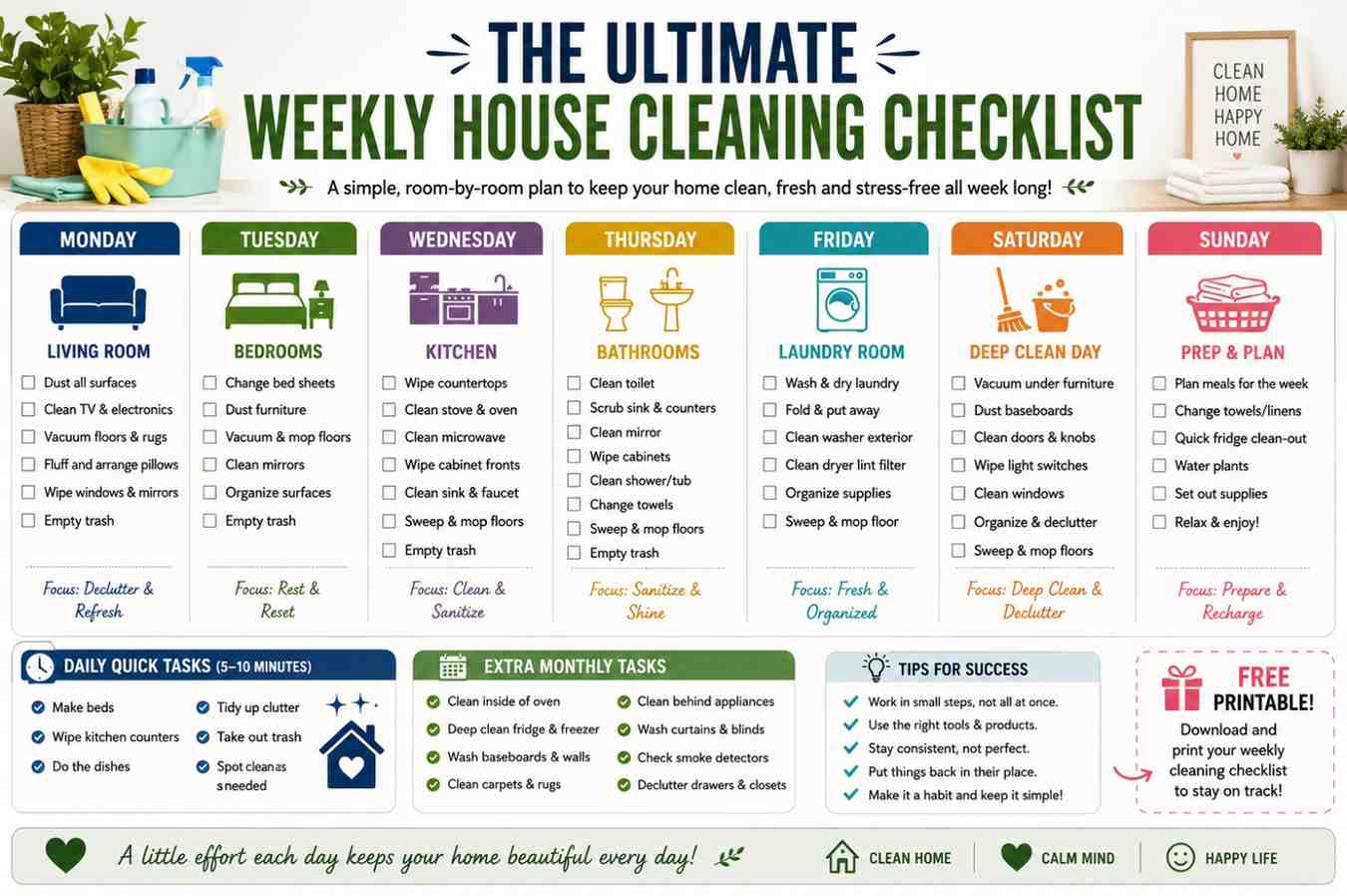
Most people do not have a cleaning problem. They have a consistency problem. The house gets clean once and then gradually falls apart over the following week until it is overwhelming enough that another big cleaning session feels necessary. Then the cycle repeats.
A weekly house cleaning checklist breaks that cycle. Not by demanding more time, but by distributing the work across the week in a way that keeps the home consistently clean without any single session ever feeling like a major undertaking. When you follow a weekly house cleaning checklist consistently, the house never gets bad enough to require a heroic effort to fix.
This is the weekly house cleaning checklist that actually works for real households with real schedules, covering every room without overcomplicating the process.
Why a Weekly House Cleaning Checklist Changes Everything
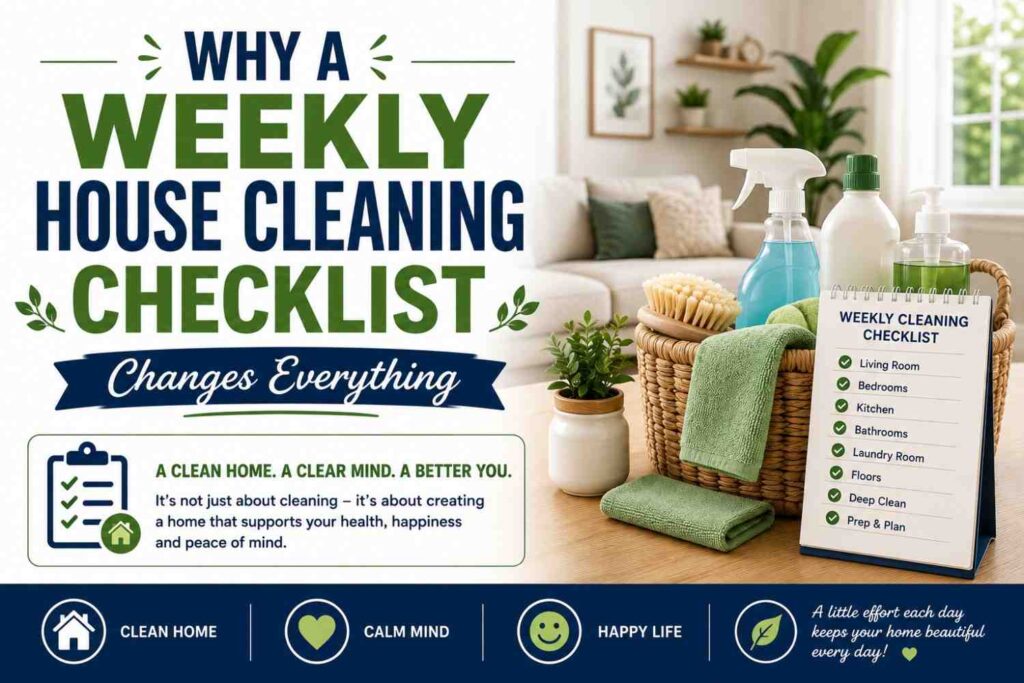
Before getting into the checklist itself, it is worth understanding why having a written weekly house cleaning checklist produces better results than cleaning whenever things look bad enough to address.
The first reason is that a checklist removes decision fatigue. When you sit down to clean without a plan, you spend mental energy deciding what to clean, in what order, and whether you have done enough. A weekly house cleaning checklist eliminates all of those decisions in advance. You follow the list, check things off, and stop when the list is done.
The second reason is that a weekly house cleaning checklist catches the tasks that are easy to forget. Wiping down light switches. Cleaning the bathroom trash can. Disinfecting the kitchen sink. These tasks do not look dirty when they are overdue, so they never feel urgent, and they accumulate quietly until they are genuinely problematic. A checklist puts them on the schedule before they become issues.
The third reason is psychological. A completed checklist gives you a clear endpoint. You know when you are done, and you know what done actually looks like. That clarity makes the process less draining and more sustainable week after week.
How to Use This Weekly House Cleaning Checklist
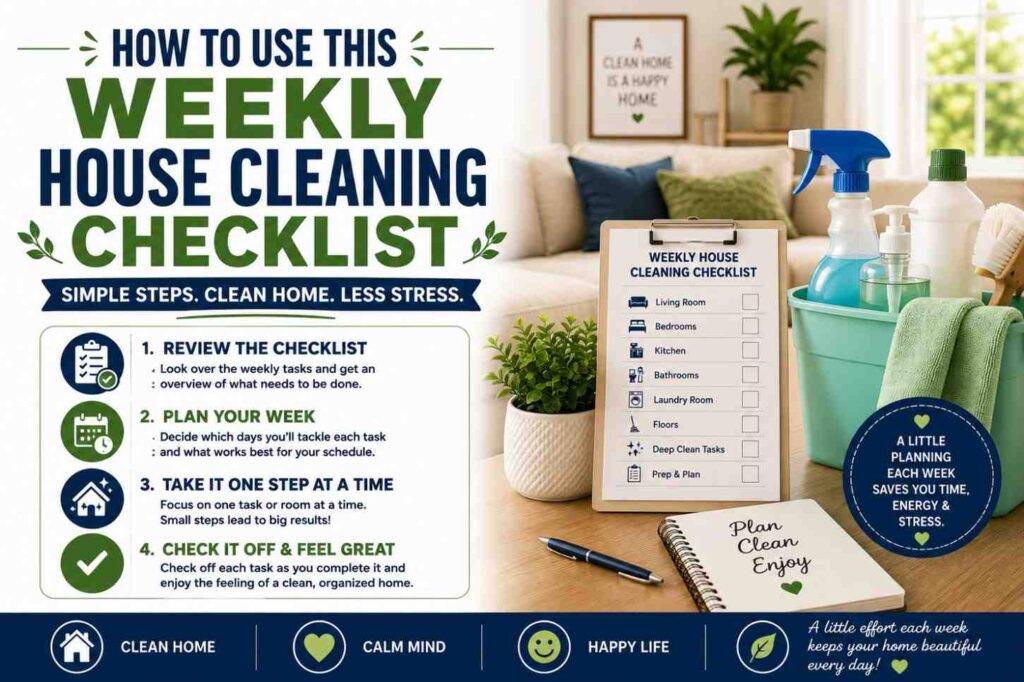
This weekly house cleaning checklist is designed around two approaches: a daily ten minute habit to maintain order throughout the week, and a focused weekly session where the actual cleaning happens room by room.
The daily habit takes ten minutes or less and prevents the kind of accumulation that turns a weekly clean into an all-day event. The weekly session handles everything the daily habit does not and keeps every room in the home genuinely clean rather than just tidy.
Most households can complete the full weekly house cleaning checklist in ninety minutes to two and a half hours depending on the size of the home and how consistently the daily habits are maintained. If you have a larger home or multiple people helping, the time drops significantly.
Work from top to bottom within each room and from room to room in a logical sequence that does not require doubling back. The sequence in this weekly house cleaning checklist moves from bedrooms to bathrooms to kitchen to living areas to floors throughout, which is the most efficient order for most home layouts.
Daily Habits That Make the Weekly House Cleaning Checklist Faster
The daily habits that support a weekly house cleaning checklist are not cleaning tasks in the traditional sense. They are maintenance behaviors that prevent disorder from accumulating to the point where cleaning requires significantly more effort.
Make the bed every morning. This single habit makes the bedroom look and feel organized regardless of anything else and takes less than two minutes. A made bed anchors the room and makes the weekly bedroom clean significantly faster because the largest surface in the room is already dealt with.
Wipe down kitchen counters after every meal preparation and after doing dishes. A counter that is wiped down daily after each use never develops the dried food residue and grease buildup that requires significant scrubbing during the weekly clean. Thirty seconds after each cooking session saves ten minutes during the weekly session.
Do a five minute pickup before bed each night. Walk through the living areas and return anything that is out of place to where it belongs. Dishes go to the kitchen, clothes go to the bedroom, toys go to their storage, mail gets sorted. This nightly reset means the weekly house cleaning checklist starts from a tidy baseline rather than from clutter that must be addressed before any actual cleaning can begin.
Run the dishwasher at night and empty it in the morning so dishes never pile up in the sink. A sink full of dishes makes the entire kitchen feel dirty and adds time to the weekly kitchen clean. An empty sink that gets wiped down daily stays genuinely clean with minimal effort.
Weekly House Cleaning Checklist: Bedrooms
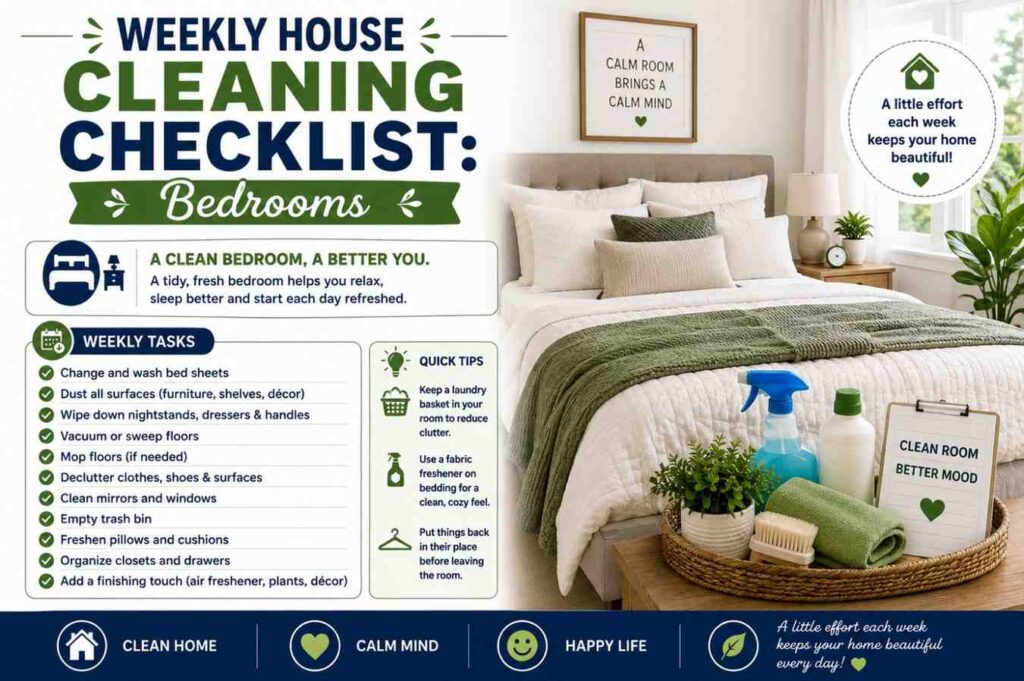
The bedroom section of the weekly house cleaning checklist is where most people start because clean bedrooms set the tone for the rest of the home and are the spaces most directly connected to sleep quality and morning mood.
Change and wash the bed sheets every one to two weeks. While fresh sheets are not strictly a weekly task, checking whether sheets need changing belongs in the weekly house cleaning checklist so it does not get pushed indefinitely. Wash pillowcases weekly even if the full sheet set is on a two-week rotation, as pillowcases accumulate oils and bacteria from direct contact with skin and hair.
Dust all surfaces in the bedroom including nightstands, dressers, shelves, and the tops of picture frames. Use a microfiber cloth that captures dust rather than spreading it. Work from the highest surfaces downward so any falling dust lands on surfaces not yet cleaned.
Wipe down the nightstand surfaces and remove any clutter that has accumulated during the week. The nightstand is one of the highest-accumulation surfaces in the home because it collects items placed there before sleep and never returned to their proper location.
Vacuum the floor, including under the bed where dust accumulates significantly and where most weekly cleaners never look. Use the crevice tool along baseboards and in corners. If the bedroom has hard floors, sweep before mopping with an appropriate floor cleaner.
Wipe down light switches and door handles with a disinfectant cloth. These are high-touch surfaces that are consistently overlooked in bedroom cleaning and that accumulate bacteria from daily contact.
Weekly House Cleaning Checklist: Bathrooms
The bathroom section of the weekly house cleaning checklist is the most time-sensitive because bathroom surfaces accumulate bacteria and mildew faster than any other room in the home. A bathroom that is cleaned weekly never reaches the level of buildup that makes the task unpleasant. A bathroom cleaned monthly absolutely does.
Clean the toilet completely, starting with the bowl. Apply toilet bowl cleaner under the rim and let it sit while you clean other surfaces so it has time to work before you scrub. Wipe down the exterior of the toilet including the tank, lid, seat top and bottom, and the base where the toilet meets the floor. This area around the base is one of the most commonly missed parts of toilet cleaning and one of the most bacteria-dense.
Scrub the sink basin and wipe the faucet, handles, and the area around the drain. Soap scum and toothpaste residue accumulate around the faucet base and in the drain collar with every use. A weekly wipe-down keeps this under control with minimal effort. Spray and wipe the mirror from top to bottom.
Clean the shower or bathtub weekly rather than waiting until soap scum is visible. Soap scum that is addressed weekly takes thirty seconds to wipe away. Soap scum that builds for a month requires significant scrubbing. Spray the shower walls and tub surface with an appropriate cleaner, let it sit for a few minutes, and wipe clean. Pay particular attention to the grout lines and the corners at the floor level where mildew begins.
Sweep and mop the bathroom floor. Wipe down the baseboards. Empty the trash can and replace the liner. Hang a fresh hand towel if the current one has been in use for more than a few days.
Weekly House Cleaning Checklist: Kitchen
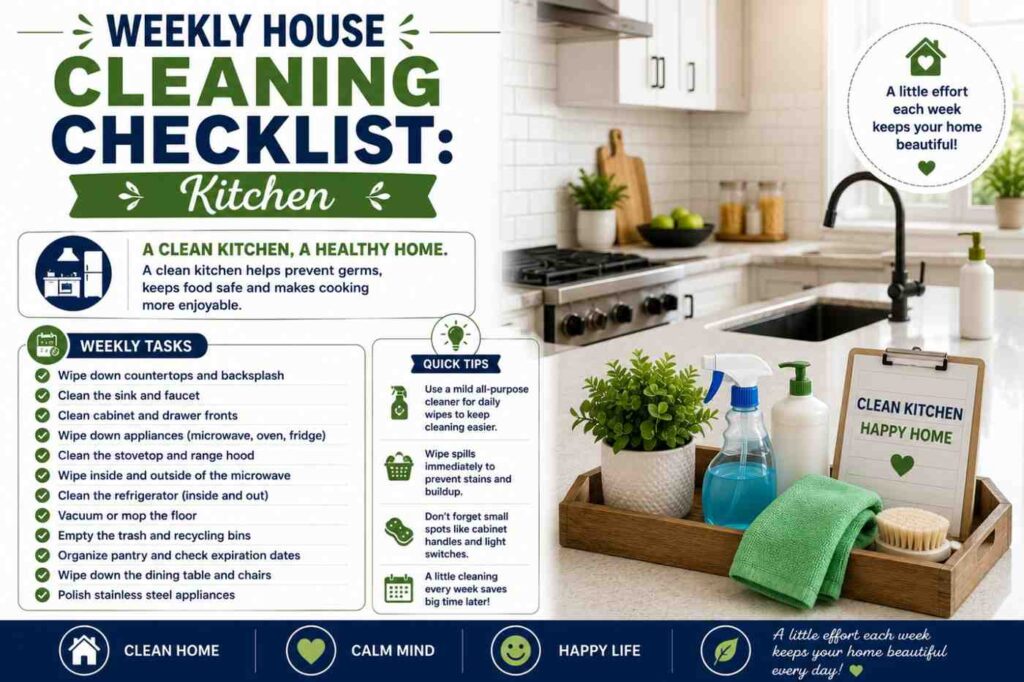
The kitchen section of the weekly house cleaning checklist takes the most time because of the number of surfaces and the presence of cooking grease, but consistent weekly attention keeps it manageable in under thirty minutes for most kitchens.
Wipe down all countertops completely, moving small appliances to clean underneath them rather than around them. The space under the toaster, the coffee maker, and the knife block accumulates crumbs and debris that regular surface wiping never reaches.
Clean the stovetop thoroughly. Remove burner grates if applicable and wipe the surface beneath them. A weekly stovetop clean takes a few minutes. A stovetop that has not been cleaned in a month requires significantly more effort because cooking grease bonds to the surface over time and becomes progressively harder to remove.
Wipe down the exterior of all appliances including the refrigerator, microwave, dishwasher, and oven. Pay particular attention to the handles, which are high-touch surfaces that accumulate bacteria and grease from food-covered hands.
Clean the kitchen sink completely. Scrub the basin with baking soda or an appropriate cleaner, clean the faucet and handles with a toothbrush if necessary, and wipe the countertop area around the sink dry. A dry sink and dry surrounding counter is one of the clearest visual signals that a kitchen is genuinely clean.
Wipe down cabinet fronts in high-touch areas, particularly around handles and near the stove where grease splatter reaches. Take out the trash and replace the liner. Sweep the kitchen floor thoroughly, including under the appliances that can be moved easily, then mop with an appropriate cleaner.
Weekly House Cleaning Checklist: Living Room and Common Areas
The living room section of the weekly house cleaning checklist is where the daily pickup habit pays off most directly. A living room that has been picked up each evening requires only cleaning during the weekly session, not decluttering followed by cleaning.
Dust all surfaces including shelves, the TV stand, end tables, the coffee table, and any decorative items. Use a microfiber cloth and work from the highest surfaces downward. Dust the ceiling fan blades if the room has one, as fan blades accumulate dust rapidly and distribute it throughout the room when the fan runs.
Vacuum the sofa and any upholstered chairs using the upholstery attachment. Remove the cushions and vacuum beneath them. Fluff and return the cushions. Straighten throw pillows and fold or hang throw blankets.
Wipe down the coffee table and end tables with an appropriate cleaner for the surface material. Clean the TV screen with a dry microfiber cloth only. Wipe down remotes, which are among the most bacteria-laden surfaces in the average American home according to research cited by the CDC (https://www.cdc.gov).
Clean windows and window sills on the interior side as part of the monthly rotation, but include a quick wipe of the window sill in the weekly house cleaning checklist as dust and debris accumulate there weekly.
Vacuum or sweep and mop all floors in the living areas. Use the crevice tool along baseboards and in the corners where dust accumulates but the main vacuum head does not reach. Move lightweight furniture to vacuum underneath it.
Weekly House Cleaning Checklist: Floors Throughout the Home
Floors are the final step of the weekly house cleaning checklist and should always be addressed last so that dust and debris from cleaning above floor level settles onto the floor before it is vacuumed or mopped rather than after.
Vacuum all carpeted areas thoroughly including along the edges where carpet meets baseboards. Use the upholstery attachment on stairs if the home has them. Vacuum area rugs on both sides monthly and as part of the regular floor routine on the upper surface weekly.
Sweep all hard floors before mopping. Sweeping first removes loose debris that would be pushed around by a wet mop rather than removed. Use a microfiber dust mop or broom and work from the far corners toward the door.
Mop hard floors with an appropriate cleaner for the floor material. Wood floors require a specific wood-safe cleaner and should never be saturated with water. Tile floors can handle more moisture but should still be dried rather than left to air dry to prevent water spots and streaking. Vinyl and laminate floors need only damp mopping with a gentle cleaner.
Pay attention to high-traffic transition areas between rooms, which accumulate dirt faster than the main floor areas and are often missed because they fall between the coverage of two rooms in a cleaning routine.
How Long the Weekly House Cleaning Checklist Takes
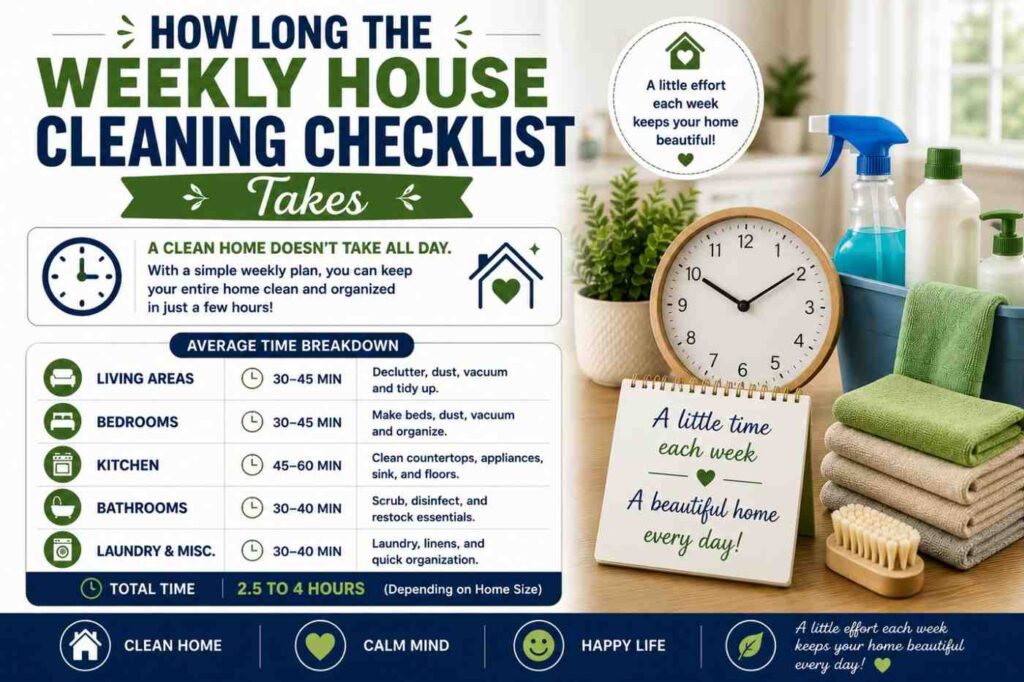
One of the most common reasons people abandon a weekly house cleaning checklist is underestimating the time required and then feeling like a failure when the first attempt takes longer than expected.
A realistic time estimate for a two-bedroom home following this weekly house cleaning checklist is ninety minutes to two hours. A three-bedroom home takes two to two and a half hours. A four-bedroom home takes two and a half to three hours. These estimates assume the daily habits are being maintained consistently. A home that has not been touched all week will take longer.
Breaking the weekly house cleaning checklist across multiple days is a completely valid approach. Bedrooms and bathrooms on one day, kitchen and living areas on another, and floors as a final pass takes the full session from one long block to three shorter ones that fit more naturally into a busy schedule.
Keeping the Weekly House Cleaning Checklist Sustainable
The weekly house cleaning checklist that you actually complete every week is infinitely better than the perfect system you abandon after three attempts. Sustainability matters more than comprehensiveness, and the checklist above is designed with that in mind.
If your household has multiple people, assigning specific sections of the weekly house cleaning checklist to different people distributes the work and reduces the total time for any single person. Even children who are old enough to follow instructions can handle specific tasks reliably with clear guidance.
Keep your cleaning supplies in a single caddy that moves room to room with you rather than requiring trips back and forth to a storage area. The less friction involved in completing each task, the more consistently the weekly house cleaning checklist gets done.
Review the checklist every few months and adjust it based on what your household actually needs. Some homes need the bathroom done twice a week. Some need the kitchen floors done more frequently than the bedroom floors. A weekly house cleaning checklist that is calibrated to how your household actually lives works better than one that is calibrated to how a generic household lives.
Consistency is the only thing that makes a weekly house cleaning checklist work. And consistency, once the habit is established, is the easiest part of all.