
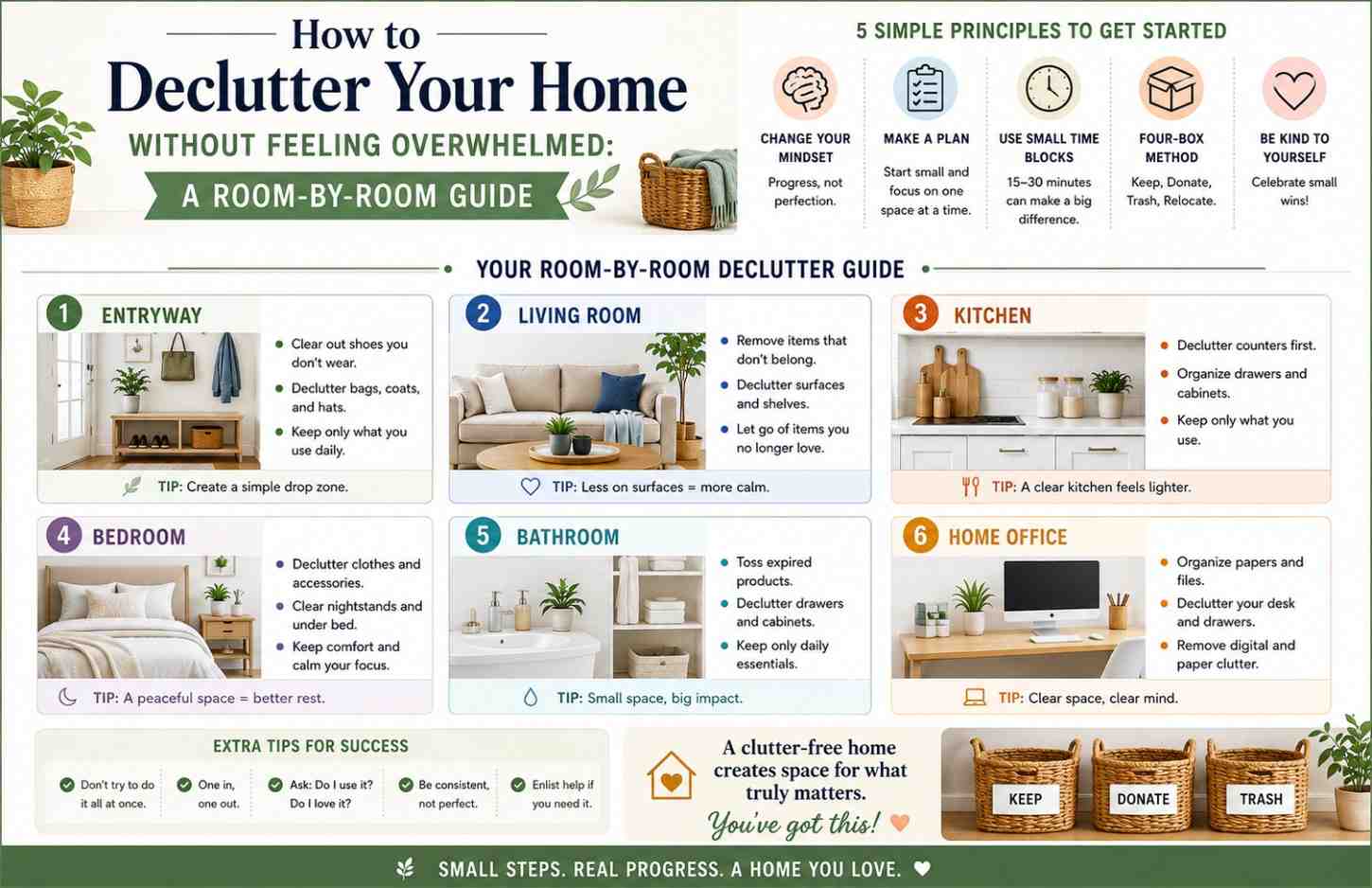
There is a specific kind of paralysis that sets in when you decide it is finally time to declutter your home. You stand in the middle of a room, look around at everything that needs to go, and feel simultaneously like you need to do everything right now and like you cannot figure out where to start. So you do nothing. Or you start one corner, get distracted, and end up with the room in a worse state than when you began.
If that sounds familiar, the problem is not motivation. It is method. Most people who struggle to declutter their home are trying to do it in a way that is fundamentally incompatible with how the human brain handles large, emotionally loaded tasks. This guide gives you a method that works, room by room, decision by decision, without the overwhelm that stops most decluttering attempts before they produce any lasting result.
Why Decluttering Your Home Feels So Hard
Before getting into how to declutter your home effectively, it helps to understand why it feels so difficult in the first place. The difficulty is rarely about the physical act of sorting and removing items. It is about the mental and emotional weight attached to possessions.
Every item in your home carries some level of memory, obligation, or identity. The gift you never use but feel guilty discarding. The hobby supplies for a version of yourself that no longer exists. The clothes that fit a body you used to have or plan to return to. Deciding what to do with these items is not a physical task. It is an emotional one, and approaching it as if it were purely logistical is why most decluttering attempts stall.
The room-by-room approach in this guide works because it breaks the emotional labor into manageable pieces, gives you a clear starting and stopping point for each session, and lets you build momentum from rooms where decisions are easier before tackling the ones where they are harder.
Research cited by the National Association of Professional Organizers (https://www.napo.net) consistently shows that clutter is one of the primary sources of household stress for American homeowners, and that the act of decluttering produces measurable improvements in mood and sense of control even when only a single room has been addressed. When you learn how to declutter your home one space at a time, you do not need to tackle everything at once to feel the benefit. You need to start somewhere and finish that somewhere completely.
Before You Start: The Rules That Make Decluttering Work
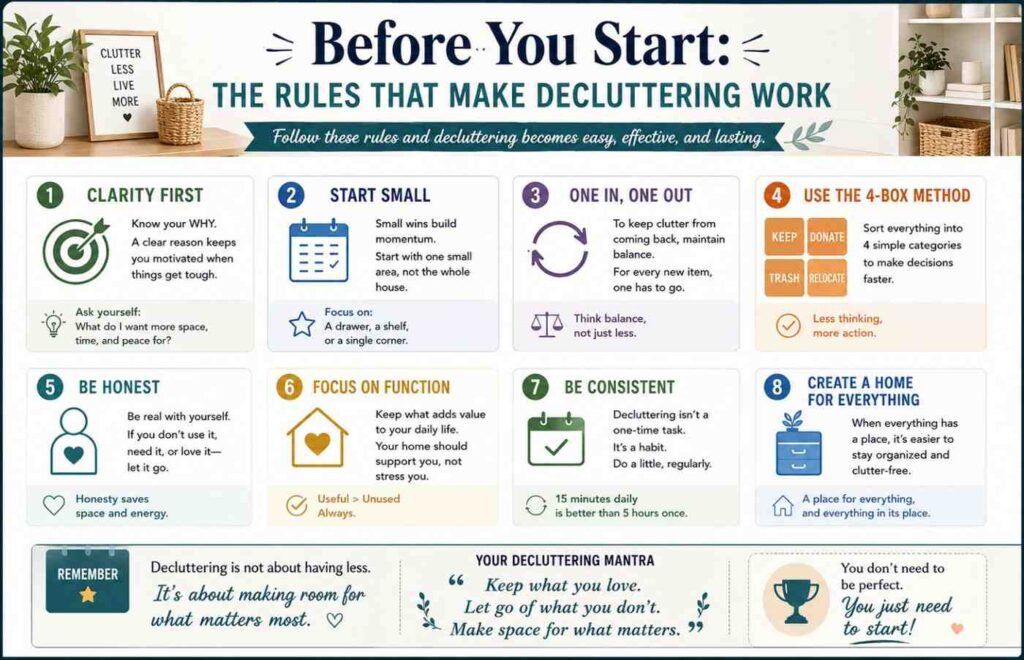
There are a few principles that make the difference between a decluttering session that produces lasting results and one that moves clutter from one place to another without solving anything.
The first principle is to finish one space completely before moving to the next. This sounds obvious but it is the rule most commonly broken. When you declutter your home by doing a little bit in every room at once, nothing ever reaches a finished state and the improvement is invisible. When you finish one drawer, one shelf, one closet, or one room completely, the result is visible and motivating.
The second principle is the one-year rule for most categories of possessions. If you have not used, worn, or needed something in the past year and it is not a seasonal item, sentimental item, or emergency supply, it is a strong candidate to leave your home. This rule removes the need to make a complex individual judgment about every item and replaces it with a simple factual question: have I used this in the past year?
The third principle is to have a destination ready for items leaving the home before you start sorting. Donate boxes, trash bags, and a space for items to sell should be prepared in advance. Items that leave a drawer or closet without a clear destination end up in a pile somewhere else in the home, which moves the problem rather than solving it.
The fourth principle when you decide how to declutter your home is to not buy any organizational products before decluttering. Bins, baskets, and storage systems purchased before decluttering almost always end up organizing things that should have been discarded. Declutter first, then assess what storage is actually needed for what remains.
How to Declutter Your Home: Starting With the Easiest Room
The best way to start when you decide to declutter your home is not with the most important room or the most cluttered one. It is with the easiest one. Starting easy builds momentum and confidence that carries into harder spaces.
For most households, this means starting with a bathroom or a laundry room rather than the bedroom closet or the garage. These spaces have less emotional weight attached to their contents. Expired medications, empty bottles, duplicate products, and worn-out cleaning supplies are easier to part with than clothes, books, or sentimental items, and clearing a bathroom completely in a single session produces a visible result that makes the next session feel achievable.
Set a timer for thirty to sixty minutes. This creates a defined endpoint that makes starting feel less daunting and prevents the session from expanding into an all-day undertaking that ends in exhaustion rather than completion.
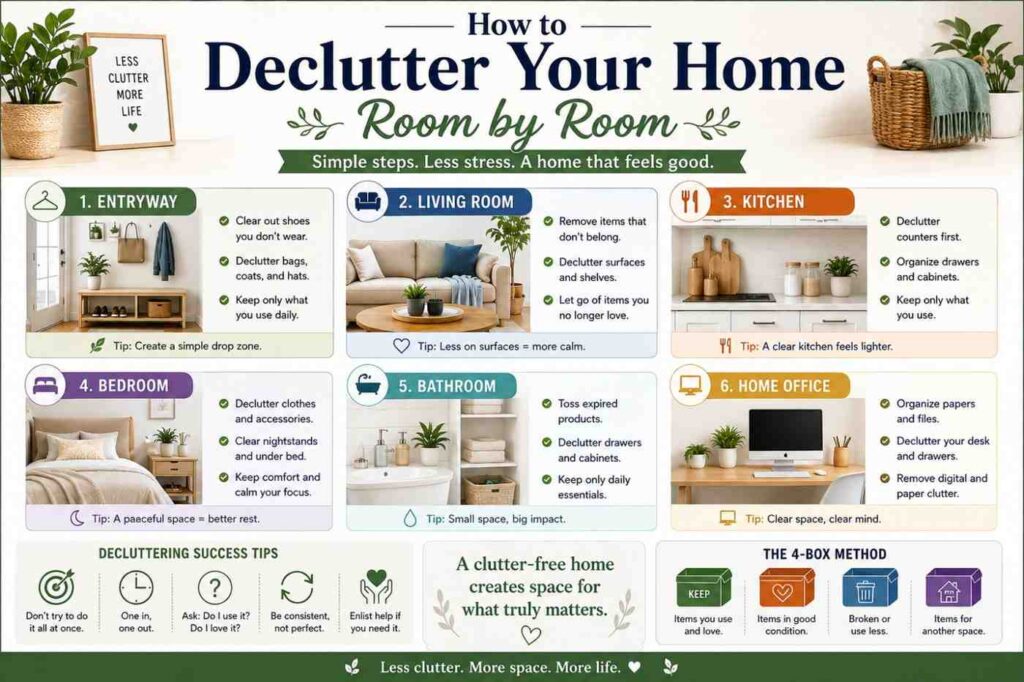
How to Declutter Your Home Room by Room
Kitchen
The kitchen is one of the best early rooms to declutter your home because decisions here are largely practical rather than emotional. A kitchen item either gets used regularly or it does not, and that clarity makes the sorting process faster than in rooms where sentiment plays a larger role.
Start with the cabinets and drawers. Remove everything from one cabinet or drawer at a time and place it on the counter. Wipe the empty space clean. Then return only what you actually use, placing items used most frequently in the most accessible locations. Anything that has not been used in the past year, has a duplicate that serves the same purpose, or belongs to a cooking method you no longer practice goes into the donate box.
The pantry is the kitchen area where most households have the most obvious clutter in the form of expired food, duplicate items purchased without checking what was already there, and products bought for a single recipe never made again. Check every expiration date. Toss what has expired. Donate unexpired non-perishables you will not use to a local food bank.
Gadget drawers and specialty appliances deserve particular scrutiny when you declutter your home kitchen. The waffle maker used twice since purchase, the bread machine from a phase that passed, the collection of spatulas that exceeds any reasonable need. These items occupy cabinet space that could be used for things you actually reach for daily.
Bedroom and Closet
The bedroom closet is where decluttering your home gets emotionally harder, and where the most impactful results are available. The average American closet contains a significant number of items that do not fit, do not suit the current lifestyle, or have not been worn in years. Removing them creates not just physical space but a daily experience of a wardrobe that actually reflects who you are now rather than who you were or plan to be.
Remove everything from the closet and sort into four categories: keep, donate, sell, and discard. The keep category is for items worn in the past year that fit and that you feel good wearing. Everything else goes into one of the other three categories without being returned to the closet.
Be honest about the items in the aspirational category: clothes kept because they might fit again, because they were expensive, or because you wore them once at a specific event. These items occupy space and generate low-level guilt every time you open the closet without providing any practical value. If you have not worn something in a year, it belongs in the donate or sell category regardless of its original cost.
Under the bed is one of the most common clutter destinations in any bedroom. Pull everything out and apply the same sorting process. Items stored under the bed should be genuinely seasonal or genuinely needed rather than simply forgotten.
Living Room
Decluttering your home living room is primarily about surfaces and storage furniture rather than the room’s main function. The living room accumulates clutter on horizontal surfaces, in entertainment center cabinets, and in the various baskets and bins that get filled and forgotten.
Clear every surface completely and return only items that serve a purpose or that you genuinely love and choose to display. The difference between a curated display and clutter is intentionality. Every item on a surface should be there because you chose it, not because it landed there and was never addressed.
Entertainment centers and media storage cabinets in most American living rooms contain a significant amount of outdated technology, media that has been replaced by streaming services, and cables belonging to devices no longer owned. Remove everything, sort it honestly, and return only what is current and in use.
Books deserve their own honest assessment. A bookshelf displaying books you have read and would read again or recommend is a meaningful collection. A bookshelf filled with books purchased with good intentions, read once, or never opened is storage masquerading as a library. Keep the books that genuinely matter and donate the rest to a local library or used bookshop.
Home Office or Paperwork Areas
Paper clutter is one of the most common and most manageable categories to address when you declutter your home, because most paper in the average American household is either already processable as trash or recycling or can be transitioned to digital storage.
Sort paper into four categories: action required, file, scan and discard, and recycle immediately. The action required category is the smallest and most important. The scan and discard category is usually the largest, covering documents that need to be retained as records but do not need to exist as physical paper.
The American Institute of CPAs recommends keeping tax returns and supporting documents for seven years, major financial records for the life of the relevant account or property, and most other documents for one to three years. Everything older than its retention period can be shredded and discarded. A cross-cut shredder is a worthwhile investment for anyone decluttering a home office with years of accumulated paper.
Office supplies accumulate without limit in most households. Pens that do not write, dried-out markers, duplicate staplers, and supplies from jobs or schools long past occupy drawer space indefinitely. Test every pen before returning it to a drawer. Discard any supply that is not functional or that you would not actively choose to use.
Garage and Storage Areas
The garage is where decluttering your home gets hardest for most people, not because of emotional attachment but because of sheer volume and the diversity of categories involved. Tools, sports equipment, seasonal items, automotive supplies, gardening equipment, and the general accumulation of items that left the house without quite leaving the property all end up in the garage.
Approach the garage in one category at a time rather than one area at a time. All tools together, all sporting goods together, all holiday decorations together. This grouping reveals duplicates and quantities that are not apparent when items are spread across the space, and it makes the keep or discard decision easier because you can see the full picture of what you own in each category.
The question to ask about every item in the garage when you declutter your home is whether it would be worth replacing if you got rid of it and later needed it. For most items, the honest answer is either no because the need is hypothetical and unlikely, or yes but the cost of replacing it is low enough that storing it indefinitely is not worth the space it occupies.
Donate functional tools and equipment to a local Habitat for Humanity ReStore (https://www.habitat.org/restores) or similar organization that can put them to immediate practical use. Sporting goods in good condition can be donated to organizations that provide equipment to youth sports programs. These destinations make parting with usable items easier because the items continue to serve a purpose rather than ending up in a landfill.
What to Do With Items Leaving Your Home
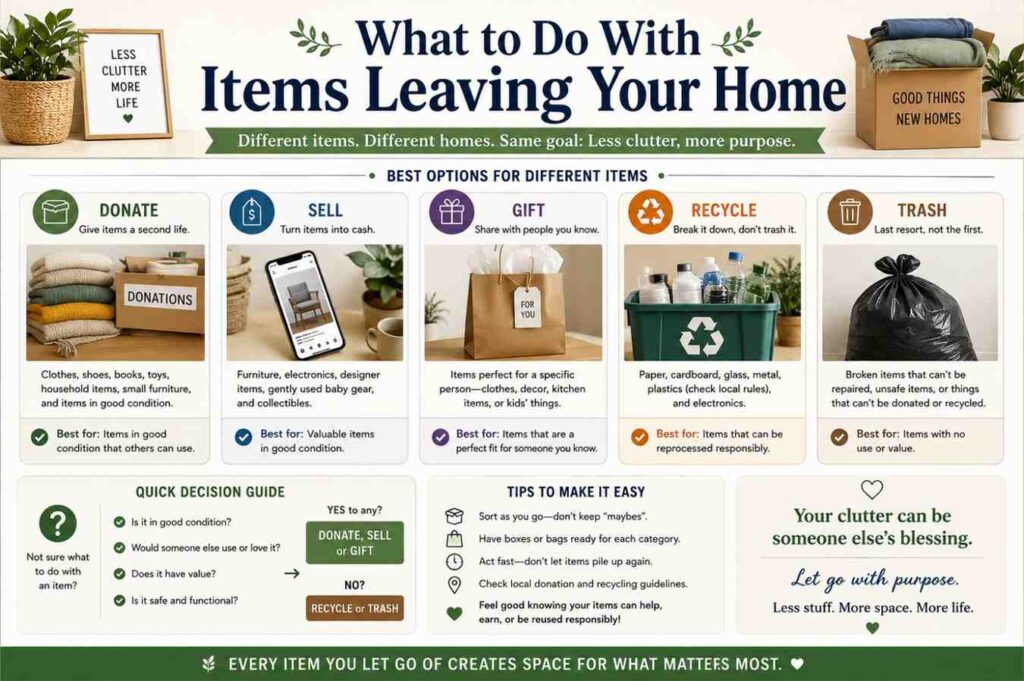
Having a clear plan for where items go when they leave your home is one of the most important parts of successfully decluttering your home, because uncertainty about disposal is one of the most common reasons items end up in a pile that never actually leaves.
Donation is the simplest path for most functional items in good condition. Goodwill, Salvation Army, local thrift stores, and specialty donation organizations for specific categories like books, clothing, and household goods accept donations regularly. Many offer free pickup for larger quantities, which removes the friction of transporting items yourself.
Online selling through platforms like Facebook Marketplace, Craigslist, or eBay is worthwhile for items of genuine value, but be realistic about the time involved. If an item is worth less than twenty to thirty dollars and would require photography, listing, communication with buyers, and a meeting to hand over, the time investment may not justify the return. Donate it instead and reclaim your time.
Items that are broken, stained, heavily worn, or otherwise not suitable for donation should go directly to the trash rather than a donation bin. Donating unusable items creates work for the receiving organization without benefiting anyone.
Maintaining a Decluttered Home
Once you declutter your home, the challenge is preventing it from returning to its previous state. The most effective preventive habit is what organizers call the one in one out rule: when a new item comes into the home, an existing item of the same category leaves. New shirt comes in, old shirt goes out. New kitchen gadget comes in, an existing one that it replaces goes out.
This rule works because it keeps the volume of possessions stable rather than allowing it to grow continuously. Clutter is not usually the result of a single large acquisition. It is the result of continuous small additions that are never matched by equivalent removals.
The other key maintenance habit is addressing accumulation before it becomes clutter. A single piece of mail on the counter is easy to deal with. Three weeks of mail on the counter is a project. The same applies to every category of item that tends to accumulate in your home. Address it when it is small and it never becomes a problem that requires a dedicated session to fix.
Knowing how to declutter your home is the beginning. Keeping it that way is a daily practice of small decisions made consistently. The homeowners who successfully figure out how to declutter your home and maintain it are not more disciplined than anyone else. They simply have better systems and clearer habits. Neither part is complicated. Both are completely within reach.