
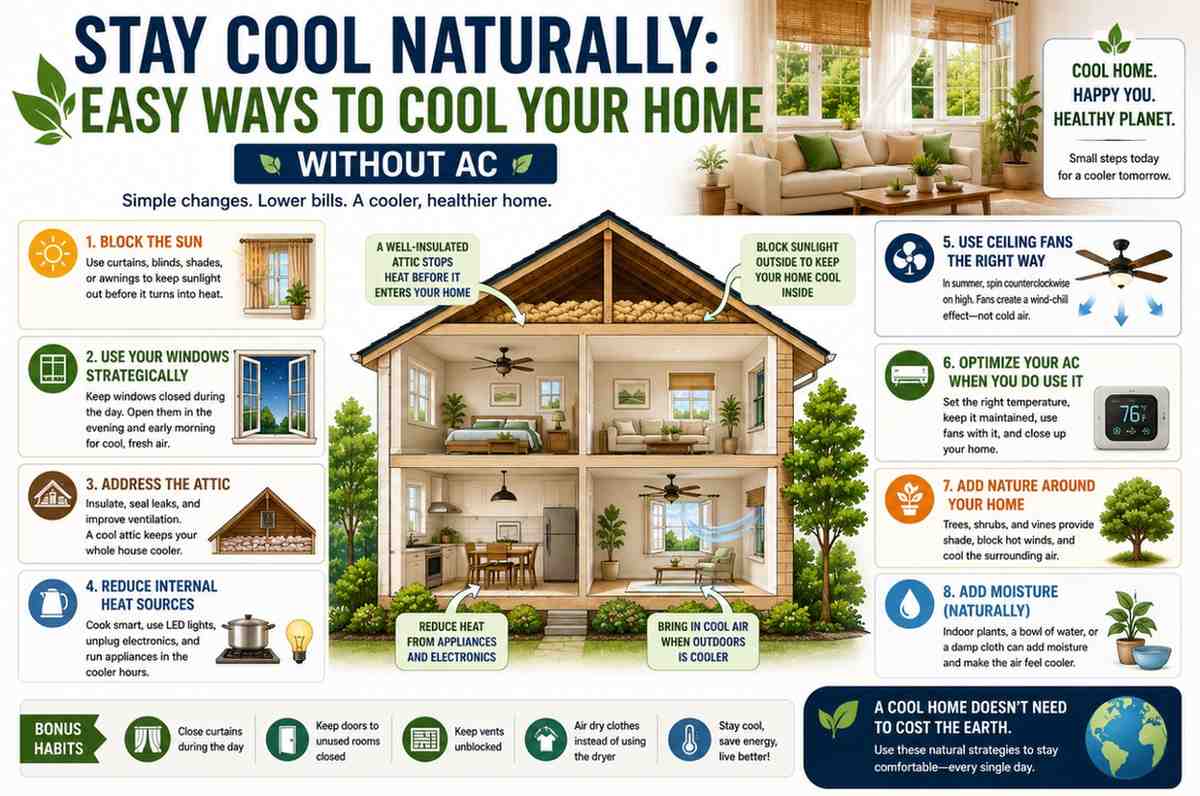
Your air conditioner is not the only way to survive a hot summer. In fact, for millions of American homeowners, it is not even the best way when you factor in the electricity bills, the wear on the equipment, and the frustration of a system that cannot quite keep up on the hottest days of the year.
Learning how to cool your home without AC, or at least without relying on it exclusively, is one of the most practical things you can do as a homeowner in 2026. Energy costs are higher than they have ever been, summers are consistently hotter than previous decades, and the strategies available to cool your home without AC have never been better understood or more accessible.
This guide covers every effective method to cool your home without AC, from zero-cost habits you can start today to smart investments that pay for themselves within a single summer.
Why Trying to Cool Your Home Without AC Makes Financial Sense
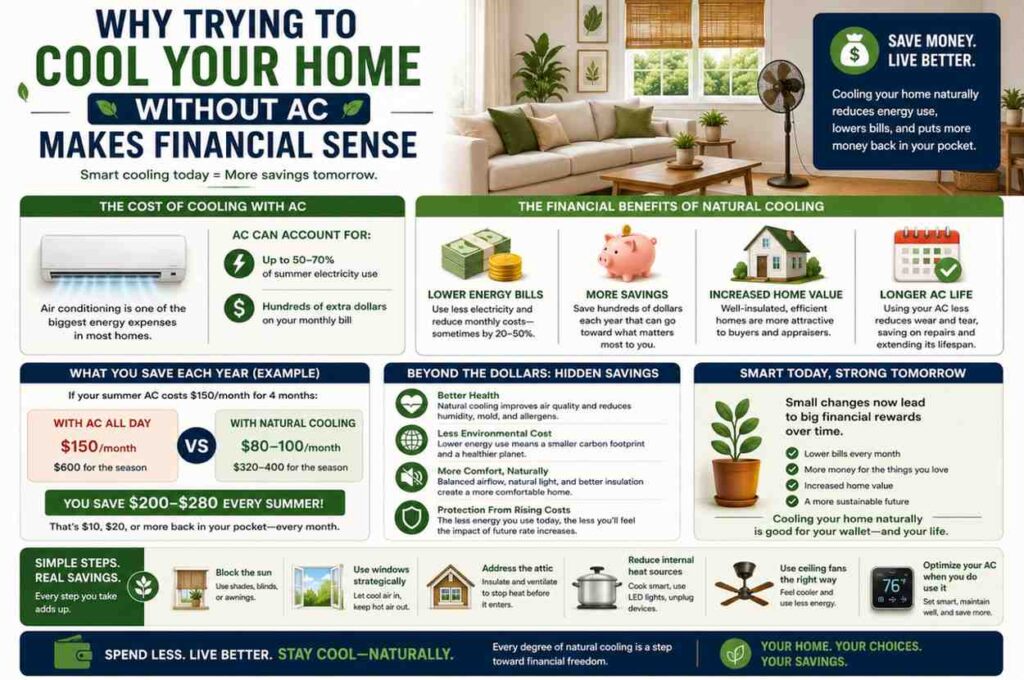
Before getting into specific strategies, consider what running the AC exclusively actually costs. According to the U.S. Energy Information Administration (https://www.eia.gov), air conditioning accounts for nearly 12 percent of total home energy expenditure in the United States, and in hot southern states that figure climbs significantly higher. On a summer electricity bill of $300 per month, that is $36 per month just for cooling, and many households pay far more.
Every strategy that lets you cool your home without AC running, or that reduces how hard and how long the AC runs when it does operate, directly reduces that cost. The strategies below are not about suffering through heat. They are about working smarter than a machine that knows only one way to solve a problem.
Block Solar Heat Before It Enters
The most effective way to cool your home without AC is to prevent heat from getting inside in the first place, and the largest single source of unwanted heat in most American homes is sunlight coming through windows.
Solar radiation passing through glass converts to radiant heat the moment it strikes any surface inside the room. That heat warms the floor, the furniture, the walls, and the air, and once it is inside the home it has to be removed mechanically or it stays there. Blocking solar gain before it crosses the glass is therefore the highest-leverage strategy available to cool your home without AC assistance.
Close blinds, shades, and curtains on south and west-facing windows before the sun reaches them each morning. This is the step most homeowners get backwards, waiting until the room is already warm before closing the blinds. By then the heat is already inside. Blackout curtains, cellular shades, and reflective window film all reduce solar heat gain significantly and require no ongoing energy cost to operate.
Exterior shading is even more effective because it intercepts sunlight before it reaches the glass. Retractable awnings, exterior solar screens, and strategically planted shade trees on the south and west sides of the home block heat at the source. The Department of Energy (https://www.energy.gov/energysaver/energy-efficient-window-coverings) estimates that exterior shading can block up to 77 percent of solar heat gain, making it one of the single most impactful interventions to cool your home without AC.
Use Natural Ventilation at the Right Times
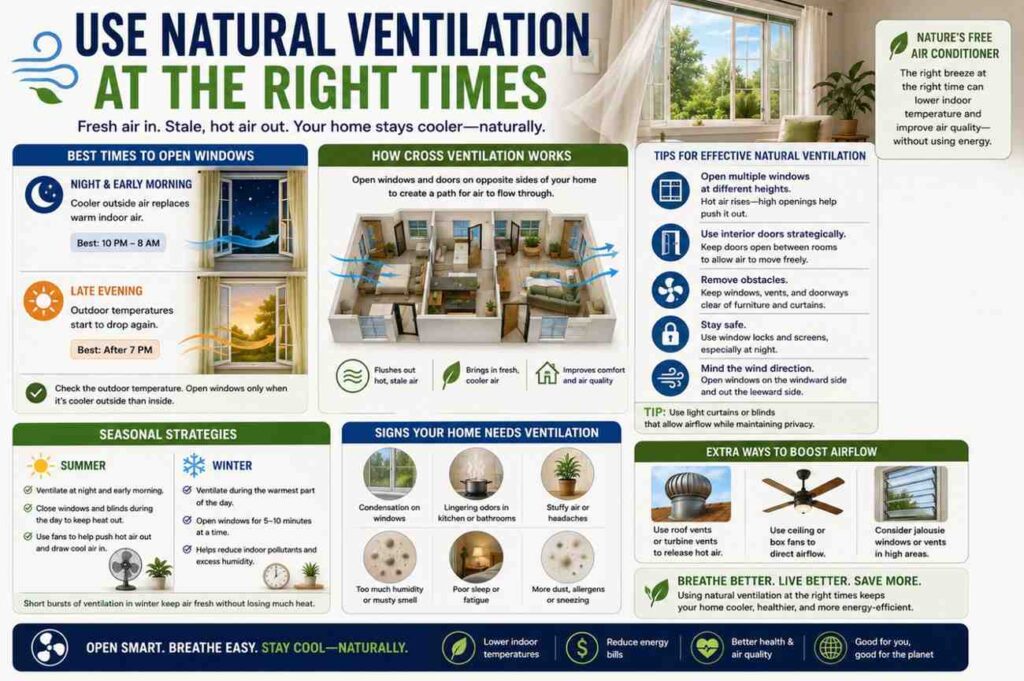
Natural ventilation is one of the oldest and most effective ways to cool your home without AC, and it works best when used strategically rather than continuously.
Outdoor temperatures in most parts of the United States drop significantly overnight, often by fifteen to twenty degrees or more during summer heat waves. When the outdoor temperature falls below the indoor temperature in the evening, typically after 8 or 9 PM in most regions, opening windows creates an opportunity to flush the accumulated heat of the day out of the home and replace it with cooler outdoor air.
Cross ventilation is the most effective form of natural cooling. Open windows on opposite sides of the home to create airflow that draws cool air in on the shaded side and pushes warm air out on the opposite side. This natural convection current cools the home far more effectively than opening windows on a single side of the house.
Close everything up again in the morning before the outdoor temperature rises above the indoor temperature and before direct sun hits any windows. This traps the cool air inside and gives you a head start on the day before any mechanical cooling is needed. Used consistently, this morning and evening window strategy can cool your home without AC assistance for a meaningful portion of each summer day.
A box fan placed in a window facing outward pulls warm air out of the room and accelerates the natural ventilation process. Placed in an upstairs window where hot air naturally accumulates, an outward-facing fan is particularly effective at helping you cool your home without AC on summer evenings.
Whole House Fans: The Most Powerful Way to Cool Your Home Without AC
If you want to cool your home without AC in the most effective way possible and you live in a climate with cooler nights, a whole house fan is the single best investment available.
A whole house fan is installed in the ceiling between the living space and the attic. When windows are opened and the fan is switched on, it pulls air from throughout the home and exhausts it through the attic and out the attic vents, creating whole-home air exchange in minutes rather than hours. The cooling effect of a whole house fan on a summer evening when outdoor temperatures have dropped is immediate and dramatic.
The Energy Star program (https://www.energystar.gov) estimates that whole house fans can reduce cooling energy costs by 50 to 90 percent in climates with significant day-night temperature differences. In the western United States, the Mountain regions, and much of the Midwest, where summer nights are significantly cooler than summer days, a whole house fan is one of the most cost-effective tools available to cool your home without AC.
The operating cost of a whole house fan is a small fraction of the cost of running a central air conditioner for the same period. For many households, a whole house fan used on appropriate evenings can eliminate the need to run the AC for a significant portion of the summer.
Ceiling Fans and Portable Fans Used the Right Way
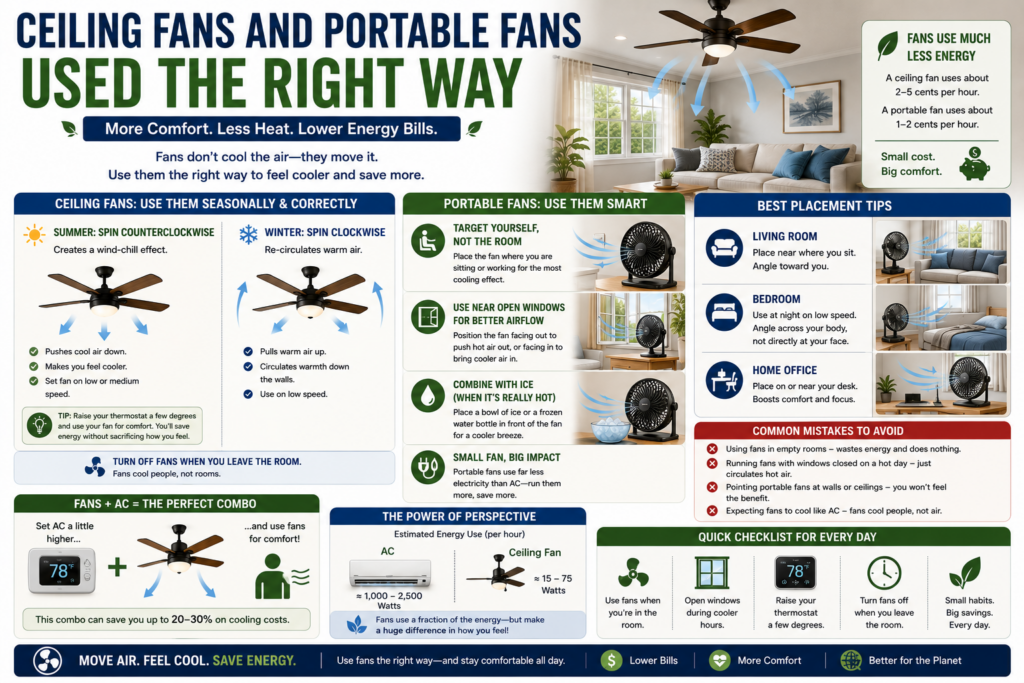
Fans cannot cool your home without AC in the same way a refrigeration system does. They do not lower air temperature. But they create a wind chill effect on people in the room that makes the temperature feel four to five degrees cooler than it actually is, which is meaningful when you are trying to cool your home without AC on a moderately hot day.
The key word in that sentence is people. A ceiling fan running in an empty room is consuming electricity and generating motor heat for no benefit whatsoever. Every fan in your home should be turned off when the room is not occupied. This is one of the most common mistakes homeowners make when trying to cool their home without AC, running fans throughout the house when only one or two rooms are being used.
In summer, ceiling fans should run counterclockwise when viewed from below. This pushes air downward and creates the wind chill effect directly beneath the fan. Most ceiling fans have a direction switch on the motor housing that should be checked and set at the beginning of each summer.
Portable fans used in conjunction with open windows on cool evenings significantly accelerate the natural ventilation process and help cool your home without AC more quickly than passive ventilation alone.
Reduce the Heat Your Home Generates Internally
One of the most overlooked aspects of trying to cool your home without AC is the heat produced inside the home by cooking, lighting, and electronics. Every BTU of heat generated inside the home adds to the cooling load, and reducing internal heat sources is a free and immediate way to make the job easier.
Cooking on a full-sized oven during the hottest part of a summer day is one of the most counterproductive things you can do when trying to cool your home without AC. An oven running at 375 degrees for an hour adds substantial heat to the kitchen and surrounding rooms. Shift cooking to the early morning before peak heat, use a microwave or air fryer that generates far less heat, or move cooking outside to the grill entirely during the hottest weeks.
LED lighting produces up to 80 percent less heat than incandescent bulbs while using less electricity. If your home still has any incandescent or halogen bulbs, replacing them with LEDs reduces both your electricity bill and the heat load inside the home, making it easier to cool your home without AC in every room where the switch is made.
Electronics left on standby mode produce a low but continuous heat output throughout the day. Televisions, gaming consoles, desktop computers, and phone chargers all contribute to the ambient heat load. Turning off or unplugging electronics that are not in use removes these heat sources entirely.
Optimize Your Attic to Cool Your Home Without AC
The attic is where summer heat has its greatest impact on the living space below, and addressing attic conditions is one of the most impactful ways to cool your home without AC running constantly.
An attic without adequate ventilation can reach 150 degrees Fahrenheit on a hot summer day. That extreme heat radiates downward through the ceiling into the living space and creates a cooling load that no reasonable AC system can fully overcome. Proper attic ventilation, combining soffit intake vents with ridge or gable exhaust vents, allows hot air to escape continuously and keeps attic temperatures far closer to outdoor ambient levels.
Attic insulation at or above the R-38 level recommended by the EPA Energy Star program prevents conducted heat from moving from the attic into the living space below. Upgrading inadequate attic insulation is one of the highest-return home improvements available for homeowners trying to cool their home without AC, and the federal tax credit currently available covers 30 percent of the installation cost.
A radiant barrier on the underside of the roof decking reflects the sun’s radiant energy before it can heat the attic air, reducing attic temperatures by 20 to 30 degrees in hot sunny climates. In the South, the Southwest, and anywhere with intense summer sun, a radiant barrier is one of the most effective permanent investments to cool your home without AC bearing the full load.
Smart Thermostat Habits When You Do Use the AC
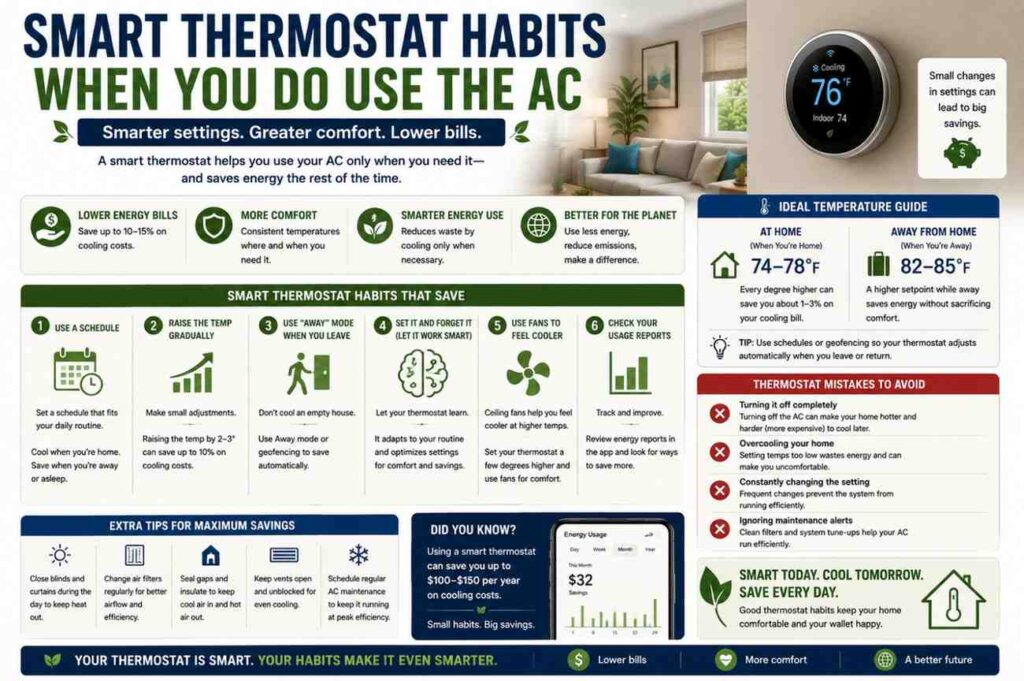
Cooling your home without AC does not mean never using it. It means using it strategically so it does less work and costs less to operate. A smart or programmable thermostat is the most practical tool for this.
Program the thermostat to allow temperatures to rise during the hours the home is empty and cool down before occupants return. Running the AC at full capacity for an empty house all day is one of the most expensive and least necessary habits in American home energy consumption. A smart thermostat eliminates it automatically.
Set the thermostat as high as comfort allows, which for most households is 76 to 78 degrees when ceiling fans are also running. The combination of a higher thermostat setting and fan-created wind chill delivers equivalent comfort at significantly lower operating cost. According to the Department of Energy, each degree higher on the thermostat saves approximately three percent on cooling costs, which adds up meaningfully over an entire summer.
Pre-cooling the home in the early morning before outdoor temperatures peak, then shutting windows and relying on the stored coolness as long as possible before the AC turns on, is one of the most effective strategies to cool your home without AC carrying the full load during peak afternoon heat.
Plants and Landscaping as Natural Cooling Tools
The area immediately around your home affects how hot your home gets, and strategic landscaping is a long-term investment in the ability to cool your home without AC working as hard.
Shade trees planted on the south and west sides of the home block direct sunlight from reaching the walls and windows during the hottest parts of the day. A mature shade tree on the west side of a home can reduce the temperature of the wall beneath it by ten to fifteen degrees compared to an unshaded wall in the same conditions. The Arbor Day Foundation (https://www.arborday.org) provides guidance on the best tree species for heat reduction by US region and the optimal placement for maximum cooling benefit.
Ground cover plants and mulched garden beds around the foundation absorb solar radiation rather than reflecting it back toward the home the way bare soil, gravel, or concrete does. Replacing heat-absorbing hardscape immediately around the house with vegetation reduces the radiant heat that the walls and foundation absorb during the day and release into the home in the evening.
Green walls or climbing plants trained up a trellis on sun-exposed exterior walls create a layer of insulation and evaporative cooling between the sun and the wall surface. This technique has been used to cool buildings for centuries and remains one of the most effective passive strategies to cool your home without AC assistance.
Final Thoughts on How to Cool Your Home Without AC
The ability to cool your home without AC, or with significantly less of it, is within reach of every American homeowner regardless of budget. The strategies range from zero-cost habits like closing blinds before the sun hits them and opening windows after dark, to moderate investments like whole house fans and attic insulation upgrades that pay for themselves in reduced utility costs within one to two summers.
No single strategy on this list is complicated. But combining several of them creates a home environment that stays meaningfully cooler than it would otherwise, extends the life of your AC by reducing its operating hours, and puts real money back in your pocket every month from June through September.
The summer heat is not going anywhere. But your approach to it can be smarter than simply turning the thermostat down and hoping for the best.