
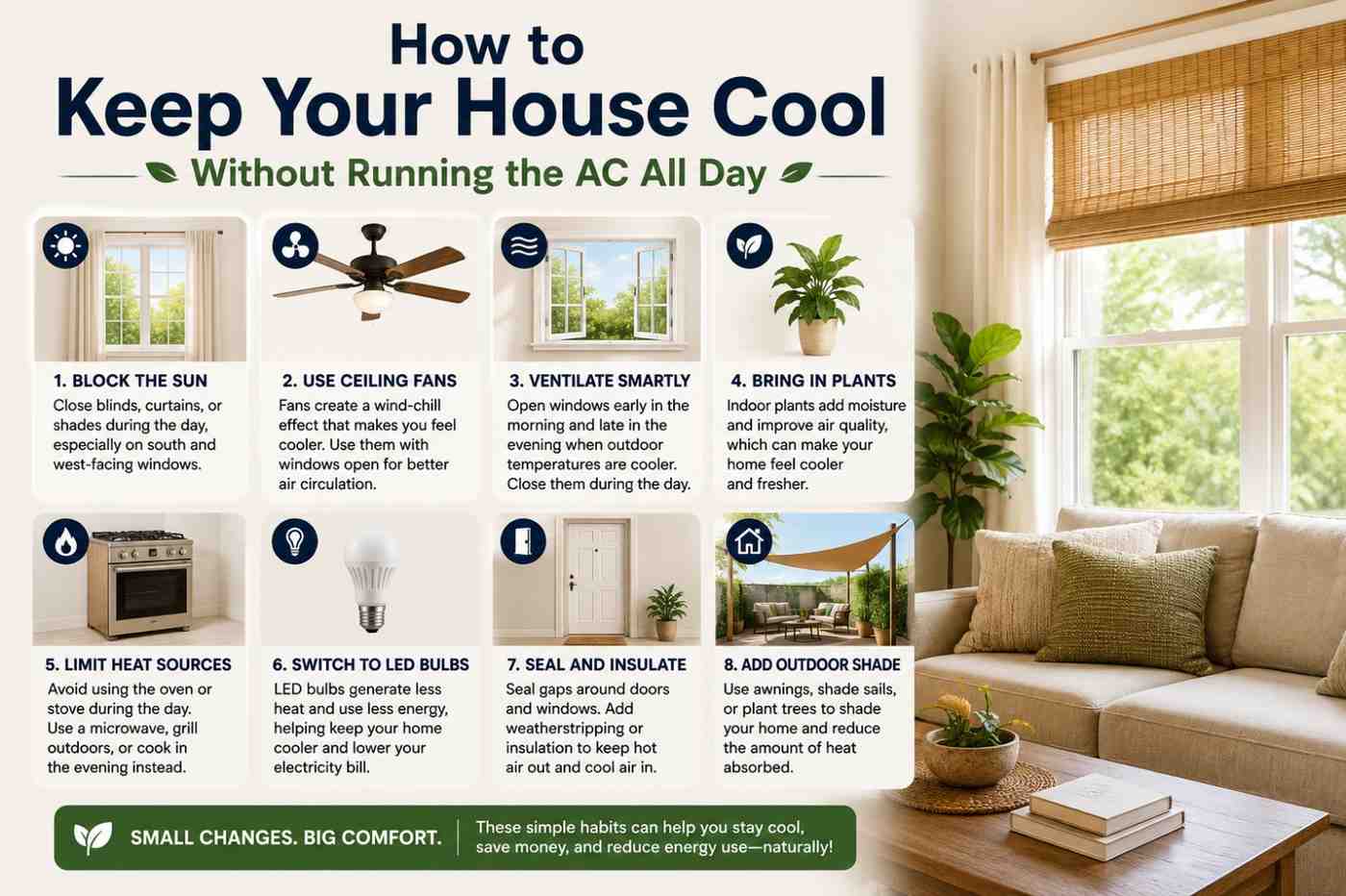
Summer in America is getting hotter every year, and so are the electricity bills that come with it. If you have been running your air conditioner from morning to night just to keep the house bearable and still opening your utility bill with a sense of dread, this guide is for you.
Knowing how to keep your house cool without relying entirely on the AC is not about suffering through the heat. It is about understanding how heat actually gets into your home, where it comes from, and how to block it, redirect it, and remove it more efficiently than running a mechanical cooling system at full power all day long. The result is a cooler home, a lower bill, and an AC that lasts longer because it is not being asked to do the impossible on its own.
Here is everything you need to know about how to keep your house cool when the temperature outside is doing its worst.
Why Your House Gets So Hot in the First Place
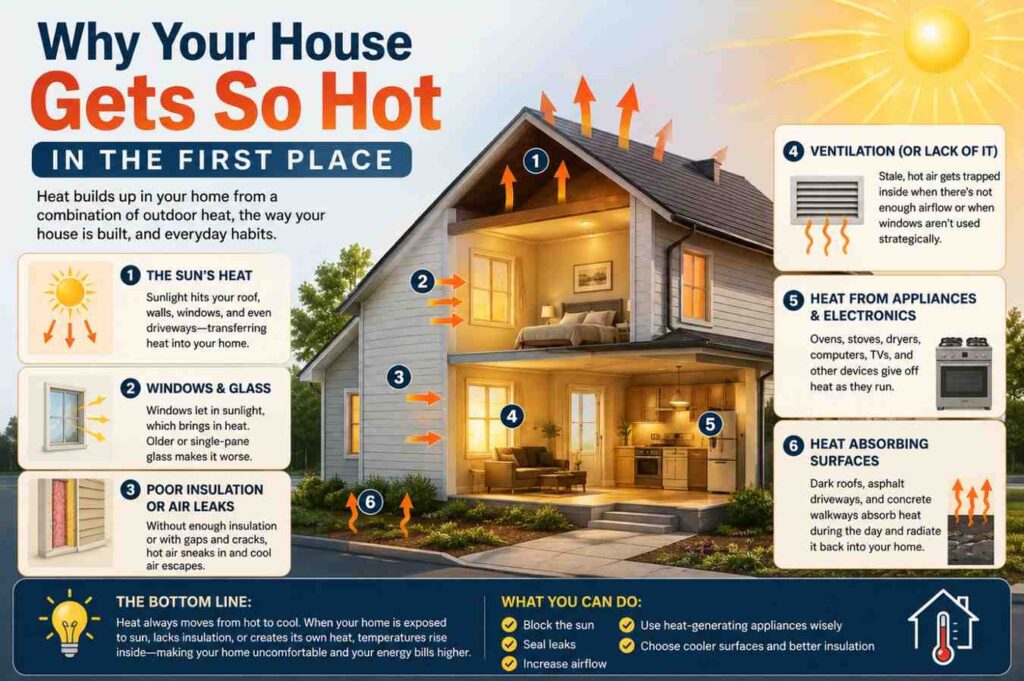
Before getting into how to keep your house cool, it helps to understand where the heat is actually coming from. Most homeowners assume the answer is simply the outdoor temperature, but that is only part of the story.
Solar gain through windows is one of the largest sources of heat in any home. Sunlight passing through glass carries significant radiant heat that warms everything it touches, including floors, furniture, and walls, which then release that heat slowly throughout the day and into the evening. A home with large south or west-facing windows in direct sun is absorbing enormous amounts of heat through the glass alone.
Heat conducted through the roof is the other major source. An attic that reaches 150 degrees Fahrenheit on a hot summer day, which is common in homes with inadequate attic insulation and ventilation, radiates heat downward through the ceiling into the living space below. Cooling that living space while the ceiling above it is acting as a radiator is an exercise in futility that no AC system can fully overcome.
Internal heat sources including cooking, lighting, electronics, and appliances add meaningful heat load inside the home that the AC must then remove. Understanding all of these sources is the foundation of knowing how to keep your house cool effectively.
Block the Sun Before It Becomes Heat
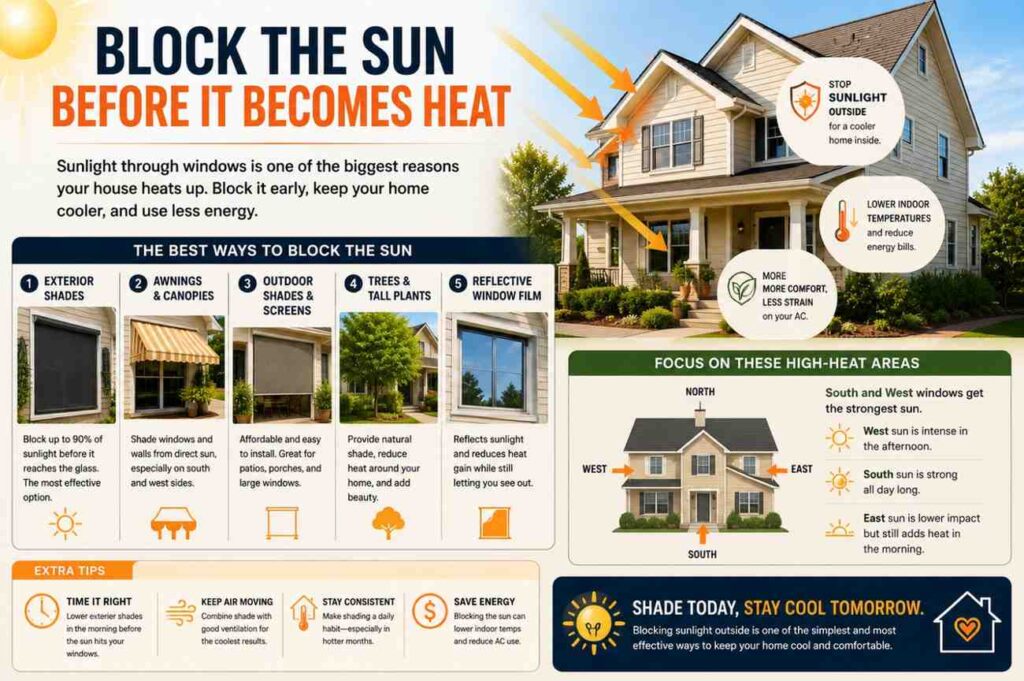
The single most impactful thing you can do to keep your house cool is to prevent solar heat from entering through your windows in the first place. Once sunlight has entered through glass and converted to radiant heat inside the room, the AC has to remove it mechanically. Blocking it before it enters costs nothing to operate and reduces your cooling load dramatically.
Close blinds, shades, and curtains on the south and west-facing windows before the sun hits them in the morning, not after the room is already warm. This sounds obvious but most homeowners do it backwards, closing the blinds after the room has already heated up. Cellular shades, blackout curtains, and reflective window film all significantly reduce solar heat gain and are among the most cost-effective investments for learning how to keep your house cool.
Exterior shading is even more effective than interior shading because it blocks sunlight before it reaches the glass at all. Awnings over south and west-facing windows, shade trees planted in the right locations, and exterior solar screens all prevent solar gain rather than just slowing it down. The U.S. Department of Energy (https://www.energy.gov/energysaver/energy-efficient-window-coverings) estimates that proper window shading can reduce solar heat gain by up to 77 percent, which is one of the most significant single interventions available for keeping a home cool.
Use Your Windows Strategically
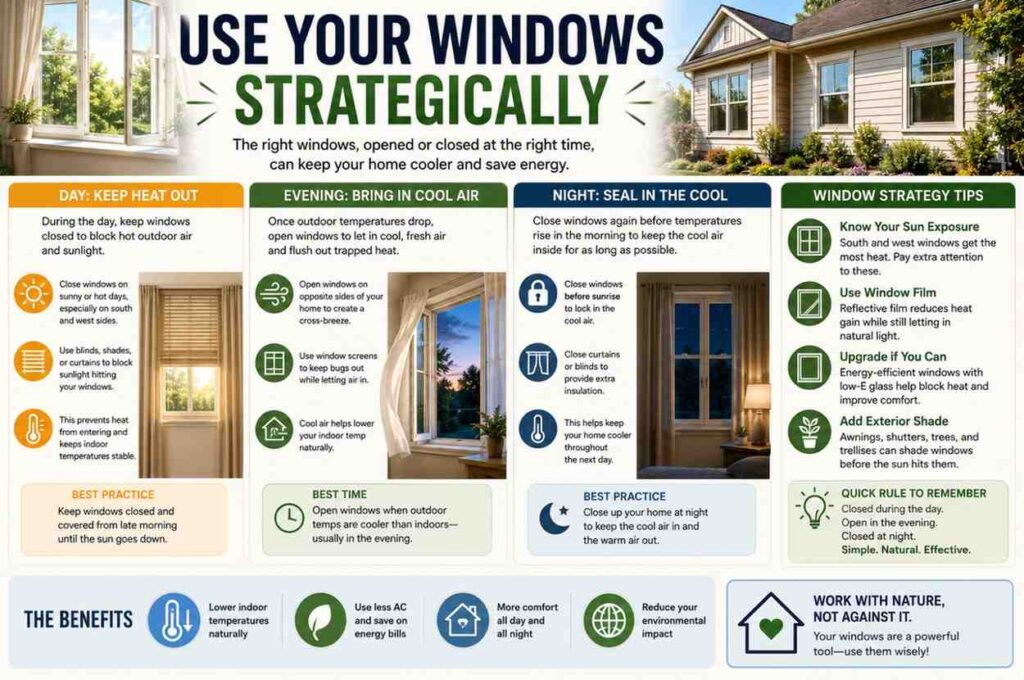
Windows are not just a source of heat gain. Used correctly, they are one of the most effective tools for how to keep your house cool without mechanical cooling.
The outside temperature drops significantly overnight in most parts of the United States, even during heat waves. If the outdoor temperature falls below the indoor temperature in the evening, opening windows creates natural ventilation that flushes the accumulated heat out of the home and replaces it with cooler outdoor air. By the time you close the windows and blinds in the morning before the sun heats things up again, the home starts the day significantly cooler than it would have otherwise.
Cross ventilation amplifies this effect. Opening windows on opposite sides of the home creates airflow that moves warm air out and draws cooler air in far more effectively than opening windows on a single side. If you can create a path from a cool shaded side of the home to the opposite side where warm air can exit, you are running a natural ventilation system that costs nothing to operate.
A box fan placed in a window facing outward pulls warm air out of the room and creates a pressure difference that draws cooler air in through other openings. This simple technique is one of the most effective and underused strategies for how to keep your house cool on evenings when the outdoor temperature has dropped but the home is still holding the day’s heat.
Address the Attic
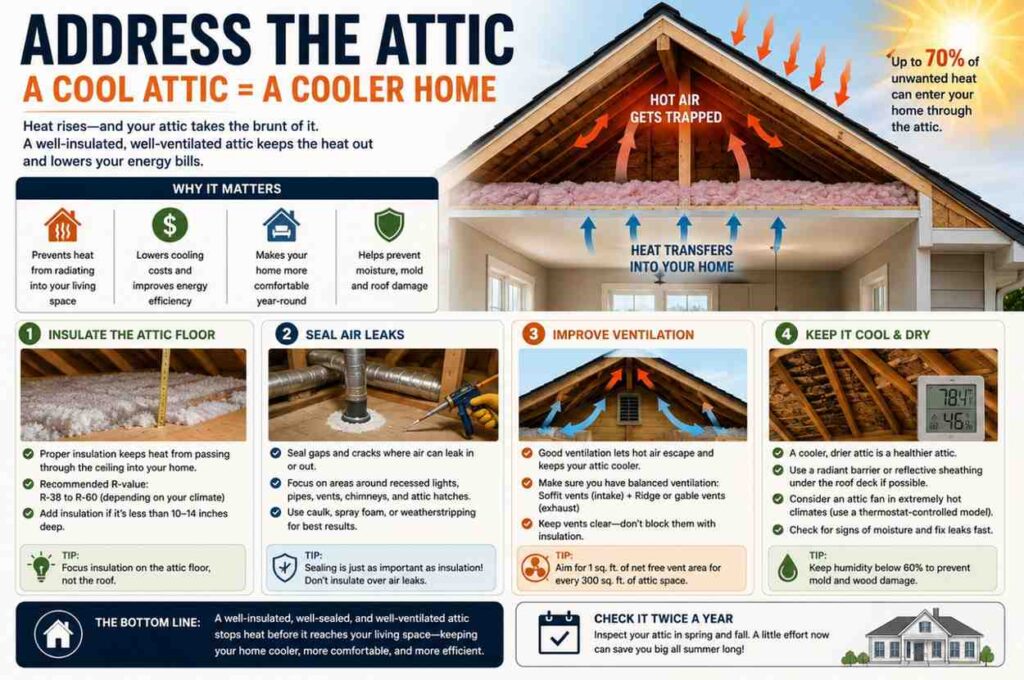
If you want to know how to keep your house cool and you have not looked at your attic recently, start there. The attic is where the battle against summer heat is most often lost, and it is where the most impactful improvements are available.
An attic without adequate ventilation traps hot air that builds to extreme temperatures and radiates that heat directly into the living space below. Proper attic ventilation, combining intake vents at the soffit level with exhaust vents at the ridge or gable, allows hot air to escape continuously and keeps attic temperatures significantly closer to outdoor temperatures rather than multiplying them.
Attic insulation is equally critical. The EPA’s Energy Star program (https://www.energystar.gov) recommends a minimum of R-38 insulation in attics for most US climate zones, and many older homes fall well short of this. Upgrading attic insulation is one of the highest-return investments available for homeowners focused on how to keep your house cool in summer and warm in winter, and the federal tax credit available through the Inflation Reduction Act covers 30 percent of the cost of insulation upgrades.
A radiant barrier installed on the underside of the roof decking reflects radiant heat from the roof before it can heat the attic air, reducing attic temperatures by 20 to 30 degrees in some installations. Radiant barriers are particularly effective in hot sunny climates like the South and Southwest and can meaningfully reduce the cooling load on the AC system below.
Reduce Internal Heat Sources
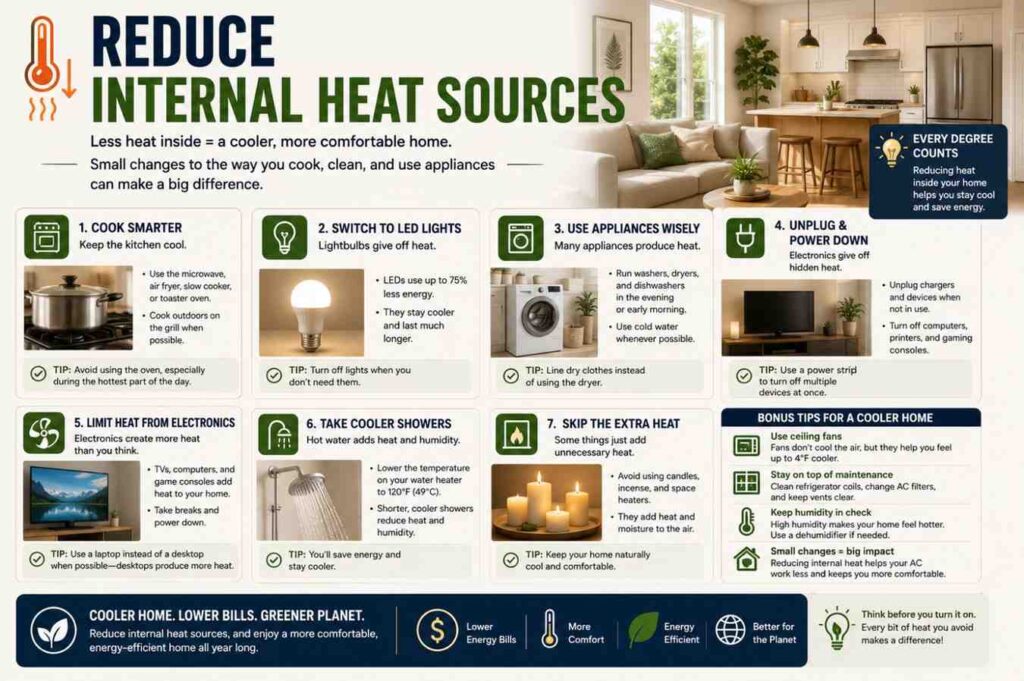
Learning how to keep your house cool also means reducing the heat your home generates from the inside, because every BTU of heat produced by appliances, lighting, and cooking is a BTU the AC has to remove.
Cooking on the stovetop or in the oven adds significant heat to the kitchen and the surrounding areas. During the hottest parts of summer, shifting cooking to the morning before peak heat, using a microwave or air fryer that generates less heat than a full oven, or cooking outside on the grill are all practical strategies for reducing internal heat load. A conventional oven running for an hour in the afternoon during a heat wave is directly increasing the workload on your AC system.
Incandescent and halogen light bulbs convert a significant portion of their energy to heat rather than light. Replacing them with LED bulbs reduces heat output from lighting by up to 80 percent while using less electricity. This is one of the home upgrades that simultaneously reduces internal heat load and lowers your electricity bill, making it one of the most straightforward answers to how to keep your house cool available to any homeowner.
Electronics produce heat when in use and even when on standby. Televisions, gaming consoles, desktop computers, and other devices left on or in standby mode add a consistent low-level heat source throughout the day. Turning off electronics that are not in use and using smart power strips to eliminate standby power draw reduces this contribution to your home’s heat load.
Use Ceiling Fans the Right Way
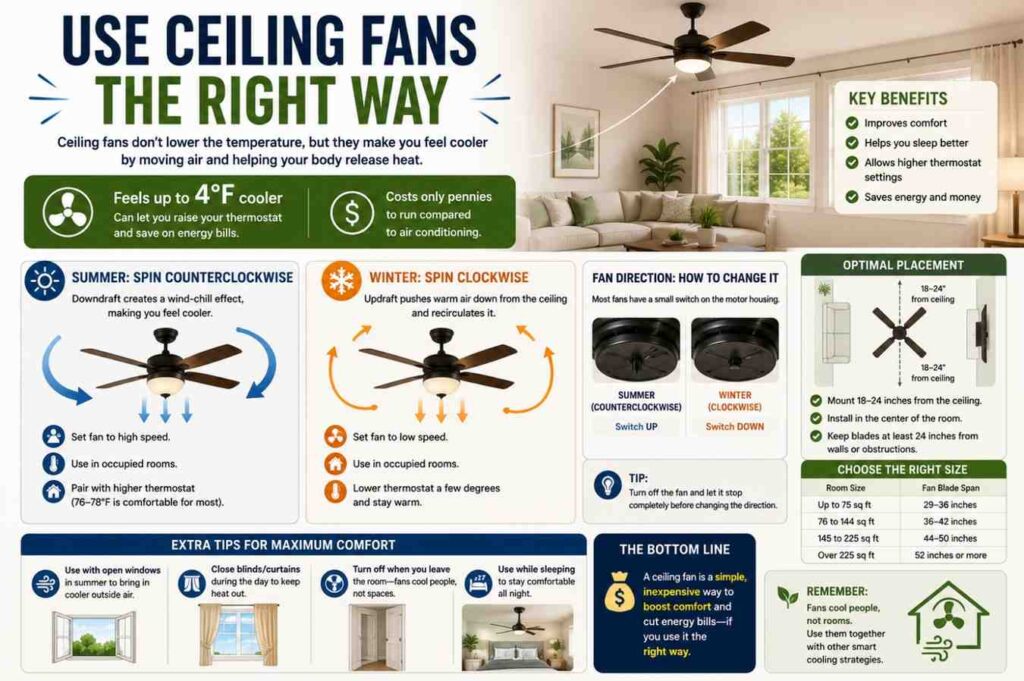
Ceiling fans do not cool air. This is one of the most persistent misunderstandings in home cooling, and it leads homeowners to use fans in ways that do not help and sometimes make things worse.
What ceiling fans do is create a wind chill effect that makes people in the room feel cooler by increasing the rate at which perspiration evaporates from the skin. This is meaningful when a person is in the room and can feel up to four degrees cooler with a properly sized and positioned ceiling fan running. It is completely irrelevant when no one is in the room, which is why running ceiling fans in empty rooms is simply wasting electricity and generating heat from the motor.
In summer, ceiling fans should run counterclockwise when viewed from below, which pushes air downward and creates the wind chill effect directly below the fan. Most ceiling fans have a direction switch on the motor housing. Check and set this at the beginning of summer.
The correct approach to how to keep your house cool with ceiling fans is to use them in occupied rooms, set the thermostat two to four degrees higher than you normally would, and turn the fans off when you leave the room. The combination of higher thermostat setting and fan comfort can reduce cooling energy use significantly without any reduction in perceived comfort.
Optimize Your AC When You Do Use It
Knowing how to keep your house cool is not about eliminating the AC entirely. It is about making the AC as effective as possible when it does run so it accomplishes more in less time with less energy.
A programmable or smart thermostat is the simplest tool for AC optimization. Programming the thermostat to allow temperatures to rise when the home is empty during the day and cool down before occupants return uses the AC only when it is needed and prevents it from running continuously against a heat load that keeps building from solar gain through windows that could have been covered.
The AC thermostat should be set to the highest temperature that remains comfortable, which for most households is somewhere between 76 and 78 degrees when combined with ceiling fans. Every degree higher saves approximately three percent on cooling costs according to the Department of Energy. The difference between 72 degrees and 78 degrees on an electricity bill over an entire summer is significant.
Keep the area around the outdoor condenser unit clear of vegetation, debris, and obstructions. A condenser that cannot move air freely works harder and less efficiently. Ensure that indoor supply and return vents are not blocked by furniture, rugs, or drapes, as blocked vents reduce airflow and force the system to run longer to achieve the set temperature.
Have the AC professionally serviced once a year. A system running with low refrigerant, a dirty evaporator coil, or a failing capacitor uses more electricity and cools less effectively than a properly maintained system. Annual maintenance is one of the most cost-effective investments available for homeowners focused on how to keep your house cool efficiently.
Whole House Fans as a Cooling Alternative
A whole house fan is one of the most effective and underused tools for how to keep your house cool in climates where outdoor temperatures drop significantly at night. Installed in the ceiling between the living space and the attic, a whole house fan pulls air from open windows throughout the home and exhausts it into the attic and out through the attic vents, creating powerful whole-home ventilation in minutes.
On an evening when the outdoor temperature drops below 70 degrees, running a whole house fan for an hour can bring the entire home temperature down to match outdoor conditions and flush the accumulated heat of the day out completely. The energy cost of running a whole house fan is a fraction of running the AC for the same period.
Whole house fans are most effective in climates with significant day-night temperature swings, including most of the western United States, the Midwest, and the Mountain regions. They are less effective in hot and humid climates like the Southeast where nighttime temperatures remain high and humidity makes outdoor air less refreshing.
The Energy Star program (https://www.energystar.gov) estimates that whole house fans can reduce cooling energy costs by 50 to 90 percent in appropriate climates when used in combination with strategic window management.
Final Thoughts on How to Keep Your House Cool
The most effective approach to how to keep your house cool in summer is not a single strategy. It is a combination of blocking solar heat gain before it enters, ventilating strategically when outdoor conditions allow, reducing internal heat sources, optimizing the attic, and using the AC efficiently when it does run.
None of these strategies requires significant investment. Most of them are habits and adjustments that cost nothing to implement and begin working immediately. Combined, they can meaningfully reduce the temperature inside your home, lower your electricity bill, and make summer genuinely comfortable without the AC running from sunrise to sunset.
The heat is not going anywhere. But knowing how to keep your house cool without surrendering to it entirely makes a real difference to both your comfort and your wallet every single summer day.