
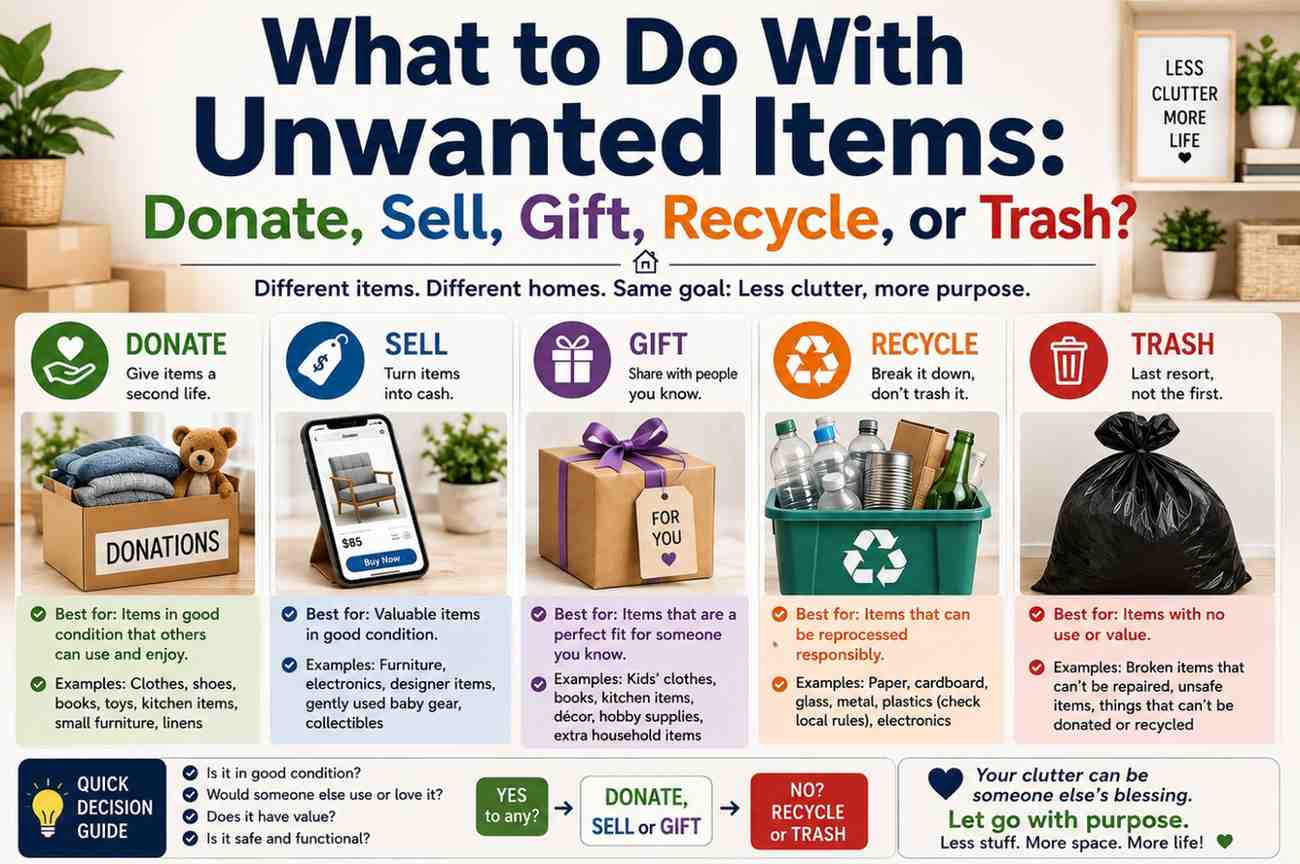
You finally cleared out the closet. You sorted through the garage, went through the kitchen cabinets, and now you are standing in front of a pile of things that no longer belong in your home. And somewhere between the satisfaction of finishing the sort and the reality of the pile sitting in front of you, a new question takes over.
What do you do with all of it now?
Figuring out what to do with unwanted items is where most decluttering efforts stall. The boxes of donations sit in the garage for three months. The things you meant to sell get listed and forgotten. The pile that was supposed to leave your home quietly becomes a permanent fixture in the corner. The work of decluttering gets undone not because you changed your mind but because you never had a clear plan afor the exit.
This guide gives you that plan. Every option for what to do with unwanted items, every organization and platform worth knowing about, and a simple framework for making the right decision for every category of thing in your home.
Why What You Do With Unwanted Items Actually Matters
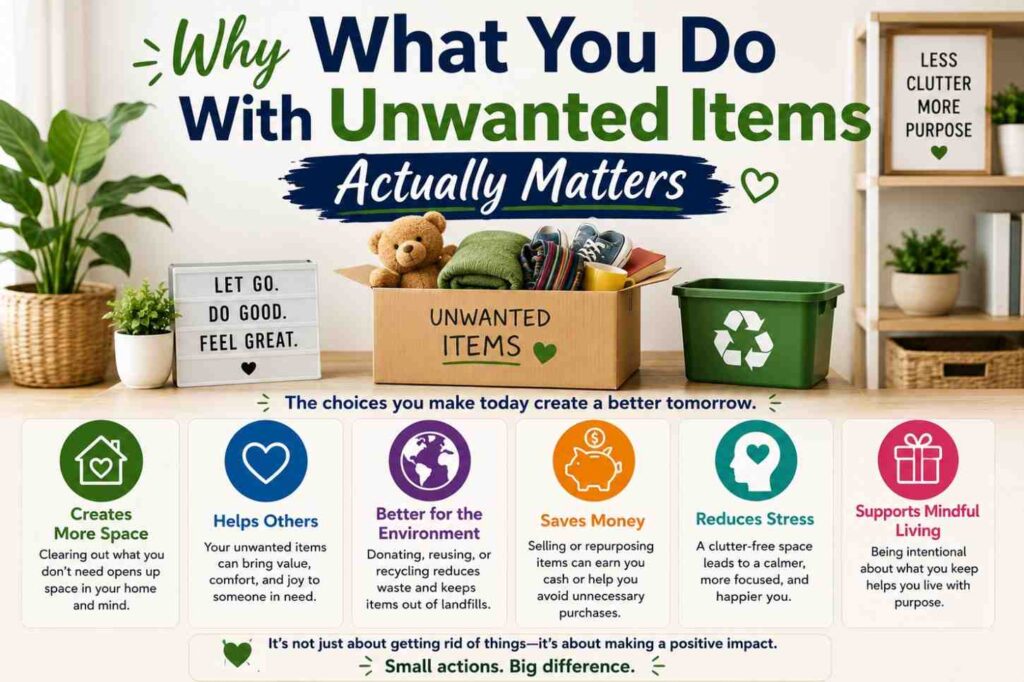
Before getting into the specific options, it is worth understanding why the decision about what to do with unwanted items has consequences beyond your own home.
According to the EPA (https://www.epa.gov/recycle), Americans generate over 292 million tons of municipal solid waste per year. A significant portion of that waste consists of items that were functional and usable at the time of disposal but ended up in a landfill because the person discarding them did not know where else to take them. Clothing, electronics, furniture, appliances, and housewares that could have been donated, sold, or recycled fill landfills at a rate that has real environmental consequences.
At the same time, donation organizations across the United States consistently report need for the exact categories of items that most American households discard during a decluttering session. Functional clothing, kitchen items, furniture in good condition, and working electronics are in constant demand at shelters, thrift stores, and community organizations that serve people who need them.
Knowing what to do with unwanted items connects your decluttering work to something larger than the pile in your living room. The decisions you make about where things go have real downstream effects, and making them thoughtfully costs nothing beyond a little more intentionality.
Option One: Donate
For the majority of functional unwanted items in reasonable condition, donation is the fastest and most impactful answer to what to do with unwanted items. It gets things out of your home quickly, requires no negotiation or scheduling with buyers, and provides direct benefit to people who need what you no longer use.
The single most important rule for donation is that items must be genuinely usable. Donation organizations are not disposal services, and donating damaged, broken, heavily stained, or otherwise unusable items creates work for staff and volunteers without helping anyone. Before donating anything, apply this simple test: would you give this to a friend? If the honest answer is no, it does not belong in a donation bin.
Goodwill (https://www.goodwill.org) and the Salvation Army (https://www.salvationarmyusa.org) are the most accessible general donation destinations for most American households, accepting clothing, housewares, books, furniture, and working electronics at locations across the country. Both have store locators on their websites and accept walk-in donations during business hours.
Habitat for Humanity ReStores (https://www.habitat.org/restores) are the right destination for what to do with unwanted items in the home improvement category including tools, appliances, cabinets, flooring, light fixtures, and building materials that general thrift stores do not accept. Revenue from ReStore sales directly funds Habitat’s home building work.
Specialty organizations extend your donation impact further. Books go to local library sales, Little Free Libraries, or Books for Africa (https://www.booksforafrica.org). Professional clothing goes to Dress for Success (https://dressforsuccess.org) or similar organizations that provide work attire to people entering the workforce. Sports equipment goes to youth athletic programs. Musical instruments go to school music programs. Matching the item to the most relevant organization produces better outcomes than defaulting to the nearest general thrift store for everything.
Option Two: Sell
Selling is the right answer for what to do with unwanted items that have genuine resale value, and the wrong answer for items where the time and effort involved exceeds what you will realistically earn.
Before deciding to sell something, be honest about whether it will actually sell, how long it will take, and whether the return justifies the effort. A useful threshold is whether an item is likely to sell for $25 or more and whether a buyer exists within a reasonable timeframe. Items worth $10 after platform fees and time spent photographing, listing, and coordinating are better donated. Items worth $75 or more are worth the effort to sell properly.
Facebook Marketplace is currently the most effective platform for selling used household items locally. It requires no shipping, charges no listing fees, and connects you with buyers in your area who can pick up the item. Furniture, appliances, tools, bicycles, and general household items move reliably on Facebook Marketplace when priced realistically and photographed clearly. It is the first platform to try for large or heavy items that would be impractical to ship.
eBay remains the best platform for what to do with unwanted items that have a specific collector or enthusiast market, including vintage items, branded goods, electronics, and collectibles with demand beyond your local area. eBay charges selling fees and requires shipping, making it best suited to items valuable enough to absorb those costs.
Poshmark and ThredUp are the leading platforms for clothing resale, with Poshmark operating as a direct listing model and ThredUp as a managed service where you send items in and they handle everything else. For a wardrobe cleanout with items of real resale value, these platforms reach a much larger audience of clothing buyers than local options.
Price items based on what comparable sold listings show, not on what you paid or what you hope to receive. Overpriced items sit unsold indefinitely and become the next generation of clutter you have to deal with again later.
Option Three: Gift
Gifting is the most personal answer to what to do with unwanted items, and it works best when it is genuinely about the recipient rather than about solving your disposal problem.
The distinction matters because gifting something to someone who does not actually want it transfers the problem rather than solving it. The recipient now has an item they feel obligated to keep out of politeness, and you have moved your clutter into their home. Before gifting anything, ask yourself honestly whether the specific person you have in mind would genuinely use and appreciate the item, or whether you are gifting primarily because it is easier than finding another path.
Gifting works well when you know someone specifically who would benefit from what you have. A piece of furniture that fits perfectly in a family member’s first apartment. A kitchen appliance your neighbor mentioned wanting. Books a specific friend would enjoy. A hobby item for someone you know actively pursues that interest.
Always ask before assuming. A quick message takes thirty seconds and avoids the awkwardness of handing something to someone who now feels obligated to keep it.
For items you want to give away without a specific recipient in mind, neighborhood platforms like Nextdoor (https://www.nextdoor.com) and Buy Nothing groups on Facebook connect unwanted items with neighbors who want them. Posting something as free on a neighborhood forum often results in someone picking it up from your porch within hours, with no coordination required beyond leaving it outside.
Option Four: Recycle
Many categories of unwanted items that cannot be donated or sold can be recycled rather than discarded, and the primary barrier for most households is simply not knowing where to take them. This is one of the most important things to understand about what to do with unwanted items that fall outside the donate or sell categories.
Electronics are one of the highest-priority recycling categories. Old televisions, computers, laptops, phones, tablets, printers, and batteries contain materials that are harmful in landfills and valuable for recovery. Best Buy (https://www.bestbuy.com/site/services/recycling/pcmcat149900050025.c) offers free electronics recycling drop-off at most store locations regardless of where the items were originally purchased, making it one of the most accessible options for what to do with unwanted items in this category.
Clothing and textiles too worn or damaged to donate can still be recycled rather than trashed. H&M, Patagonia, and several other clothing retailers operate textile recycling programs that accept worn or damaged garments of any brand. The Council for Textile Recycling estimates that 95 percent of all textiles are recyclable in some form, yet most end up in landfills because most people do not know recycling is an option.
Mattresses present a specific challenge for most households because of their size. The Mattress Recycling Council (https://mattressrecyclingcouncil.org) operates recycling programs in California, Connecticut, and Rhode Island, and many municipalities offer bulk curbside pickup for mattresses or permanent drop-off locations. Many mattress retailers also offer haul-away of the old mattress when delivering a new one.
Paint is one of the most commonly improperly disposed of household materials. Latex paint that is fully dried can go in regular trash in most areas. Liquid latex paint and all oil-based paint require drop-off at a hazardous waste facility. PaintCare (https://www.paintcare.org) operates a network of drop-off locations at hardware stores across the United States and is the easiest starting point for finding the nearest paint recycling option.
For any material you are unsure how to recycle, Earth911 (https://earth911.com) maintains a searchable database of recycling locations for virtually every household material by zip code. It is the most comprehensive resource available for figuring out what to do with unwanted items that require special handling.
Option Five: Trash
Trash is the honest answer for what to do with unwanted items that are broken, unusable, contaminated, or otherwise not suitable for any of the above options, and being willing to use it is important for keeping the decluttering process moving.
Items that are broken beyond reasonable repair, heavily stained or damaged, torn, moldy, infested, or otherwise genuinely unusable belong in the trash rather than a donation bin. Donating these items is not a solution. It transfers the disposal burden to an organization operating on limited resources and staff time.
Hazardous materials including old medications, pesticides, chemical cleaners, and certain types of batteries require specific disposal rather than regular household trash. The DEA operates a national prescription medication take-back program with permanent drop-off locations at pharmacies and law enforcement facilities throughout the United States. Local municipalities operate household hazardous waste collection events and permanent drop-off facilities for chemical products that cannot go in regular trash.
Knowing when trash is the right answer is as important as knowing all the other options. The goal when deciding what to do with unwanted items is to move them out of your home and into the most appropriate destination. Sometimes that destination is the trash can, and treating that as a failure rather than a legitimate outcome keeps items in your home longer than they need to be.
A Simple Decision Framework for What to Do With Unwanted Items
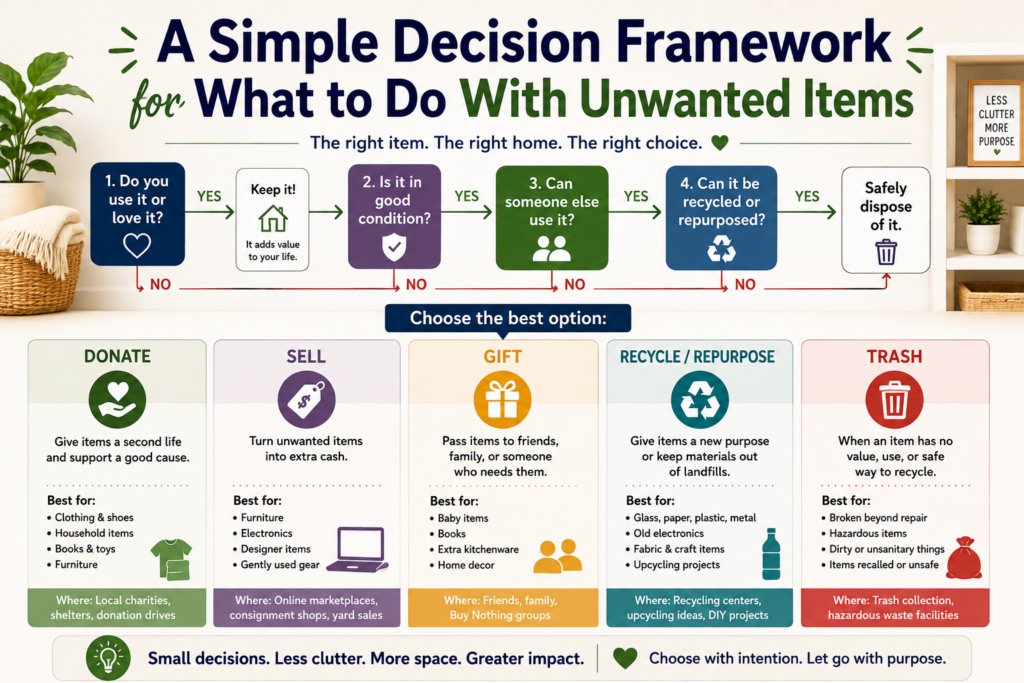
When you are standing in front of a pile and need to make decisions without getting stuck, this framework covers every scenario.
Start by asking whether the item is functional and in acceptable condition. If yes, it is a candidate for donation, sale, or gifting. If no, it goes to recycling if a pathway exists for that material, or to the trash if it does not.
For functional items in good condition, ask whether it has meaningful resale value, specifically whether it is likely to sell for $25 or more within a reasonable timeframe. If yes, list it for sale on the appropriate platform. If no, donate it to the most relevant organization for that item type or gift it to a specific person who would genuinely use it.
The only rule that applies throughout is that nothing goes back into a maybe pile. Every item that leaves a drawer, closet, or shelf gets a destination assigned before the session ends. What to do with unwanted items becomes significantly easier when maybe is not one of the available answers.
The pile in your garage does not have to stay there. Every item in it has somewhere better to go. Now you know exactly where that is.