
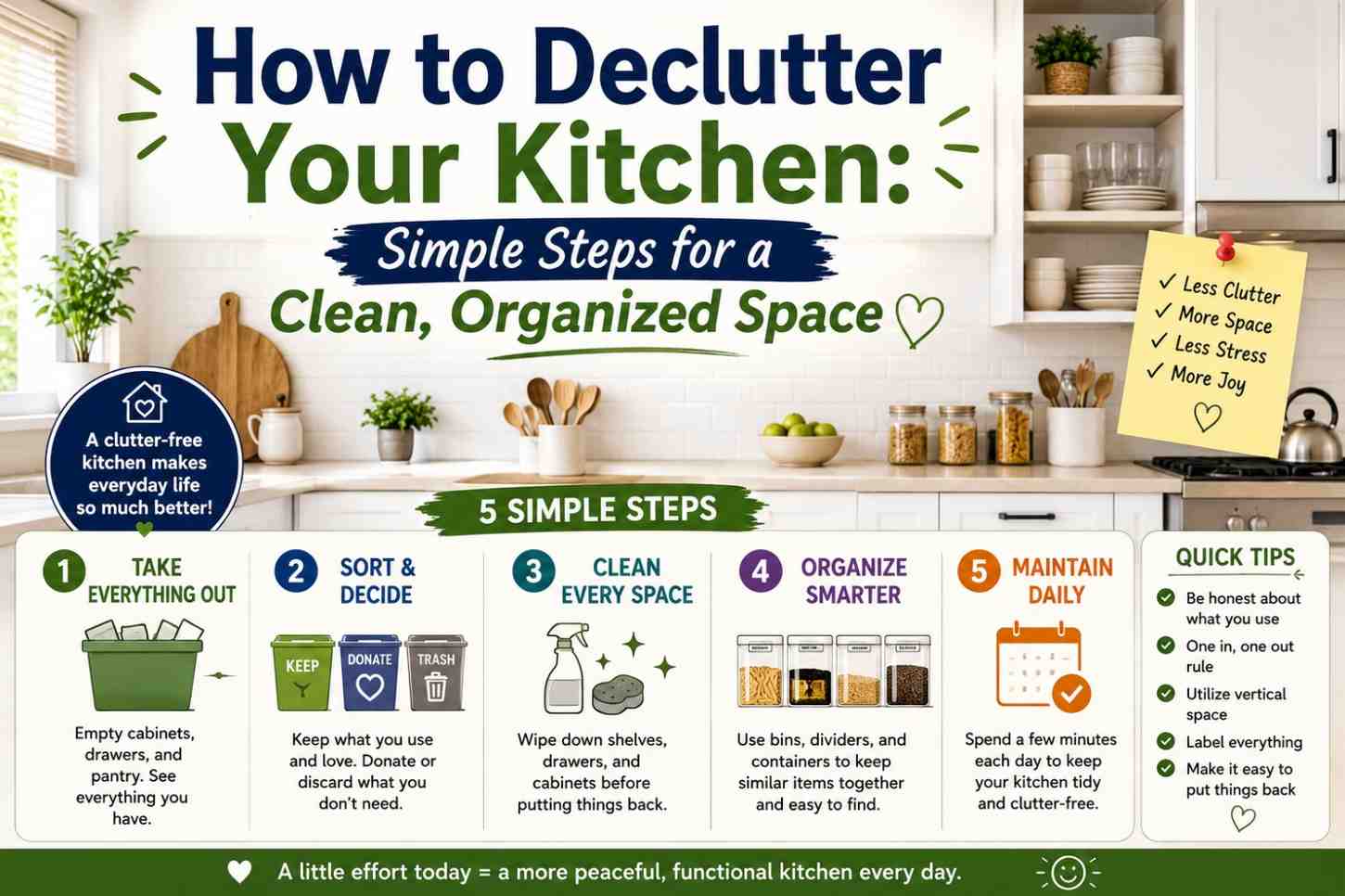
The kitchen is the hardest room in the home to declutter and the most rewarding one to get right. When most people decide to how to declutter your kitchen, they quickly realize it is the room used more times per day than any other, the room where clutter has the most direct impact on daily function, and the room where most households have accumulated the most things they no longer use, need, or even remember owning.
If you have been putting off figuring out how to declutter your kitchen because it feels like too big a job, that feeling is not wrong. It is a big job. But it is also a finite one, and done correctly it produces results that make every single day in your home easier, faster, and less frustrating. A decluttered kitchen is not just cleaner to look at. It is genuinely more functional, and that difference is felt every morning, every meal, and every time you reach into a cabinet and find exactly what you were looking for.
This guide walks you through how to declutter your kitchen completely, space by space, with a clear approach that produces lasting results rather than a clean kitchen that returns to chaos within a month.
Why the Kitchen Is So Hard to Declutter
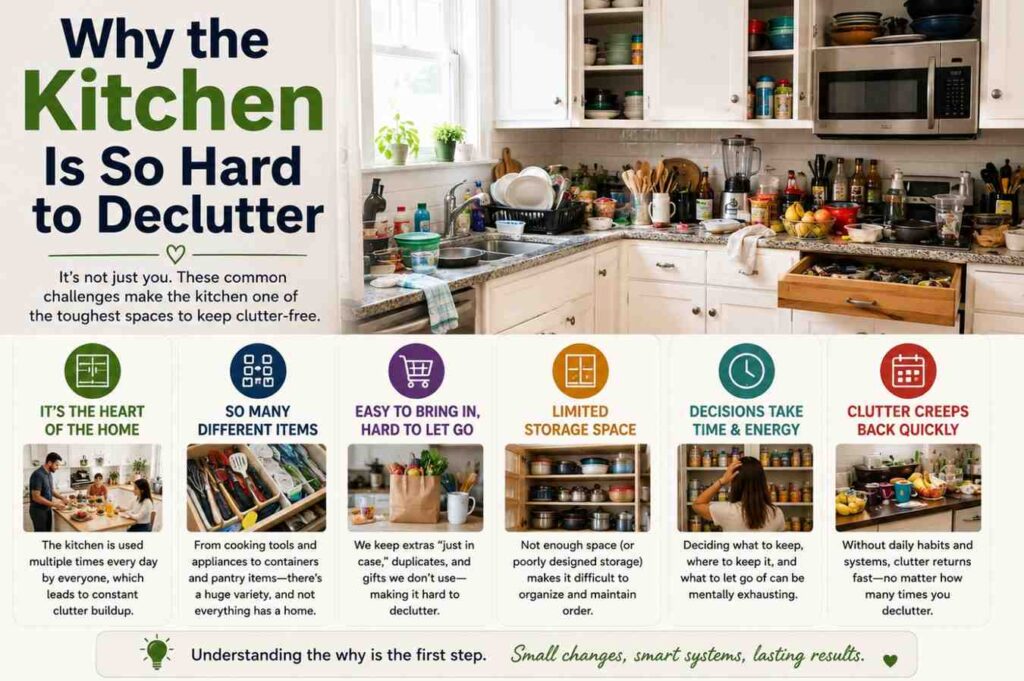
Before getting into how to declutter your kitchen, it helps to understand why kitchen clutter is so persistent compared to clutter in other rooms. There are three reasons that come up consistently.
The first is that kitchen items feel inherently useful even when they are not being used. This is one of the biggest challenges when you how to declutter your kitchen because a gadget not touched in two years still feels like it might be needed for some future recipe. A duplicate pan feels like insurance. A set of glasses that are never chosen over others feel like they might be useful for a large gathering someday. This general sense of potential utility keeps items in the kitchen long past the point where they are actually contributing to how the kitchen functions.
The second reason is guilt about cost. Kitchen items, particularly appliances and cookware, are often expensive to purchase and feel impossible to discard even when they are not being used. The bread machine that cost $80 four years ago and has been used twice sits on the counter or in a cabinet occupying space every day while generating low-level guilt every time it is noticed.
The third reason is that the kitchen has more distinct storage zones than any other room in the home, and clutter in one zone is largely invisible from another. A cluttered junk drawer does not feel connected to an overcrowded pantry or a cabinet stuffed with mismatched containers. Each zone feels like a separate problem, which makes the overall task feel larger and more fragmented than it actually is.
Knowing these patterns makes how to declutter your kitchen easier because you can address each one directly rather than fighting the feelings without understanding where they come from.
Before You Start: How to Approach Decluttering Your Kitchen
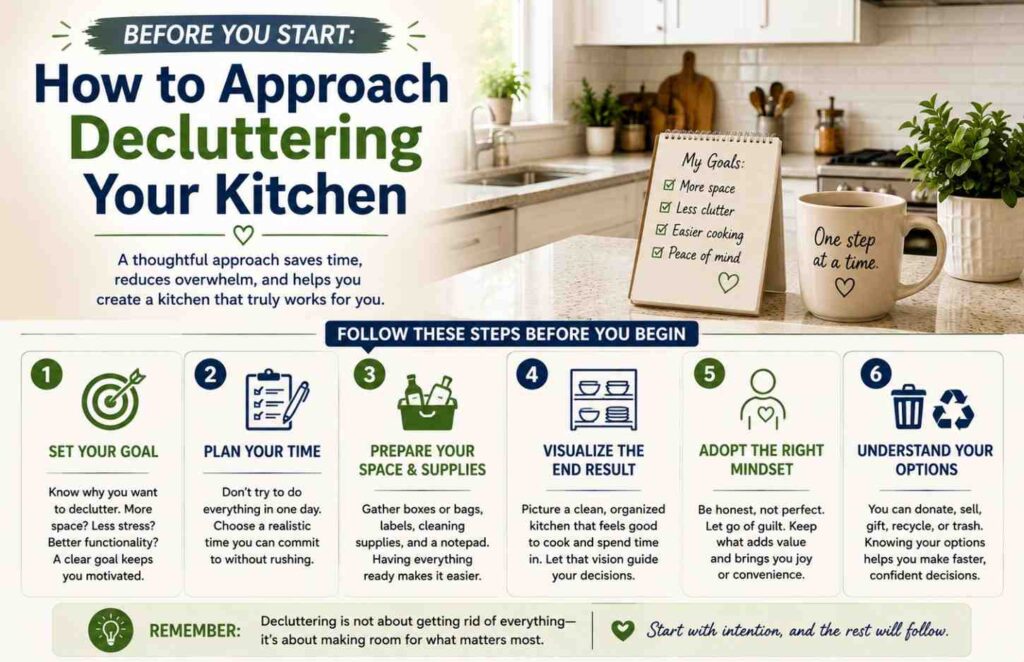
The approach you take when you declutter your kitchen determines whether the results last. There are a few principles that make the difference between a kitchen that stays organized and one that returns to its previous state within weeks.
Work one zone at a time and finish each zone completely before moving to the next. The zones in a kitchen are the countertops, each individual cabinet or group of related cabinets, each drawer, the pantry, and the refrigerator. Starting multiple zones at the same time and partially addressing each one leaves the kitchen in a state of disruption without producing any finished result, which is demoralizing and counterproductive.
Take everything out of each zone before deciding what goes back. This is the step most people skip when they try to how to declutter your kitchen properly, and it is the step that makes the biggest difference. When you remove everything from a cabinet and see its full contents on the counter at once, the duplicates, the never-used items, and the things that do not belong there become obvious in a way they never are when you are looking at them one by one on the shelf.
Have donation boxes, trash bags, and a designated area for items going elsewhere in the home ready before you start. Items that leave a cabinet without a clear destination end up on the counter, which creates the appearance of more clutter during the process and makes it harder to see progress.
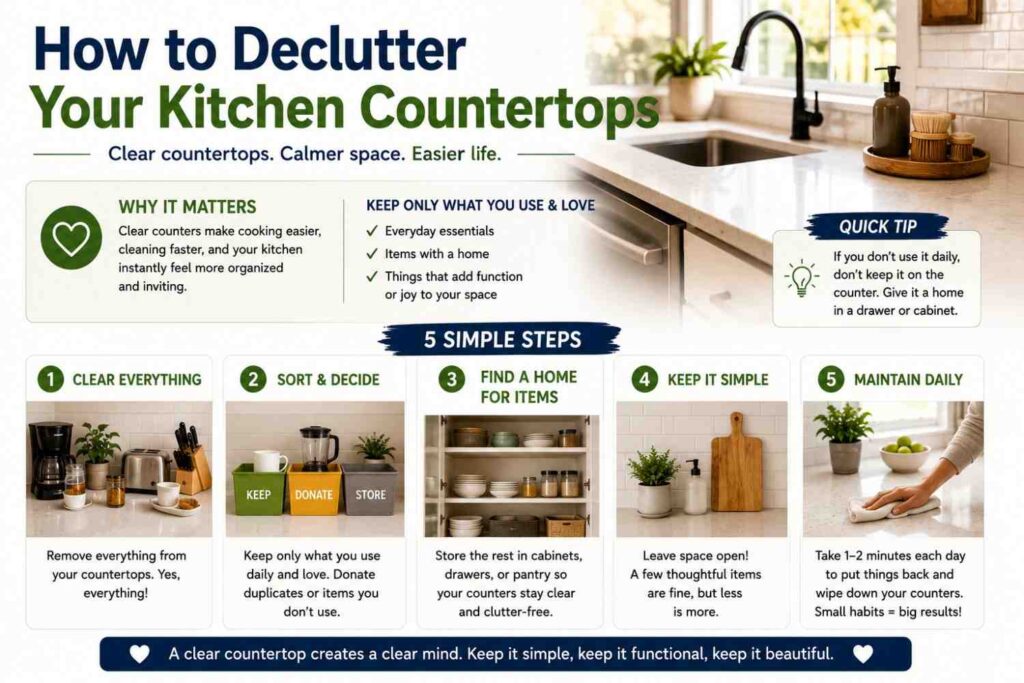
How to Declutter Your Kitchen Countertops
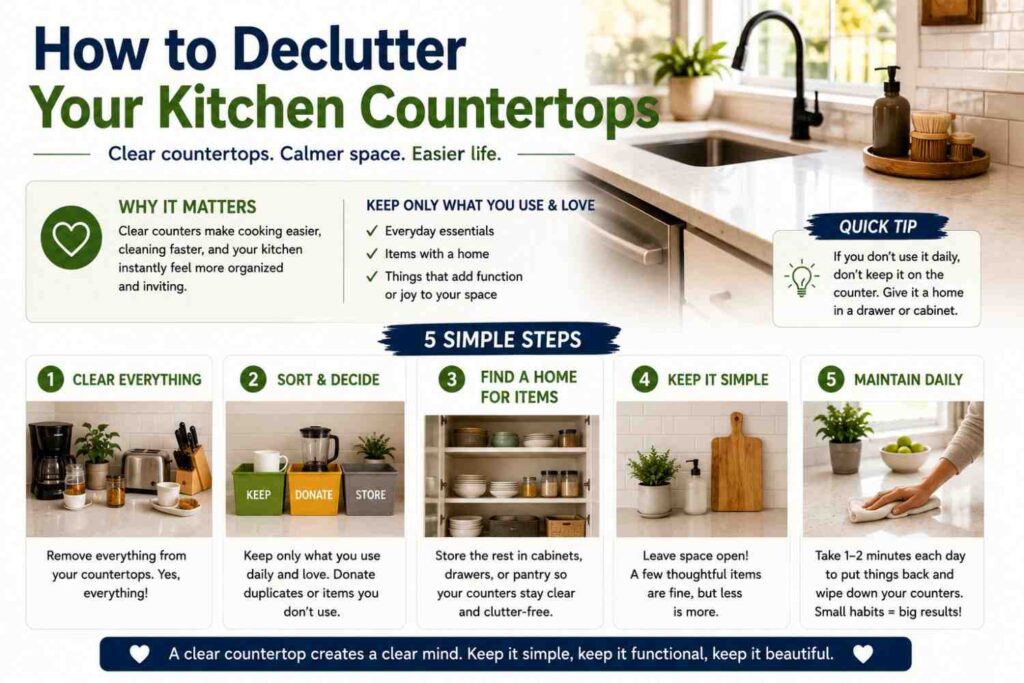
Countertops are where kitchen decluttering has the most immediate visual impact and where the discipline of how to declutter your kitchen is tested most directly. Every item on a kitchen counter should earn its place there by being used daily or near-daily. Anything used less frequently than that belongs in a cabinet, and anything rarely used at all belongs out of the kitchen entirely.
Clear everything off the counters completely. Every appliance, every utensil holder, every decorative item, every piece of mail that migrated from the entryway. Place everything on the kitchen table or another temporary surface and look at what you actually have.
Return to the counter only what you use every single day without exception. For most households this means the coffee maker, the toaster if used daily, and perhaps one or two other items specific to the household’s routine. Everything else gets a cabinet home or leaves the kitchen.
The items most commonly found on kitchen counters that do not belong there include small appliances used occasionally rather than daily, items in the wrong room entirely, mail and paperwork that have no business being in the kitchen, and things placed temporarily that became permanent. When you declutter your kitchen counters with honest daily-use as the standard, the visual result is dramatic and the functional improvement is immediate.
How to Declutter Your Kitchen Cabinets
The cabinet-by-cabinet approach is the core of how to declutter your kitchen effectively. Take each cabinet completely, sort what comes out, and return only what belongs.
Start with the cabinets you use most frequently, typically the ones directly above and below the main prep and cooking area. Remove everything and sort into three groups: keep because it is used regularly, consider because it is used occasionally, and remove because it has not been used in the past year or has a duplicate that serves the same purpose.
The keep group goes back into the cabinet in a logical arrangement with the most frequently used items at the most accessible height and position. The consider group gets a temporary home while you assess it honestly. If you have not reached for something from the consider group within the next month, it leaves the kitchen. The remove group goes directly to a donation box, a trash bag, or another room where it actually belongs.
Cookware and bakeware cabinets are where most households discover the real challenge of how to declutter your kitchen because they have significantly more than they need or use. Duplicate pans, bakeware for occasions that never occur, and pieces that do not stack or store well because they were purchased without consideration of what was already owned all accumulate in these cabinets. Keep the pieces you reach for regularly. Donate the duplicates and the rarely used items.
Dish and glass storage is another zone where excess accumulates quietly. Most households have more dishes, glasses, and mugs than they regularly use, often significantly more. When you declutter your kitchen dish storage, keep a set that covers your household’s realistic needs plus a reasonable guest capacity. The rest serves no purpose beyond occupying cabinet space.
How to Declutter Your Kitchen Drawers
Drawers are where the most chaotic kitchen clutter lives because they are easy to add things to and hard to see into clearly. When you declutter your kitchen drawers, the same remove-everything-first principle applies.
The utensil drawer is the most consistently cluttered drawer in most kitchens. Remove everything, wipe the drawer clean, and sort the contents on the counter. You will almost certainly find duplicate items, tools for cooking methods you do not practice, items belonging to sets long since incomplete, and things that ended up in the utensil drawer for no particular reason and stayed indefinitely.
Return only the utensils you actually use, arranged with a drawer divider so they stay accessible and organized. Anyone who has learned how to declutter your kitchen properly will tell you that drawer dividers are not optional. Without them the drawer returns to chaos within days regardless of how carefully it was initially organized.
The junk drawer deserves specific mention when thinking about how to declutter your kitchen because it exists in virtually every American household and it is one of the zones where the most clearly trash items accumulate alongside the few things that genuinely have no better home. Empty the junk drawer completely. Throw away the dead batteries, the dried-out pens, the mystery keys, and the accumulated receipts. Keep only the items that genuinely need a home and have no better one, and keep the quantity small enough that the drawer can be closed easily and the contents can be found without excavating.
How to Declutter Your Kitchen Pantry
The pantry is the kitchen zone where expired items, duplicate purchases, and impulse buys from grocery trips accumulate most invisibly. A thorough pantry declutter when you declutter your kitchen produces more cleared space than almost any other single zone.
Remove everything from the pantry and check every expiration date. Discard anything expired. Set aside anything that is not expired but that you are genuinely unlikely to use, whether because it belongs to a recipe phase that has passed, a dietary approach you no longer follow, or a purchase made without checking what was already in the pantry. Unopened non-perishable items in this category can be donated to a local food bank rather than discarded.
When you how to declutter your kitchen pantry properly, return items grouped by category with the most frequently used items at eye level and the most accessible positions. Baking supplies together, canned goods together, grains and pasta together, snacks together. This grouping makes it easier to see what you have when shopping and prevents duplicate purchases that contribute to future pantry clutter.
The USDA (https://www.usda.gov/foodsafety) provides guidance on food storage times that is useful when assessing pantry items whose expiration dates have passed or are not clearly marked. When in doubt about whether a food item is still safe, erring on the side of discarding rather than consuming is the right approach.
How to Declutter Kitchen Gadgets and Small Appliances
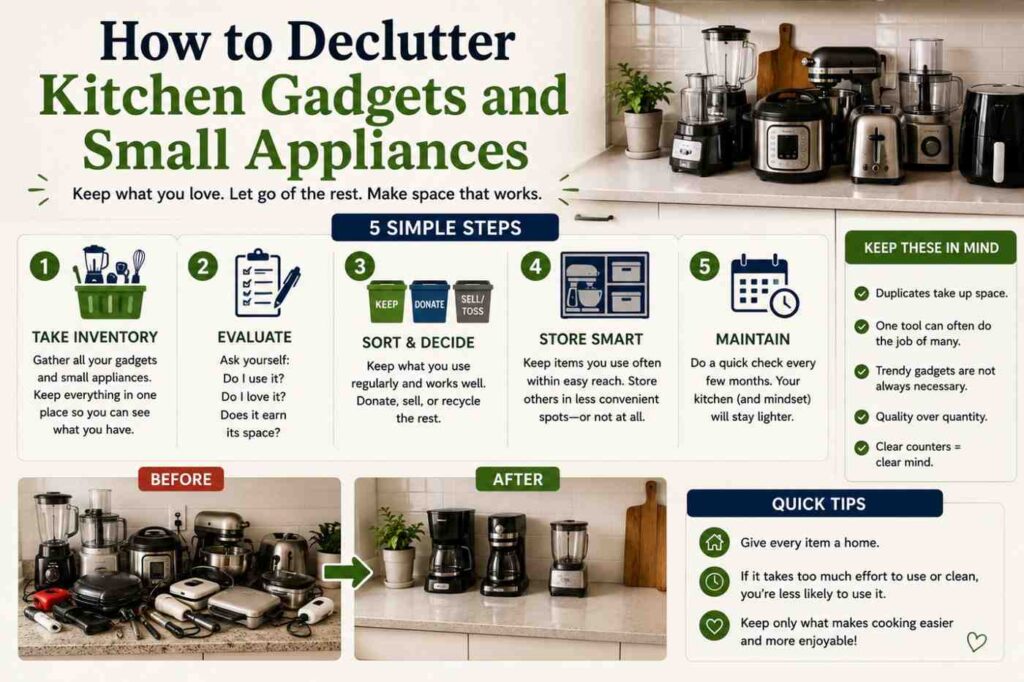
Gadgets and small appliances are the category most directly addressed by the honest assessment of how to declutter your kitchen effectively, because this is where the gap between what people own and what they actually use is widest.
When you how to declutter your kitchen gadget zone, evaluate every small appliance against one honest question: has this been used in the past year? Items used less than once per year occupy storage space every day in exchange for contribution that is at best occasional and at worst purely theoretical.
The bread machine, the pasta maker, the panini press, the quesadilla maker, the electric can opener sitting next to the perfectly functional manual one, the blender and the immersion blender and the food processor that largely duplicate each other’s functions. These are the items that make kitchen cabinets and counters feel overwhelming, and they are the items that most benefit from an honest once-per-year use standard.
Donate functional gadgets and appliances in good condition to Goodwill, a thrift store, or a local Buy Nothing group rather than discarding them. A bread machine that has not served your household in two years may be exactly what someone else’s household needs regularly. The American Cleaning Institute (https://www.cleaninginstitute.org) and kitchen organization experts consistently note that single-use gadgets are the leading driver of kitchen storage problems in American homes.
How to Keep Your Kitchen Decluttered After You Finish
Knowing how to declutter your kitchen gets you to a clean starting point. The habits below keep it there.
The one in one out rule is the most effective long-term maintenance principle for kitchen clutter. When a new item comes into the kitchen, whether a new pan, a new gadget, or a new set of glasses, an existing item of the same type leaves. This rule keeps the volume of kitchen possessions stable rather than allowing it to grow continuously.
Wipe down counters daily and return anything that does not belong there to its proper location before it becomes a permanent fixture. The mail that gets set on the counter once becomes the pile of mail that lives on the counter permanently through nothing more than repetition and inertia. Addressing misplaced items daily prevents this pattern.
Do a quick pantry check before grocery shopping. Opening the pantry before you leave for the store takes thirty seconds and prevents the duplicate purchases that gradually fill the pantry with items you already have.
Reassess and how to declutter your kitchen every six months. Habits change, cooking styles evolve, and items that were genuinely useful at one point become less so over time. A twice-yearly honest look at what is being used and what is not catches accumulation before it requires another full declutter session to address.
A kitchen that has been properly decluttered and maintained with consistent habits is one of the most tangible improvements available to any homeowner. Every task performed in it is faster, every meal easier to prepare, and every cleanup more straightforward. That is the payoff for figuring out how to declutter your kitchen the right way, and it is one that is felt every single day.