
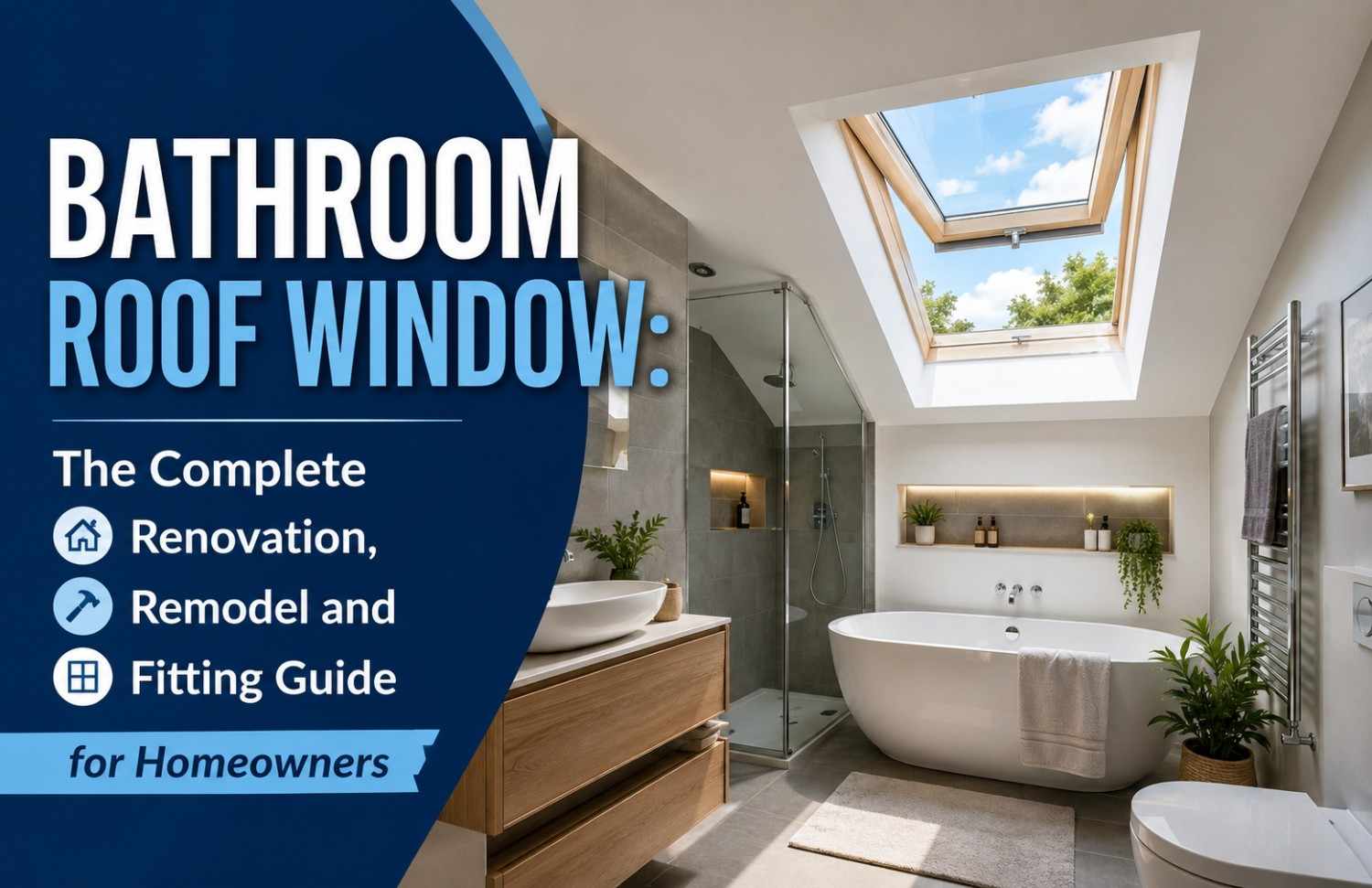
If your bathroom feels dark and stuffy no matter how much you clean it, the problem is not the paint color or the lighting fixture. The real issue is airflow and natural light, and the most effective fix is something most homeowners overlook entirely. Installing a bathroom roof window changes how the entire space feels, from the moment you walk in to the moment you step out after a hot shower.
This guide covers everything you need to know before starting your renovation, including types, fitting steps, costs, and the mistakes that turn a good project into an expensive repair.
Why a Bathroom Roof Window Makes Such a Big Difference

Most bathrooms are designed with privacy in mind, which means small or frosted wall windows that barely let in daylight. A bathroom roof window solves this without sacrificing any privacy at all, because it faces the sky rather than your neighbor’s yard.
Natural light from above is also far more powerful than light from a vertical wall window. Research shows that a roof-mounted window brings in roughly three times more daylight than an equivalent wall window of the same size. That means a single well-placed installation can brighten the entire room without any additional electrical work.
Beyond light, ventilation is where a bathroom roof window really earns its value. Bathrooms generate more moisture than almost any other room in the house. Without a proper way to release that steam, it settles into walls, ceilings, and grout lines, eventually creating mold that is expensive and difficult to remove. An operable roof window lets that warm, humid air escape directly upward, which is the most natural and efficient path it can take.
Skylight vs Roof Window: Understanding the Difference Before Your Remodel
These two terms get used interchangeably, but they refer to different products with different purposes.
A skylight is typically a fixed unit installed flush with the roofline. It does not open or opens only slightly. Skylights work well on flat or low-pitched roofs and are primarily designed to bring in light. They are simpler to install and cost less upfront.
A roof window is a fully operable unit that opens and closes like a regular window. It is installed at the same angle as a sloped roof and is designed for both light and strong ventilation. For bathroom renovations on homes with a pitched roof, a roof window is almost always the better choice because the ventilation benefit is so significant in a moisture-heavy space.
If you are planning a bathroom remodel and your home has a standard sloped roof, go with a roof window rather than a fixed skylight. The extra airflow alone justifies the difference in cost.
Types of Bathroom Roof Windows and What Each One Costs
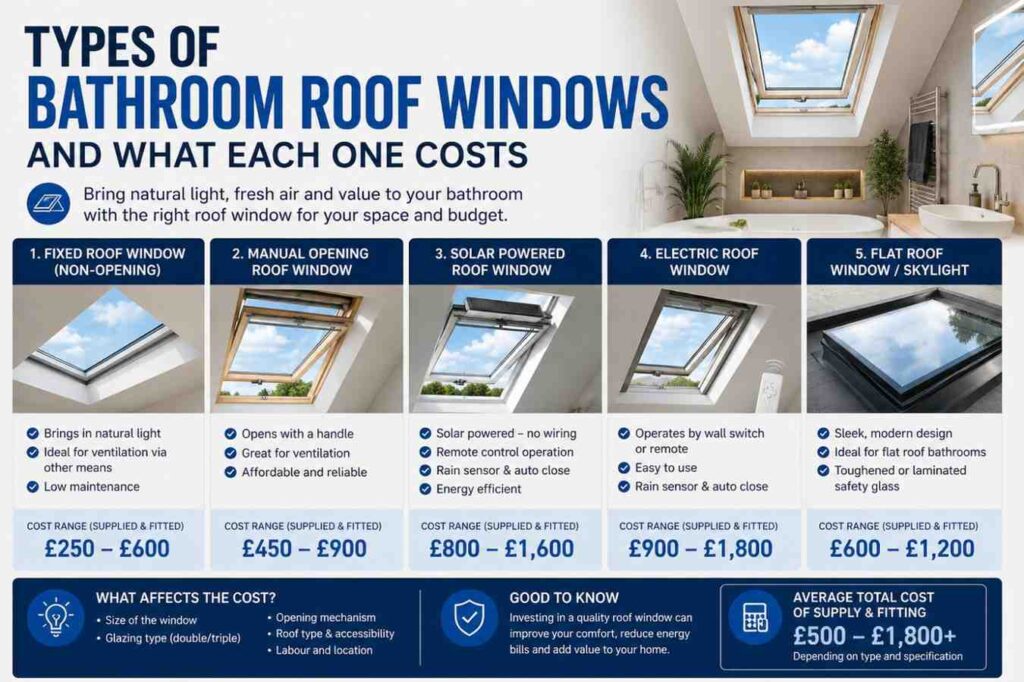
Choosing the right type before you start your renovation will save you from costly changes mid-project. Here is a breakdown of the main options available to US homeowners in 2025.
Fixed skylights do not open. They are the most affordable option and work well in bathrooms that already have strong mechanical ventilation. Expect to pay between $800 and $1,800 for professional installation, including materials.
Vented or operable roof windows are the most popular choice for bathroom renovations. They open manually or by remote control and provide genuine cross-ventilation. A standard installation runs between $1,500 and $3,000 depending on size, frame material, and roof complexity.
Solar-powered vented units operate automatically, often with built-in rain sensors that close the window when it starts raining. These are premium products and typically cost between $2,000 and $4,500 installed. They are eligible for federal energy tax credits, which brings the effective cost down meaningfully.
Tubular skylights are a compact option for bathrooms with limited ceiling space. A narrow tube channels daylight from the roof down into the room. They do not provide ventilation but are inexpensive, usually running between $500 and $1,000 installed, and require minimal structural work.
Full Cost Breakdown for a Bathroom Roof Window Renovation
Understanding where the money goes helps you plan your remodel budget accurately.
The window unit itself typically costs between $300 and $2,200 depending on type and brand. Labor for a straightforward replacement installation runs $300 to $700. A brand new installation, which requires cutting into the roof and building a proper framed opening, adds another $500 to $1,500 in structural work. If your bathroom ceiling is flat and sits below a sloped roof, you will need a light shaft built to connect the two, which adds another $300 to $800 in interior finishing costs.
Replacing an existing bathroom roof window in the same opening is significantly more affordable than a new installation because you skip most of the structural work. For a standard replacement, most homeowners spend between $700 and $1,500 all in.
One thing worth noting is the return on investment. According to the National Association of Realtors, homeowners recover 60 to 75 percent of skylight installation costs at resale. Real estate data also suggests that a well-placed skylight or roof window adds between one and three percent to a home’s overall value. On a $400,000 home, that is up to $12,000 in added value from a single renovation project.
How a Bathroom Roof Window Is Fitted: Step by Step
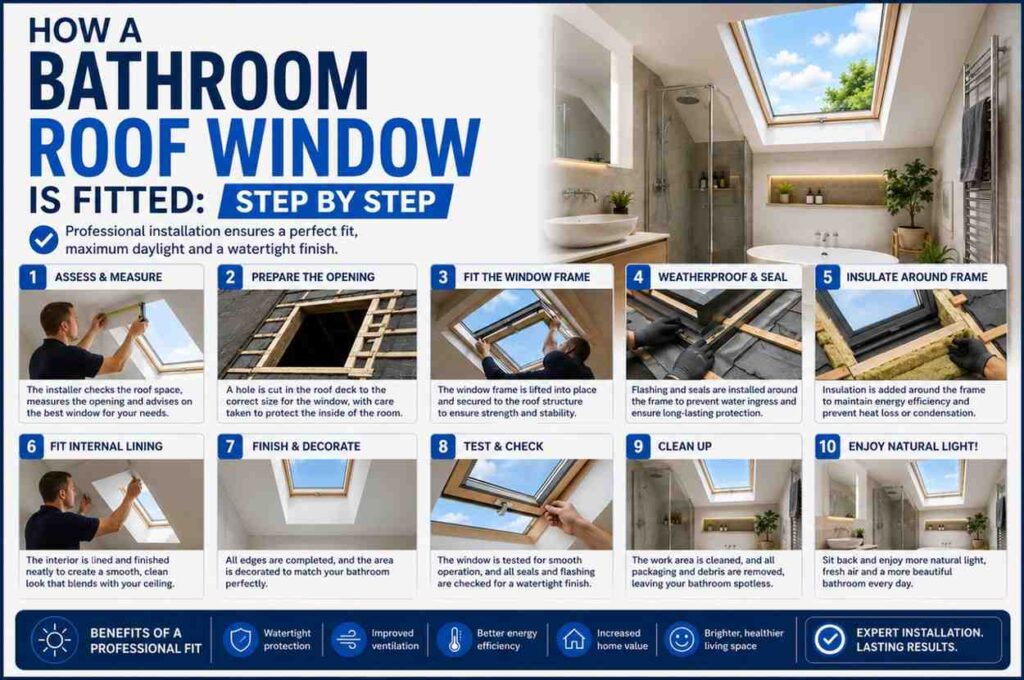
Understanding the installation process helps you ask better questions when hiring a contractor and know whether the work is being done correctly.
The first step is a roof and bathroom assessment. A contractor looks at your roof pitch, the structure above the bathroom ceiling, and the best placement for light and airflow. Placement decisions made at this stage affect performance for the entire life of the window.
Next comes the structural framing. An opening is cut in the roof deck and reinforced with a proper framed rough opening. This framing must be solid and square, because everything else depends on it.
The window unit is then set into the opening and secured. This is followed by flashing installation, which is the most critical part of the entire fitting process. Flashing is the waterproof metal system that seals the gap between the window frame and the surrounding roofing material. Poor flashing is the number one cause of skylight leaks and the most common mistake in DIY installations.
If a light shaft is needed, drywall framing is built inside the ceiling to create a tunnel that guides light from the roof opening down into the bathroom. Interior finishing, including drywall, paint, and trim, completes the inside work.
For motorized or solar-powered units, electrical connections are made before the interior is closed up. The final step is a thorough waterproofing test and a check of all opening and closing mechanisms.
DIY or Hire a Professional for Your Bathroom Roof Window Fitting
The honest answer is that most bathroom roof window installations should be handled by a professional, especially if the job involves cutting a new opening in the roof.
DIY makes sense only in limited situations, such as replacing an existing unit in the same opening on a roof you are comfortable working on, and only if you have genuine roofing and carpentry experience. The flashing work in particular requires skill and precision. A small mistake there can allow water into your walls or ceiling, leading to structural damage and mold that costs far more to fix than the installation savings.
If you are doing a full bathroom remodel and adding a new bathroom roof window to the plan, factor professional installation into the budget from the start. The peace of mind and the warranty coverage are worth it.
Top Brands to Consider for Your Bathroom Renovation
VELUX is the most recognized name in this category in the United States. Their Fresh Air Skylight systems are specifically designed for bathroom use, with features that manage condensation and moisture actively. For most bathroom renovations, VELUX is the benchmark to compare others against.
Fakro offers strong competition at a slightly lower price point and is worth looking at if budget is a concern without wanting to sacrifice quality. Sun-Tek is a reliable option for fixed skylights. Solatube specializes in tubular models for compact bathroom spaces. Andersen brings premium build quality with strong energy performance ratings.
Mistakes That Turn a Good Renovation Into a Costly Problem
Skipping proper flashing or using inadequate materials is the most expensive mistake homeowners make. Water damage from a poorly sealed bathroom roof window can cost thousands to repair and may not show up until months after installation.
Choosing a fixed skylight when the bathroom actually needs ventilation defeats a major purpose of the renovation. In a moisture-heavy space, always prioritize an operable unit unless a strong mechanical exhaust system is already in place.
Ignoring roof type compatibility is another common oversight. Metal roofs require deck-mounted units, while tile and shingle roofs support different installation methods. Confirming compatibility before purchasing any product saves time and money.
Finally, not checking local permit requirements can create problems during a home sale. Many US municipalities require a permit for any roof penetration. A quick call to your local building department before the project starts keeps everything above board.
Frequently Asked Questions
Can any bathroom have a roof window installed?
Most bathrooms can support a roof window, but the roof pitch, ceiling structure, and space above the bathroom all affect what is possible and what it will cost. A professional site assessment gives you an accurate answer for your specific home.
How long does a bathroom roof window installation take?
A standard professional installation takes one to two days. Jobs that require a new structural opening, a light shaft, and full interior finishing can take three to five days.
Will a roof window cause leaks in my bathroom?
Not when installed correctly with proper flashing and quality materials. Leaks happen when installation is rushed or when aging seals are not maintained. A reputable contractor will warranty their flashing work.
What size works best for a standard bathroom?
Most bathroom renovations use units between 21 by 38 inches and 30 by 46 inches. A 24 by 48 inch opening typically provides strong light and ventilation for a mid-sized bathroom without requiring major structural changes.
Does a bathroom roof window help with mold?
Yes, significantly. An operable roof window removes warm, moist air directly from the space where it builds up, which is the primary condition that allows mold to grow. Combined with proper cleaning habits, it is one of the most effective long-term solutions for bathroom mold prevention.
If you found this guide useful, explore more renovation tips and home improvement ideas at TidyUpHome.com.
1 thought on “Bathroom Roof Window: The Complete Renovation, Remodel and Fitting Guide for Homeowners”