

Nobody buys a home planning to neglect it. But between busy schedules, competing priorities, and the simple fact that most home problems develop invisibly until they become impossible to ignore, home maintenance mistakes happen in virtually every American household. The difference between the homeowners who spend thousands on emergency repairs and the ones who do not is rarely knowledge. It is awareness of exactly which home maintenance mistakes are the most expensive and which ones are easiest to avoid.
This guide covers the ten home maintenance mistakes that consistently cost homeowners the most money, why each one happens, and what to do instead.
1. Ignoring Gutter Maintenance
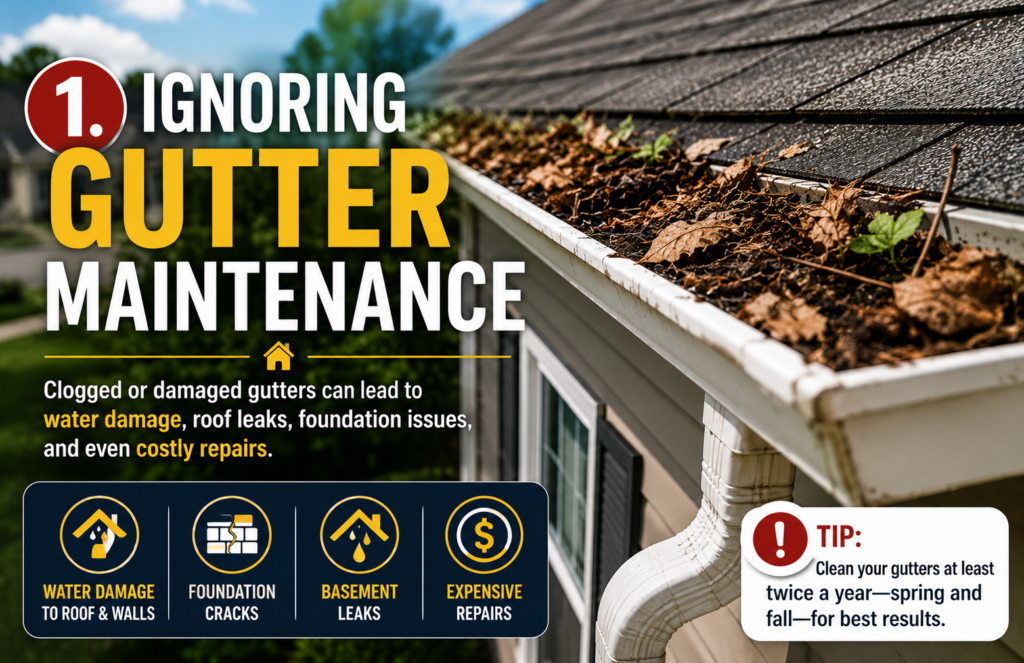
Of all the home maintenance mistakes on this list, neglecting gutters is the one that damages the most parts of a home simultaneously. Clogged gutters cause water to overflow down exterior walls, pool at the foundation, back up under roof shingles, and saturate the fascia and soffit boards behind the gutter itself. A single neglected gutter system can simultaneously damage the roof, the siding, the foundation, and the landscaping.
The cost of cleaning gutters twice a year is minimal. The cost of repairing the foundation damage, wood rot, and water intrusion that follows years of neglected gutters routinely runs into the thousands, and in serious cases into the tens of thousands.
According to the National Association of Home Builders (https://www.nahb.org), water intrusion driven by improper drainage is one of the leading causes of structural damage in American residential properties. Gutter neglect is one of the most direct contributors to that statistic.
How to avoid it: Clean gutters in late spring and late fall every year without exception. Check that downspouts extend at least four to six feet from the foundation and that water is directed away from the house on all sides. Install gutter guards if you have heavy tree coverage to reduce the frequency of cleaning required.
2. Skipping Annual HVAC Maintenance
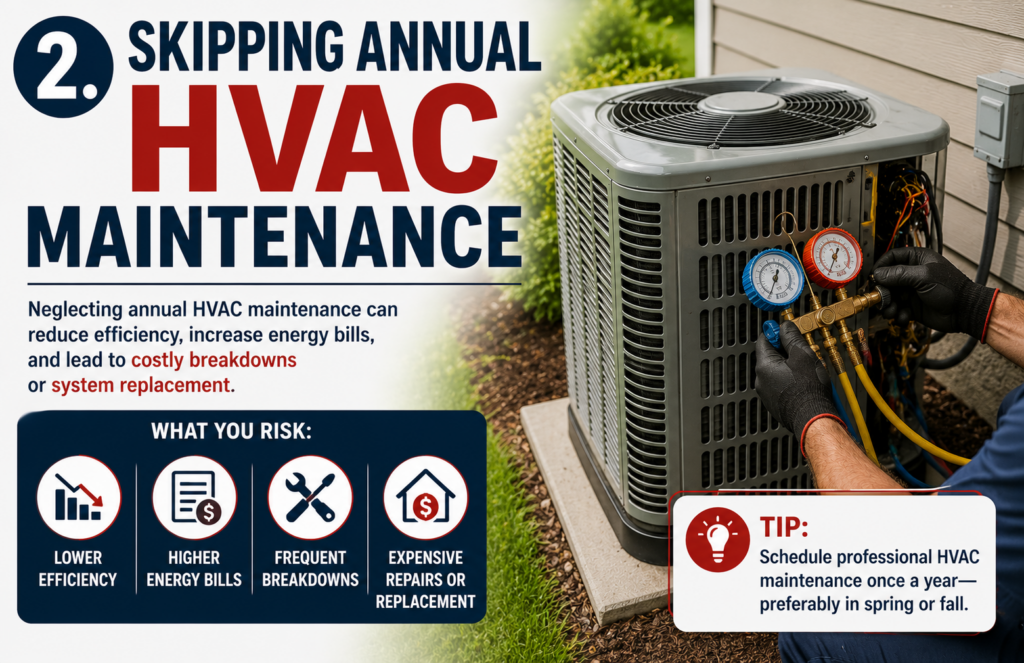
The HVAC system is the most expensive mechanical system in most American homes, and skipping annual professional maintenance is one of the home maintenance mistakes that costs homeowners money in two distinct ways. First, an unmaintained system runs less efficiently and consumes more energy every month it operates. Second, the small problems that a professional catches during a tune-up become major component failures when they go undetected.
A capacitor that costs $25 to replace during a scheduled maintenance visit becomes a compressor replacement costing $1,500 or more when it fails and takes the compressor with it. A clogged condensate drain line that takes five minutes to clear during a service call becomes a ceiling repair when it overflows. These are not unusual scenarios. They are the routine outcome of skipping HVAC maintenance over multiple seasons.
Replacing an air filter every one to three months is the single most impactful thing a homeowner can do between professional service visits. A clogged air filter restricts airflow, forces the system to work harder, reduces efficiency, and accelerates wear on every component in the system. It is also one of the home maintenance mistakes that is most baffling to HVAC professionals because the fix costs a few dollars and takes two minutes.
How to avoid it: Schedule professional HVAC maintenance once a year, in spring for cooling systems and in fall for heating systems. Replace air filters every one to three months depending on filter type and household conditions. Keep the area around the outdoor condenser unit clear of debris and vegetation.
3. Failing to Caulk and Seal Around Windows and Doors
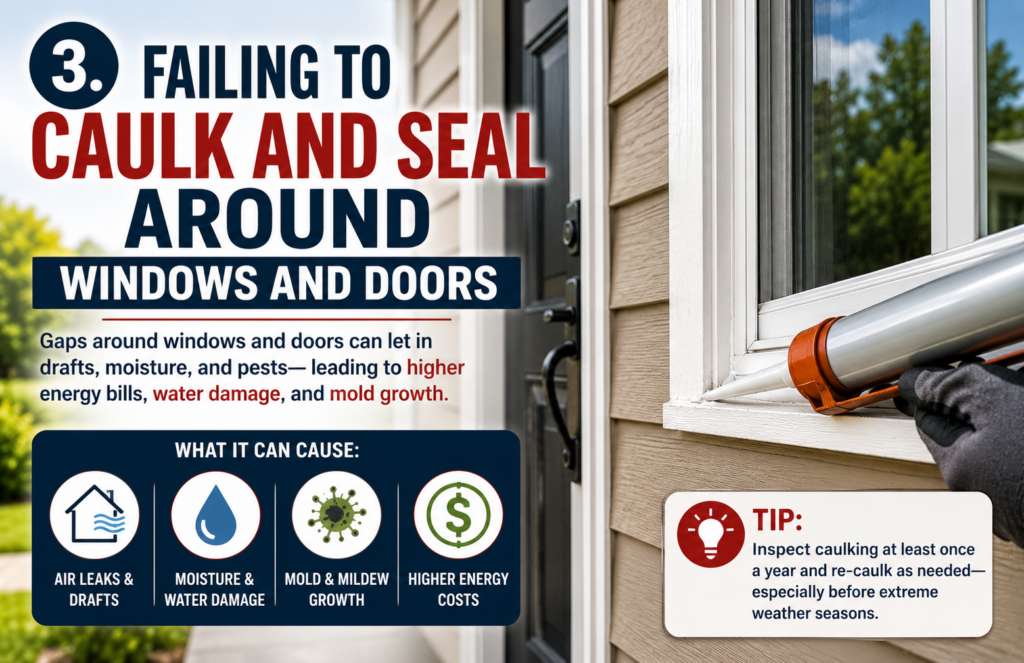
The caulking and weatherstripping around your windows and doors is doing two jobs simultaneously: keeping conditioned air inside the home and keeping water outside it. When caulking cracks, separates, or deteriorates, both jobs fail at the same time, and the result is higher energy bills and a pathway for water to reach the wall assembly behind the siding.
This is one of the home maintenance mistakes that homeowners most commonly defer because the consequences develop slowly and invisibly. Air escaping through gaps around a window does not announce itself. Water entering through failed caulking works its way into the wall framing and insulation without producing any visible sign until rot and mold are already well established.
The U.S. Department of Energy (https://www.energy.gov/energysaver/air-sealing-your-home) estimates that air leaks around windows, doors, and other penetrations account for 25 to 40 percent of the energy used for heating and cooling in a typical American home. Re-caulking and weatherstripping is one of the highest-return maintenance investments available to homeowners on an annual basis.
How to avoid it: Inspect all caulking around windows, doors, and exterior penetrations every fall. Press on the caulk with your finger. If it is hard, cracked, or separating from the surface, remove it completely and replace it with a fresh bead of exterior-grade caulk. Check weatherstripping on all exterior doors by closing the door on a piece of paper. If the paper slides out without resistance, the weatherstripping needs replacement.
4. Letting Small Roof Issues Become Large Ones
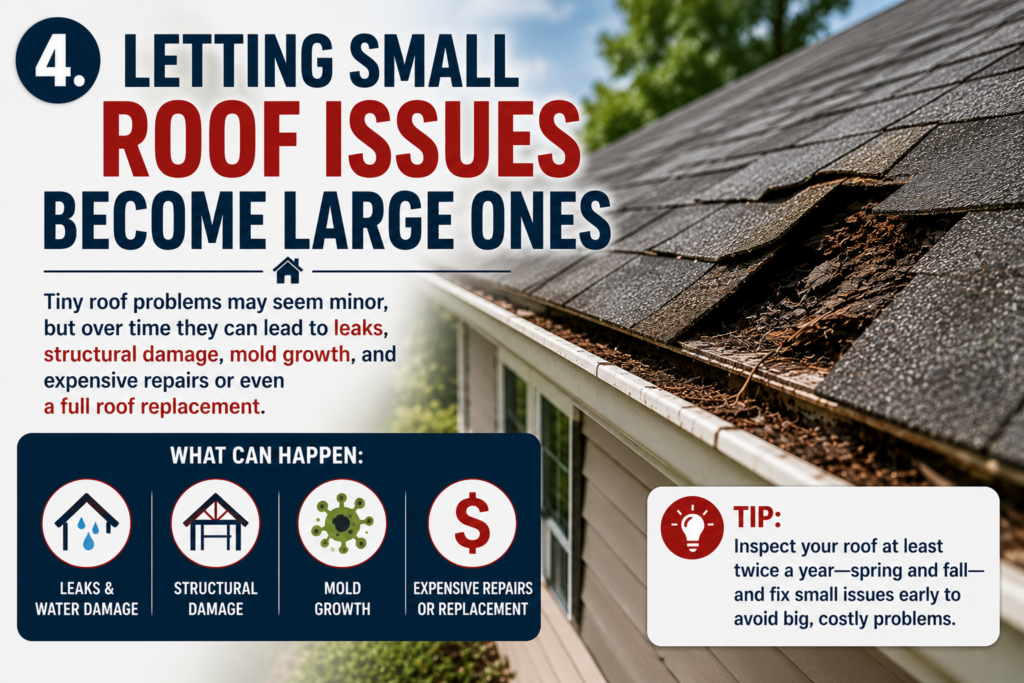
The roof is the area where home maintenance mistakes are most expensive, and the reason is straightforward: water that enters through a compromised roof does not stay at the point of entry. It travels along rafters, soaks into insulation, damages drywall, and eventually shows up as a stain on a ceiling that is nowhere near the actual entry point. By the time a roof leak is visible from inside the home, significant damage has already occurred above the ceiling.
A missing shingle, cracked flashing, or small area of damage that costs a few hundred dollars to repair becomes tens of thousands of dollars in roof decking replacement, insulation replacement, and interior repair when it is ignored for a season or two. This is one of the home maintenance mistakes where the gap between the cost of prevention and the cost of repair is widest.
How to avoid it: Inspect your roof from the ground with binoculars every spring and fall. Look for missing, curled, or cracked shingles, damaged flashing around chimneys, skylights, and vent pipes, and any areas where the roof surface appears to sag or dip. Have a licensed roofing contractor address any concerns before the next rainy season. A roof inspection from a qualified professional costs little to nothing and identifies issues while they are still minor.
5. Not Knowing Where the Main Water Shut-Off Is
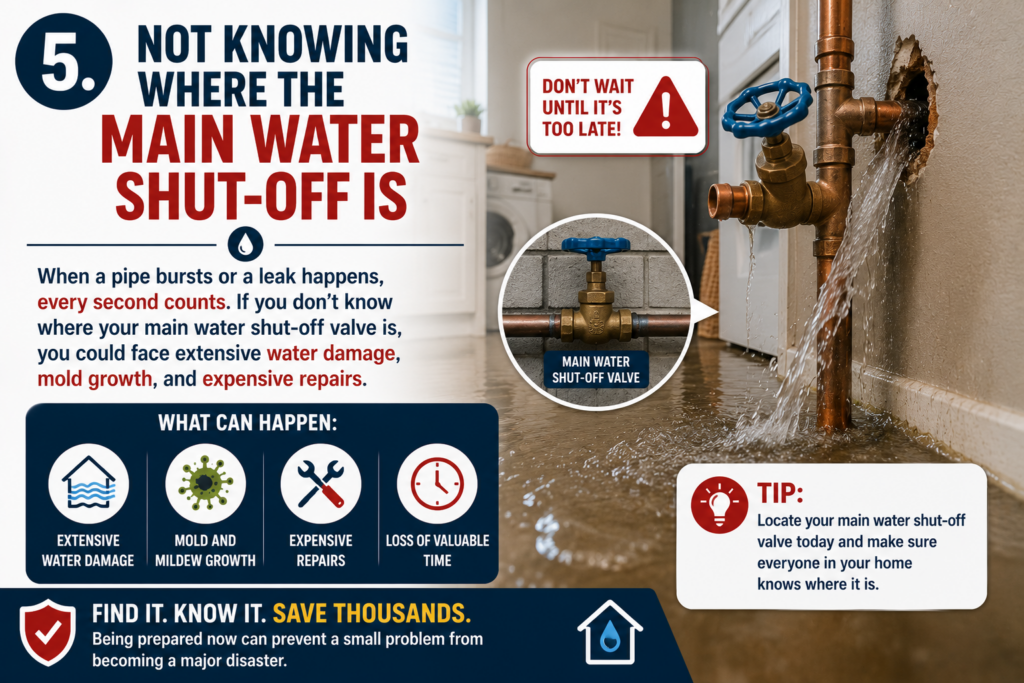
This entry is different from the others on this list because it is not a maintenance task that gets skipped. It is a piece of knowledge that most homeowners simply do not have, and the absence of it turns a manageable water emergency into a catastrophic one.
When a pipe bursts, a supply line fails, or a fixture malfunctions and releases water at full pressure, every second that passes before the water is shut off is more damage to your floors, walls, ceilings, and belongings. A homeowner who knows exactly where the main shut-off is and can operate it immediately limits the damage dramatically. A homeowner who spends ten minutes searching while water pours across the floor does not.
The Insurance Information Institute (https://www.iii.org) identifies pipe bursts and supply line failures as among the most damaging water events in residential properties, and the severity of the damage correlates directly with how quickly the water supply is stopped.
How to avoid it: Locate your main water shut-off valve today if you do not know where it is. In most American homes it is located near the front foundation wall in the basement or utility area, or near the water meter outside. Make sure every adult in the household knows its location and can operate it. Consider installing a smart water shut-off that can be operated remotely from your phone in the event of an emergency when no one is home.
6. Overlooking Dryer Vent Cleaning
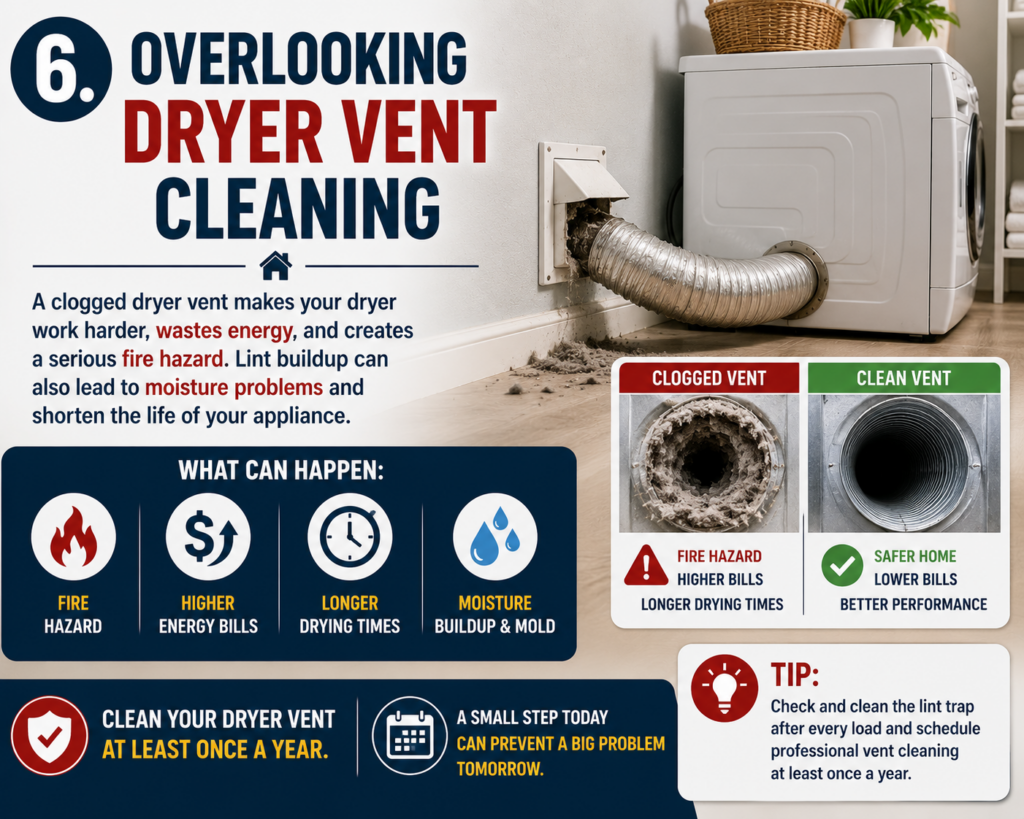
Dryer vent cleaning is one of the home maintenance mistakes that most homeowners have never even considered, and it is also one of the most genuinely dangerous to overlook. Lint accumulates in the dryer vent duct with every load of laundry, gradually restricting airflow and creating a highly flammable deposit inside the vent.
The U.S. Fire Administration (https://www.usfa.fema.gov) reports that dryers cause approximately 2,900 home fires annually in the United States, resulting in deaths, injuries, and over $35 million in property damage. Failure to clean the dryer vent is identified as the leading cause. This is a fire risk that develops quietly in a location most homeowners never inspect, from a cause most homeowners are unaware of.
Beyond the fire risk, a restricted dryer vent forces the dryer to run longer to dry each load, increasing energy costs and accelerating wear on the heating element and motor.
How to avoid it: Clean the dryer vent duct at least once a year. Disconnect the dryer from the duct connection at the back and use a dryer vent cleaning brush kit, available at any hardware store, to clean the full length of the duct from the dryer to the exterior vent cap. Check that the exterior vent flap opens freely when the dryer is running and is not blocked by debris or a bird nest.
7. Ignoring Signs of Pest Activity
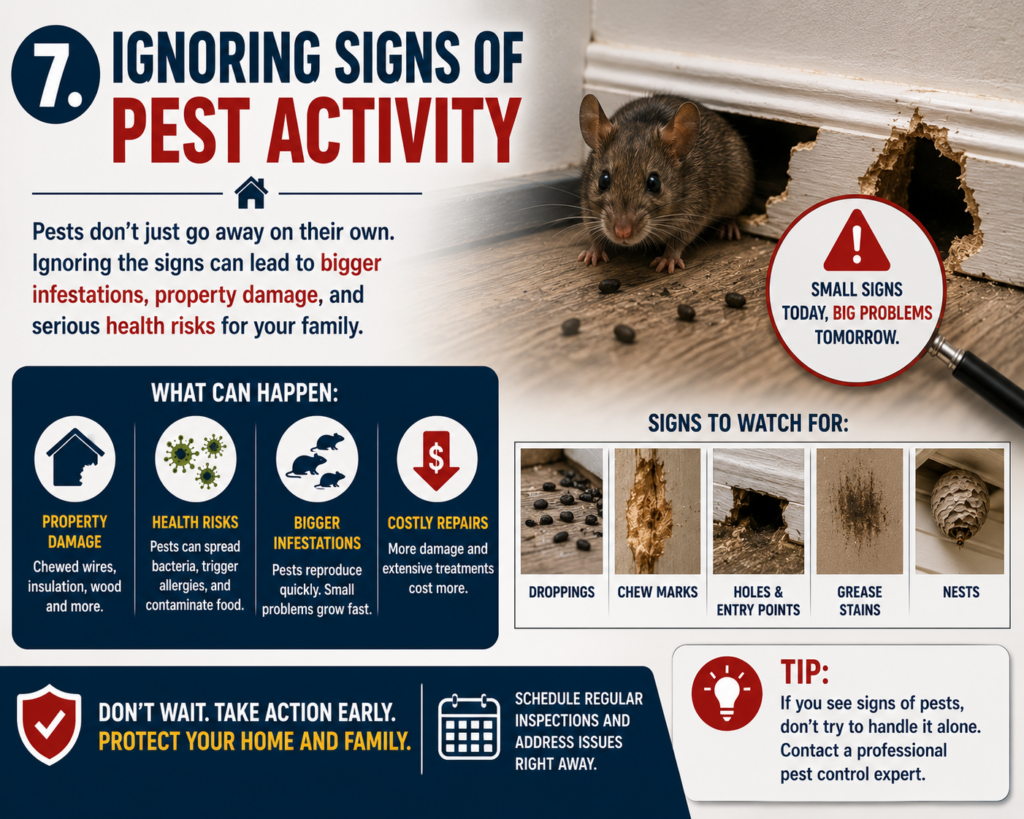
Pest damage is one of the home maintenance mistakes that homeowners most commonly rationalize away. A few ants in the kitchen becomes a minor nuisance. A mouse in the garage becomes something that will sort itself out. Evidence of termites gets dismissed as old damage that is no longer active. These rationalizations are expensive.
Termites alone cause an estimated $5 billion in property damage in the United States every year according to the National Pest Management Association (https://www.npmapestworld.org), and the vast majority of that damage is not covered by standard homeowner insurance policies because termite damage is classified as a maintenance issue rather than a sudden loss.
The common thread in serious pest damage is that the signs were present long before the damage became severe, and those signs were either not noticed or not acted upon. Wood that sounds hollow when tapped, mud tubes along foundation walls, frass that looks like sawdust near wood structures, and unexplained damage to wood framing are all signs that require immediate professional assessment.
How to avoid it: Have a licensed pest inspector assess your home annually, particularly if you live in a region with active termite populations. Address any entry points that give pests access to the home interior, including gaps around utility penetrations, damaged screens, and cracks in the foundation. Do not ignore signs of pest activity and assume they will resolve on their own.
8. Skipping the Smoke and Carbon Monoxide Detector Check
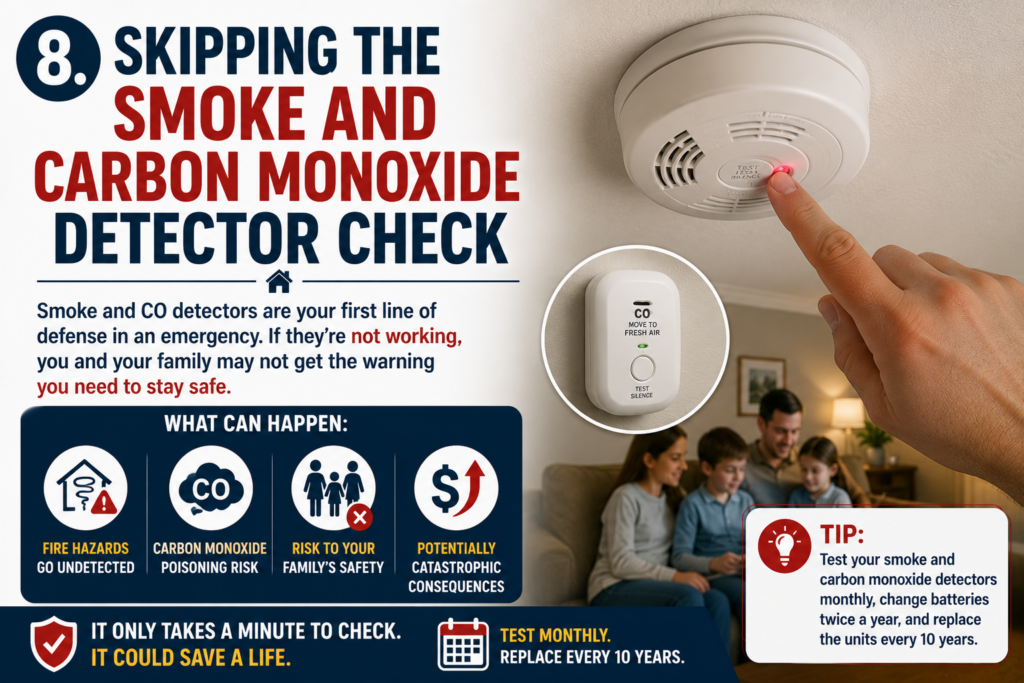
This is the home maintenance mistake with the most serious potential consequences. Smoke detectors and carbon monoxide detectors save lives, and detectors with dead or missing batteries save no one.
The National Fire Protection Association (https://www.nfpa.org) recommends testing smoke detectors monthly, replacing batteries annually, and replacing the entire detector unit every ten years. Despite these straightforward guidelines, the NFPA estimates that nearly two-thirds of home fire deaths occur in homes with no working smoke alarms.
Carbon monoxide detectors are equally important and even more commonly overlooked. Carbon monoxide is odorless and colorless, and the symptoms of CO poisoning, including headache, dizziness, and confusion, are easily attributed to other causes until exposure reaches dangerous levels.
How to avoid it: Test every smoke detector and carbon monoxide detector in your home monthly by pressing the test button. Replace batteries annually on a fixed date, such as when clocks change for daylight saving time, so the habit is attached to a consistent reminder. Replace detector units every ten years and mark the installation date on the unit with a permanent marker.
9. Letting Exterior Paint and Siding Deteriorate
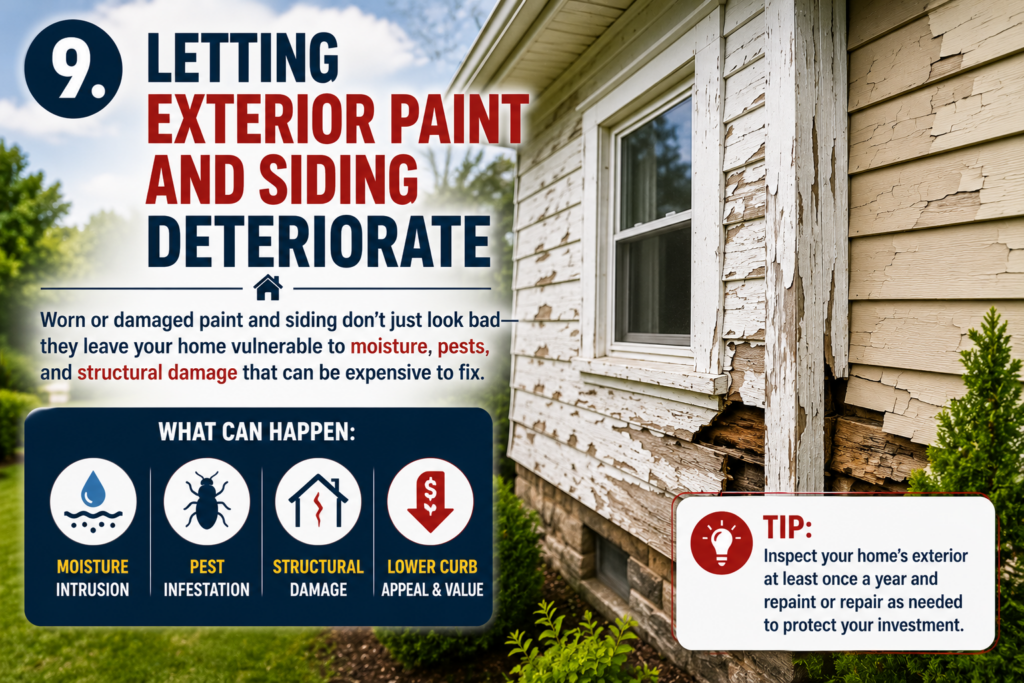
The paint and siding on your home’s exterior are not primarily aesthetic. They are the moisture barrier that protects the wall assembly, insulation, and framing behind them from the weather. Allowing exterior paint to peel or siding to crack, rot, or separate is one of the home maintenance mistakes that creates a direct pathway for water to reach structural components.
Wood that is exposed to moisture because the paint barrier has failed begins to rot. Rot spreads. By the time rot is visible on the exterior surface, it has typically penetrated significantly into the surrounding wood. What appears to be a surface repainting project frequently reveals underlying rot that requires board replacement before new paint can be applied.
How to avoid it: Inspect exterior paint and siding annually and address any areas of peeling, cracking, or physical damage promptly. Repainting before paint fails completely is significantly less expensive than repainting after rot has developed beneath it. Caulk any gaps between siding boards and around windows and doors where the siding meets other surfaces.
10. Not Maintaining the Water Heater
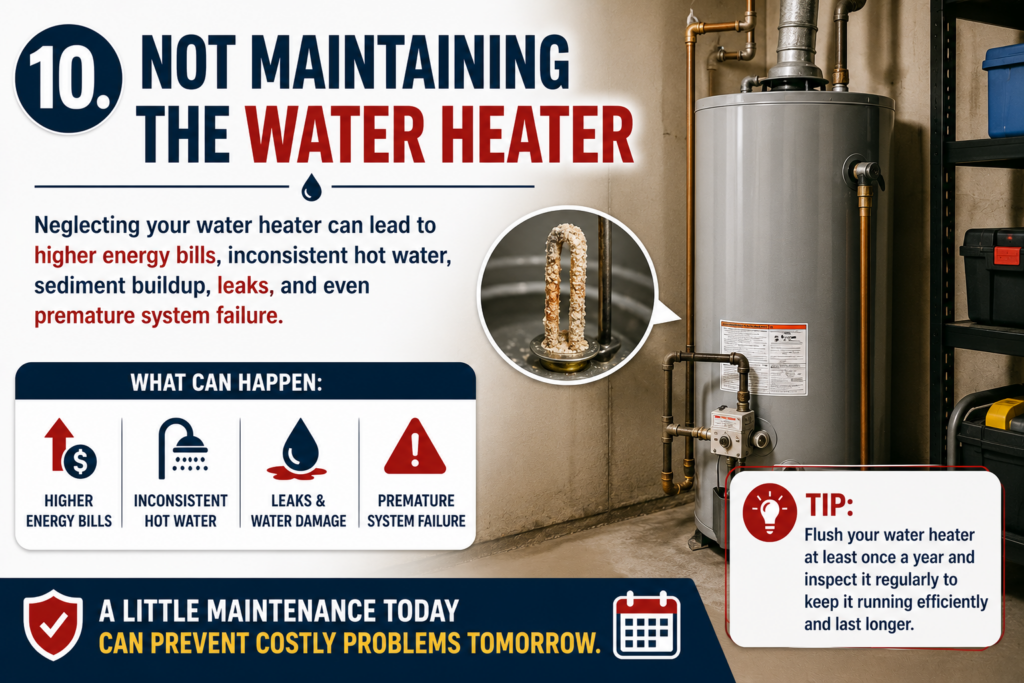
The water heater is one of those appliances that works silently in a utility closet until it does not, and by the time it fails, it often does so in a way that releases its entire tank volume onto the floor. A 50-gallon water heater failure in a finished basement is a significant water damage event, and it is almost always preceded by warning signs that went unnoticed because no one was looking.
Sediment accumulation at the bottom of the tank is the primary cause of premature water heater failure. As sediment builds up, it insulates the water from the heating element, forcing the element to work harder and reducing efficiency. The knocking or rumbling sound that a water heater makes when sediment is significant is a clear sign that maintenance is overdue.
How to avoid it: Flush the water heater annually to remove sediment by connecting a hose to the drain valve and running water through the tank until it runs clear. Test the pressure relief valve annually to confirm it opens and closes freely. Inspect the exterior of the tank for any rust staining, corrosion, or moisture at the base. A water heater approaching ten years of age that shows any of these signs should be proactively replaced rather than waiting for a failure.
The Cost of Home Maintenance Mistakes Versus the Cost of Prevention
Look at every home maintenance mistake on this list and a pattern emerges. In every single case, the cost of the preventive action is a small fraction of the cost of the repair it prevents. Gutter cleaning versus foundation repair. HVAC filter replacement versus compressor replacement. Annual roof inspection versus interior water damage remediation.
Home maintenance mistakes are rarely the result of not caring about the home. They are the result of not knowing which tasks matter most and what happens when they are skipped. Now that you have that picture clearly, the path forward is straightforward: build the preventive habits, stay consistent with them, and let the homeowners who skip these steps fund the repair industry instead of you.