
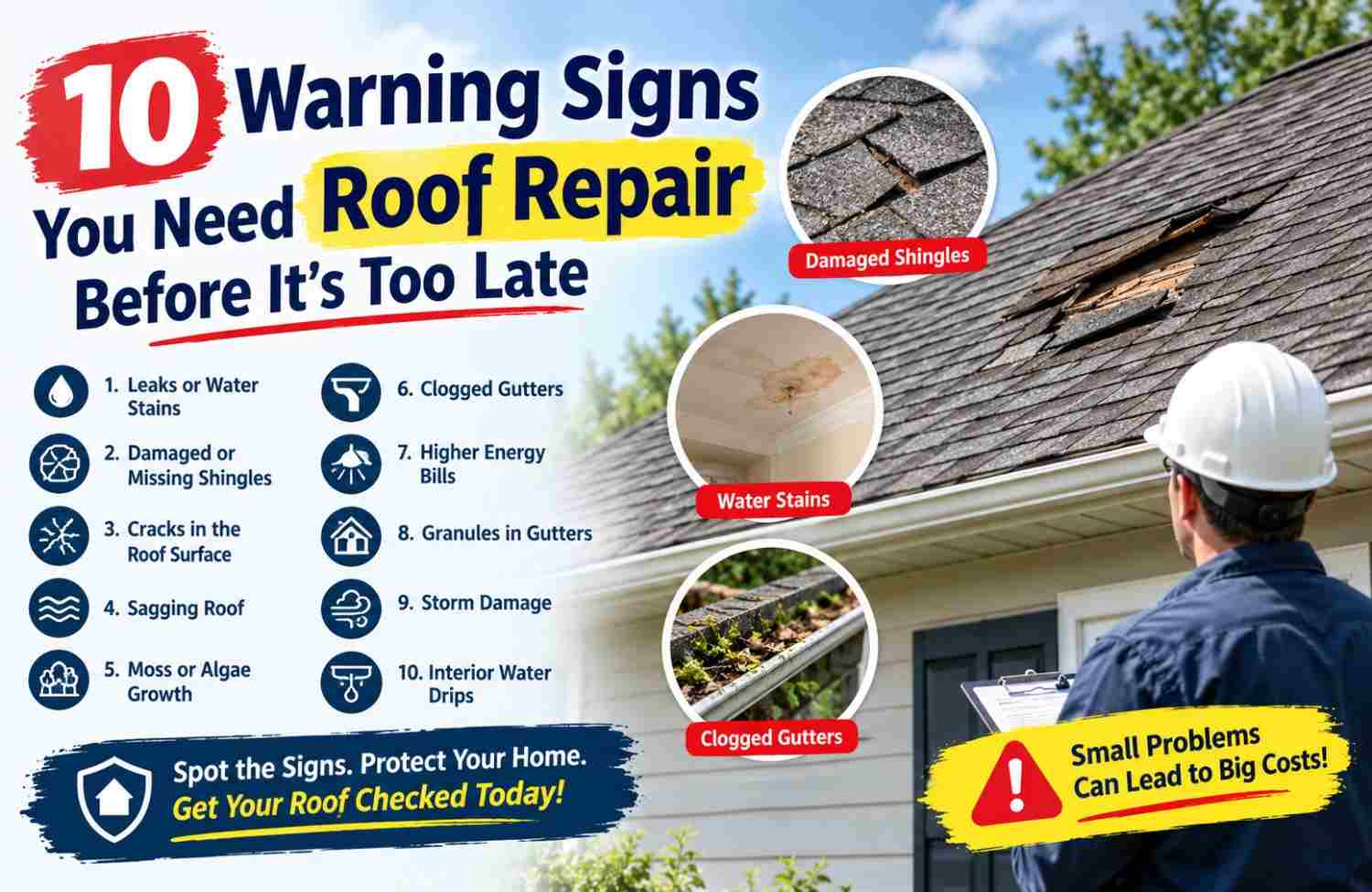
Your roof is the single most important protective barrier your home has against the outside world, yet most homeowners never think about it until water is dripping onto the living room ceiling. By the time that happens, what started as a simple roof repair job has often turned into a full roof replacement costing thousands of dollars more. The good news is that a roof rarely fails without warning. It sends signals for months, sometimes years, before a real emergency develops. Learning to read those signals is the difference between a quick, affordable roof repair and a devastating financial surprise.
In this guide, we will walk through the ten most reliable warning signs that tell you it is time to schedule roof repair. Whether you own an asphalt shingle roof, a metal roof, or a tile roof, these signs apply across almost every roofing material found on homes throughout the United States. Catching roof damage early not only saves money, it protects your family’s health, your home’s structural integrity, and the resale value of your property.
Why Timely Roof Repair Matters So Much
Before we get into the specific warning signs, it helps to understand why acting quickly on roof repair makes such a big difference. A small roof leak might seem like a minor annoyance, but water finds the path of least resistance. Once moisture gets past your shingles or roofing membrane, it can travel along rafters and joists, soaking insulation, staining drywall, and creating the perfect environment for mold growth. According to the Environmental Protection Agency, indoor mold growth caused by unresolved moisture problems can trigger allergic reactions and respiratory issues in sensitive individuals, which is one more reason to treat roof damage as a priority rather than something to put off.
Delaying roof repair also tends to multiply costs. A single cracked shingle might cost very little to fix today. Left alone through a few seasons of rain, snow, and freeze thaw cycles, that same weak point can lead to rotted decking, damaged trusses, and ruined insulation that all need to be replaced along with the shingle. Homeowners who stay alert to early warning signs and schedule roof repair promptly almost always spend less over the life of their roof than those who wait for a crisis.
1. Shingles That Are Curling, Cracking, or Buckling
One of the clearest signs that your roof needs attention is the condition of the shingles themselves. Healthy asphalt shingles should lie flat against the roof deck. When shingles begin to curl at the edges, crack across the surface, or buckle in the middle, they are no longer creating a tight seal against wind driven rain. Curling usually happens near the end of a shingle’s lifespan, but it can also appear early if the shingles were installed over poor ventilation or if moisture is trapped underneath.
If you notice a handful of curling or cracked shingles scattered across the roof, targeted roof repair replacing just those shingles can often solve the problem. If curling shingles cover large sections of the roof, that is usually a sign the whole roofing system is aging out and a broader roof repair plan, or eventually a full replacement, should be discussed with a licensed roofing contractor.
2. Missing or Loose Shingles After a Storm
High winds, hail, and heavy storms are some of the most common triggers for emergency roof repair calls. After any significant weather event, it is worth doing a visual inspection from the ground with binoculars, or hiring a professional to check the roof for you. Missing shingles leave the underlying roof deck completely exposed to rain and sun, which can lead to a leak within days rather than months.
Loose shingles are just as concerning as missing ones, even though they are easier to overlook. A shingle that has come partially unsealed will flap in the wind, wearing down its own edges and the shingles around it. Prompt roof repair after storm damage is one of the most cost effective moves a homeowner can make, and many home insurance policies specifically cover storm related roof repair, so it is worth documenting the damage with photos and contacting your insurer.
3. Granules Collecting in Gutters or Downspouts
Asphalt shingles are coated with small mineral granules that protect the underlying asphalt layer from ultraviolet rays and help shed water. As shingles age, these granules naturally begin to wear off. A small amount of granule loss is normal, especially on a brand new roof during the first year as excess loose granules wash away. However, if you start finding large amounts of granules piling up in your gutters, at the base of downspouts, or in puddles near your foundation after rain, it is a strong signal that your shingles are deteriorating and roof repair should be scheduled soon.
Heavy granule loss exposes the asphalt layer underneath to direct sunlight, which accelerates drying, cracking, and brittleness. Roofing professionals often use granule loss as one of the key indicators when deciding whether a roof needs spot roof repair or full replacement, so tracking how much material is collecting in your gutters over time gives you an early warning that is easy to monitor yourself.
4. Visible Sagging Anywhere on the Roofline
A roof should always present a straight, even line when viewed from the street or the yard. Any dip, sag, or wave in the roofline is a serious warning sign that should never be ignored. Sagging usually points to structural problems underneath the surface, such as weakened decking, deteriorated rafters, or trapped moisture that has been sitting in the same spot for a long time.
Because sagging often indicates the roof deck itself is compromised, this is one situation where roof repair needs to happen quickly, before the weak area grows larger or, in the worst cases, collapses under the weight of snow or standing water. If you notice a sag, it is best to have a structural inspection completed as soon as possible rather than simply patching the surface, since the underlying support needs to be addressed as part of any lasting roof repair.
5. Water Stains on Ceilings or Walls
By the time water stains appear on an interior ceiling or wall, moisture has already made its way through your roofing system and insulation. These stains often show up as yellowish, brown, or copper colored rings, sometimes with a slightly raised or bubbled texture in the drywall or paint. A single stain does not necessarily mean a catastrophic leak, but it does confirm that water is getting in somewhere, and that roof repair is overdue rather than optional.
Tracking down the exact source of a ceiling stain can be tricky, because water often travels sideways along rafters before dripping down in a spot far from the actual entry point. This is one of the main reasons homeowners hire a roofing professional rather than trying to guess where to apply sealant. An experienced roofer can trace the path of the leak and complete the correct roof repair the first time, instead of patching the wrong section and dealing with the same stain reappearing after the next rainstorm.
6. Daylight Visible Through the Roof Boards
If you ever go into your attic during the daytime and see pinpricks or larger gaps of light coming through the roof boards, that is an unmistakable sign that roof repair is needed immediately. Any place where light can get in is also a place where wind, rain, snow, and pests can get in. This kind of damage is often caused by rotted or warped decking, gaps around vent pipes and chimneys, or nail holes left exposed after shingles shifted out of place.
Attic inspections are one of the most underused tools homeowners have for catching roof problems early. A quarterly walk through the attic with a flashlight, checking for daylight, damp insulation, or a musty smell, can reveal issues long before they show up as ceiling stains inside the living space. Catching these small gaps early usually means a quick and inexpensive roof repair rather than a major overhaul.
7. Higher Than Normal Energy Bills
A roof in poor condition does more than let water in. It also lets conditioned air escape and outside temperatures seep through, forcing your heating and cooling system to work harder. If your energy bills have crept up noticeably without a clear explanation such as a rate increase or extreme weather, damaged roofing and compromised attic insulation are worth investigating. The Department of Energy notes that a well sealed, properly insulated roof and attic system plays a major role in a home’s overall energy efficiency, since heat naturally rises and escapes through any weak points at the top of the house.
While rising energy bills alone will not tell you exactly where the problem is, they are a useful piece of the puzzle. Combined with any of the other signs on this list, unusually high heating or cooling costs are a good reason to schedule a professional roof inspection and address roof repair needs before winter or summer extremes make the problem worse.
8. Moss, Algae, or Fungal Growth on the Roof Surface
A little bit of moss or algae growth, especially on the shaded, north facing side of a roof, is common in humid climates and does not automatically mean disaster. However, thick moss growth can trap moisture against the shingle surface, slowly breaking down the protective granules and shortening the lifespan of the roofing material. Dark streaks are often caused by algae, while thicker, cushion like growth usually indicates moss that has been developing for a while.
If left unaddressed, moss can lift shingle edges as it grows, creating small gaps where wind driven rain can get underneath. Professional roof repair services can safely remove moss and algae without damaging the shingles, and can also recommend zinc or copper strips near the roof ridge, which slowly release ions that discourage new growth. Regular cleaning paired with prompt roof repair of any lifted shingles keeps moss from turning into a long term structural problem.
9. Deteriorated Flashing Around Chimneys, Vents, and Skylights
Flashing is the thin metal material installed around roof penetrations, such as chimneys, plumbing vents, skylights, and where two roof sections meet at a valley. Flashing is designed to direct water away from these vulnerable transition points, but it is also one of the most common places roofs develop leaks. Over time, flashing can rust, crack, or pull away from the surrounding roofing material due to age, thermal expansion, and contraction, or improper installation in the first place.
Because flashing failures are localized, they are often one of the more affordable roof repair jobs a contractor handles, but they still require prompt attention. A gap of even a quarter inch around a chimney or vent pipe is enough to let significant water into the attic during a heavy storm. If you notice rust streaks, visible gaps, or flashing that looks bent or lifted when viewed from the ground or a ladder, add it to your roof repair checklist right away.
10. Your Roof Has Reached or Passed Its Expected Lifespan
Sometimes the clearest warning sign has nothing to do with visible damage and everything to do with age. Most asphalt shingle roofs are designed to last between twenty and thirty years, depending on the quality of materials and how well the attic is ventilated. Wood shake roofs typically last around thirty years, while metal and tile roofs can last fifty years or more with proper maintenance. If you know or can find out how old your roof is, and it is approaching or has passed the upper end of its expected lifespan, it is worth having a professional evaluate whether targeted roof repair can extend its life a bit further or whether replacement is the smarter long term investment.
An aging roof does not fail all at once. It becomes more prone to leaks, more likely to lose shingles in a storm, and less efficient at protecting your insulation. The Federal Emergency Management Agency has noted that regular roof maintenance is one of the most effective ways homeowners can reduce storm related property damage, since a roof already weakened by age is far more vulnerable to wind and hail than a newer, well maintained one. Scheduling an annual inspection as your roof approaches the fifteen or twenty year mark helps you plan for roof repair or replacement on your own timeline, rather than being forced into an emergency decision after a storm.
How Often Should You Inspect Your Roof
Most roofing professionals recommend a visual roof inspection at least twice a year, typically in spring and fall, along with a check after any major storm involving high winds, hail, or heavy snow load. Spring inspections catch any damage that developed over the winter, while fall inspections make sure the roof is ready to handle snow and ice before the cold season arrives. Keeping a simple log of what you observe each time, including photos, makes it much easier to spot new roof repair issues as they develop rather than after they have already caused interior damage.
When to Call a Professional for Roof Repair
While homeowners can safely spot many of the warning signs described above from the ground or through an attic inspection, actually walking on a roof and performing repairs is best left to trained professionals with the right safety equipment. A licensed roofing contractor can also spot problems that are not obvious to an untrained eye, such as deteriorated underlayment, improperly nailed shingles, or ventilation issues that are shortening the life of the roof. When you do hire a contractor, ask for proof of licensing and insurance, request a written estimate that clearly separates materials and labor, and get everything in writing before roof repair work begins.
Final Thoughts on Catching Roof Damage Early
A roof rarely fails without giving you a chance to catch the problem first. Curling or missing shingles, granule buildup in the gutters, sagging rooflines, water stains, daylight in the attic, rising energy bills, moss growth, damaged flashing, and simple old age are all signals worth taking seriously. Addressing roof repair needs as soon as you notice these warning signs protects your home from expensive structural damage, keeps your family healthier by preventing mold growth, and stretches the useful life of your roofing investment as far as it can go. A little vigilance now, paired with timely roof repair when something looks off, will save you far more than the cost of ignoring the problem and hoping it goes away on its own.
1 thought on “10 Warning Signs You Need Roof Repair Before It’s Too Late”