
Open any kitchen cabinet in the average American home and you will find the same story. Items stacked behind other items. Duplicate pans wedged in sideways. Containers without lids and lids without containers. Appliances bought with good intentions and used exactly twice. The cabinet closes with a little effort and the problem disappears until the next time it needs to be opened.
Most homeowners know they need to how to declutter your kitchen cabinets but keep putting it off because the job feels overwhelming. Every cabinet is its own small disaster, and when you multiply that by every cabinet in the kitchen, the total feels impossible to address in a single session.
The truth is that learning how to declutter your kitchen cabinets is not complicated. It is just a matter of working through one cabinet at a time with a clear process and honest criteria for what stays and what goes. This guide gives you exactly that, with specific steps for every type of cabinet in your kitchen and the habits that keep them organized once the work is done.
Why Kitchen Cabinets Get So Cluttered in the First Place
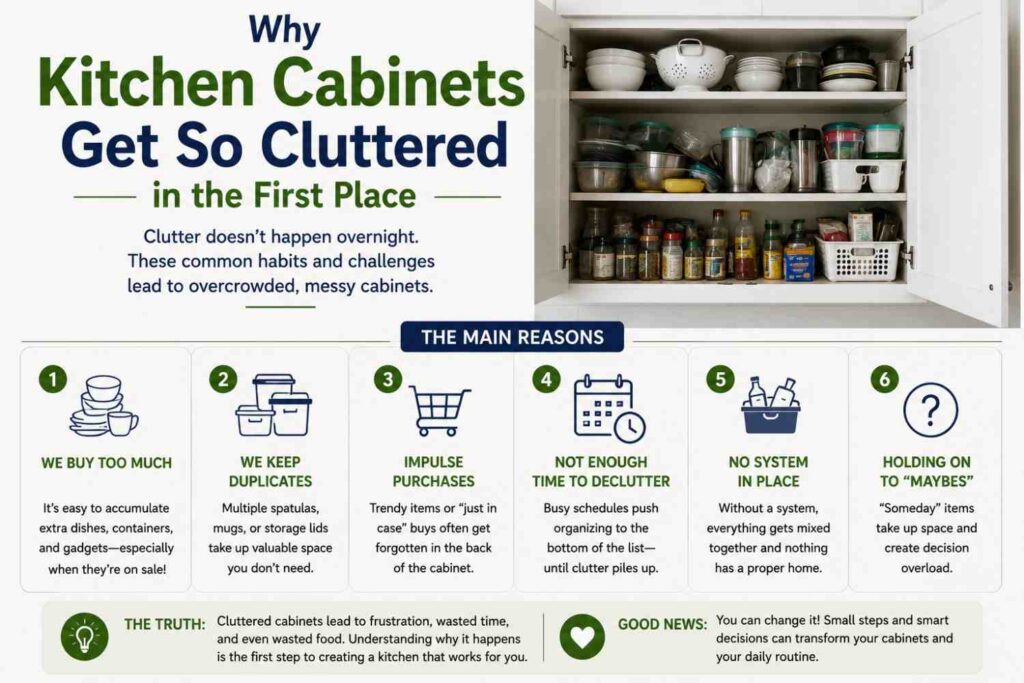
Before getting into how to declutter your kitchen cabinets, it helps to understand why they get cluttered in the first place. Kitchen cabinets fill up for three consistent reasons that affect almost every household regardless of how organized the residents consider themselves.
The first reason is that putting something into a cabinet is always easier than deciding what to do with it. When a new item comes into the kitchen, it goes into the cabinet. When an old item is no longer used, it stays in the cabinet because removing it requires a decision. Over time, cabinets accumulate new arrivals without ever losing the old occupants, and the available space shrinks continuously.
The second reason is that kitchen items feel perpetually useful even when they are not being used. A gadget not touched in eighteen months still feels like it might be needed for a specific recipe. A set of dishes used only at holidays feels wrong to remove even though they occupy space every day of the year. This sense of potential future utility keeps items in cabinets long past the point where they are contributing anything to how the kitchen actually functions.
The third reason is that kitchen cabinets are out of sight most of the time. Unlike a cluttered countertop, a cluttered cabinet is invisible when the door is closed. The problem does not generate daily frustration and therefore does not generate the daily motivation to address it. Knowing how to declutter your kitchen cabinets means deciding to address the invisible clutter before it reaches the point where the cabinet physically cannot close anymore.
The Right Approach to Declutter Your Kitchen Cabinets
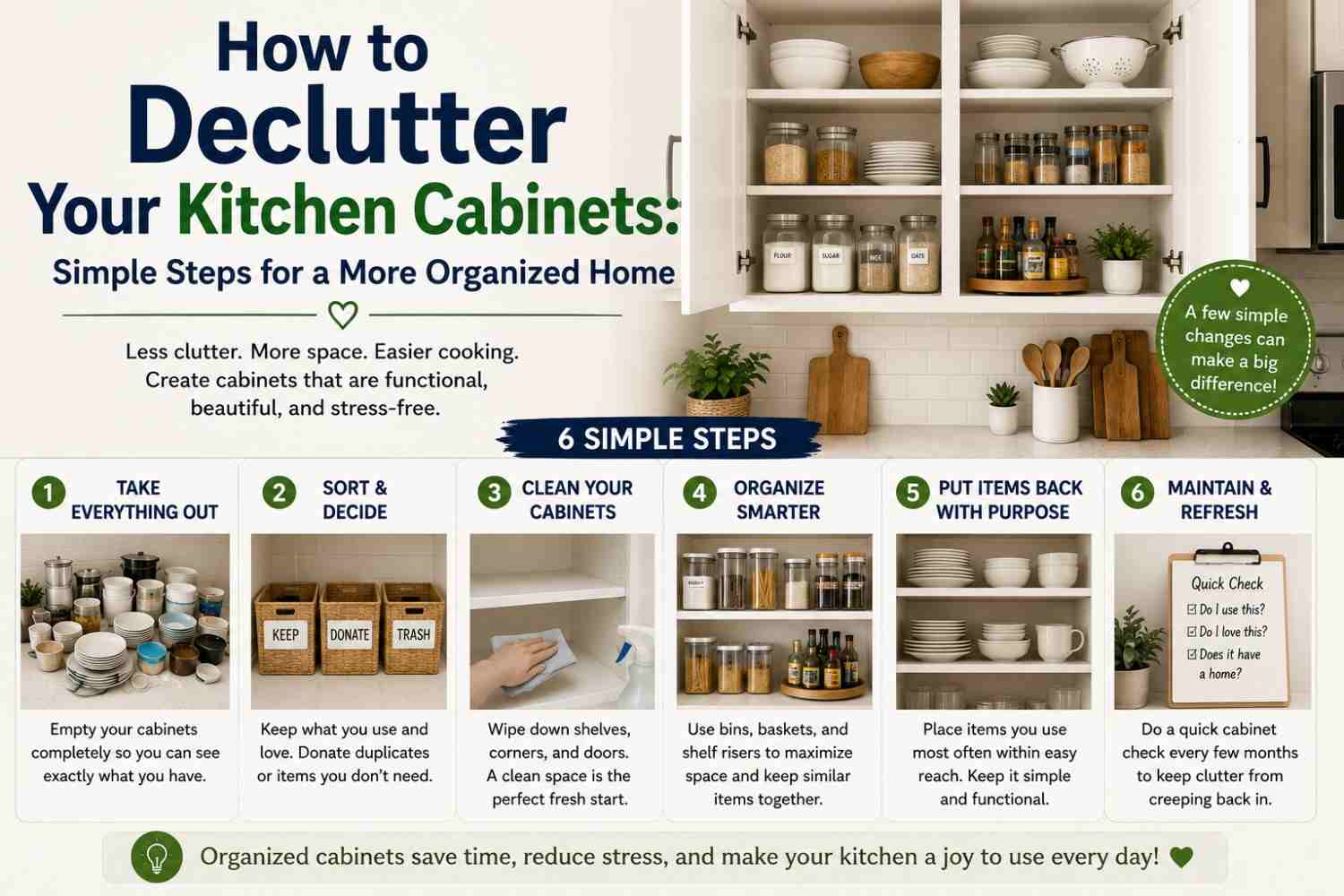
The method you use when you how to declutter your kitchen cabinets matters as much as the decision criteria you apply. The right approach produces results that last. The wrong approach produces a briefly organized cabinet that returns to its original state within weeks.
The most important rule is to empty each cabinet completely before deciding what goes back. This is the step most people skip when they try to how to declutter your kitchen cabinets because it feels like unnecessary extra work. It is not. When you remove everything from a cabinet and see the full contents laid out on the counter at once, duplicates become obvious, forgotten items become visible, and the decision about what actually earns its space becomes significantly clearer.
Work one cabinet at a time and finish it completely before moving to the next. Starting several cabinets simultaneously and addressing each one partially creates kitchen-wide chaos without producing any finished result. The visible progress of completing one cabinet at a time is what keeps the energy going through the full session.
Have donation boxes, trash bags, and a relocation area ready before you start. Every item that comes out of a cabinet needs to go somewhere specific. Items without a destination end up on the counter, which creates the appearance of a kitchen in worse shape than when you started and makes it harder to see the progress you are actually making.
Apply the one year rule as your primary decision criterion when you how to declutter your kitchen cabinets. If an item has not been used in the past year and is not a genuinely seasonal item needed for a specific annual occasion, it is a strong candidate to leave the cabinet. This rule removes the need to make a complex individual judgment about every item and replaces it with a simple factual question that has a clear answer.
How to Declutter Your Kitchen Cabinets: Cookware and Bakeware
Cookware and bakeware cabinets are typically the most physically challenging to how to declutter your kitchen cabinets because the items are heavy, awkward to handle, and tend to be stored in ways that make accessing anything without moving everything else impossible.
Remove every pan, pot, lid, baking sheet, casserole dish, and roasting pan from the cabinet. Stack them on the counter or kitchen table so you can see the full inventory at once. Most households discover at this point that they own significantly more cookware than they realized, and that the collection includes multiple pieces serving the same function.
Sort what you have pulled out into three groups. The first group is the pieces you reach for regularly, the pans that come out multiple times per week, the baking sheets used consistently, the pot that handles most of your stovetop cooking. These earn their space without question.
The second group is the pieces used occasionally but genuinely, perhaps once a month or for specific seasonal cooking. These stay but should be stored at less accessible locations, upper shelves or the back of lower cabinets, rather than occupying prime space.
The third group is everything else. Duplicate pieces serving the same purpose as something in the first group, bakeware for recipes you have never made and are unlikely to make, pieces that do not stack well and therefore disrupt the storage of everything around them, and items that came with sets where other pieces have since been lost or discarded. This group leaves the cabinet.
When you how to declutter your kitchen cabinets in the cookware zone, return items in a logical nesting arrangement with lids stored separately in a lid organizer or in the same cabinet vertically rather than stacked on top of pans. This single organizational change makes accessing cookware significantly faster and prevents the avalanche effect that happens when one item is moved and everything else shifts.
The National Kitchen and Bath Association (https://nkba.org) recommends storing cookware within two steps of the primary cooking surface so that reaching for a pan during cooking does not require moving across the kitchen. When you return items to the cabinet after decluttering, placement matters as much as selection.
How to Declutter Your Kitchen Cabinets: Dishes, Glasses, and Mugs
Dish and glass storage is the cabinet zone where most American households have the widest gap between what they own and what they actually use. The combination of sets purchased at different times, individual pieces accumulated without replacing the set, and items kept for hypothetical large gatherings creates a dish cabinet that is consistently over capacity.
When you how to declutter your kitchen cabinets in this zone, start by counting what you actually use on a daily basis. For most households this is a realistic number based on how many people live in the home and how often dishes are washed rather than accumulated. A two-person household that runs the dishwasher every one to two days realistically needs eight to ten plates at most. The additional pieces beyond that realistic number are candidates to leave.
Mugs deserve specific attention because mug accumulation is one of the most universal kitchen storage problems in American homes. Mugs arrive as gifts, as souvenirs, from promotional events, and from sets where other pieces have broken, and they almost never leave unless someone actively decides how to declutter your kitchen cabinets with mugs in mind. Count your mugs. Decide how many your household realistically uses. Donate the rest without guilt.
Mismatched items from sets that are no longer complete, glasses with chips or cracks that make them unsuitable for use, and serving pieces that have not been used in the past year all belong in the donate or discard category when you how to declutter your kitchen cabinets in this zone.
Return dishes and glasses to the cabinet arranged by frequency of use, with everyday items at the most accessible height and guest or occasional pieces stored higher or toward the back. Cabinet shelf risers create additional vertical storage in dish cabinets and make better use of the available space after decluttering reduces the total volume of items being stored.
How to Declutter Your Kitchen Cabinets: Food Storage Containers
Food storage containers, also known as the cabinet that avalanches when opened, are one of the most universally chaotic storage zones in any kitchen. When you how to declutter your kitchen cabinets in this area, the approach is the same but the specific challenge is matching.
Remove every container and every lid from the cabinet. On the counter, match each container to its corresponding lid. Any container without a matching lid goes. Any lid without a matching container goes. This single rule eliminates a significant portion of what is in most food storage cabinets immediately.
Of the matched sets remaining, assess how many your household realistically uses. Food storage containers accumulate faster than they are discarded, and most households have far more than they need for their actual meal prep and leftover storage habits. Keep a quantity appropriate to your realistic use and donate the excess as complete matched sets.
Standardizing to one or two brands or styles of container rather than a collection of mismatched sizes, shapes, and materials makes storage significantly more efficient. Containers that nest inside each other and lids that stack together take a fraction of the space of a collection of incompatible pieces.
The FDA (https://www.fda.gov/food/buy-store-serve-safe-food/safe-food-storage) recommends replacing food storage containers that are scratched, stained, or cracked as these can harbor bacteria and may leach materials into food. The decluttering process is a good opportunity to assess condition as well as quantity when deciding what to keep.
How to Declutter Your Kitchen Cabinets: Small Appliances
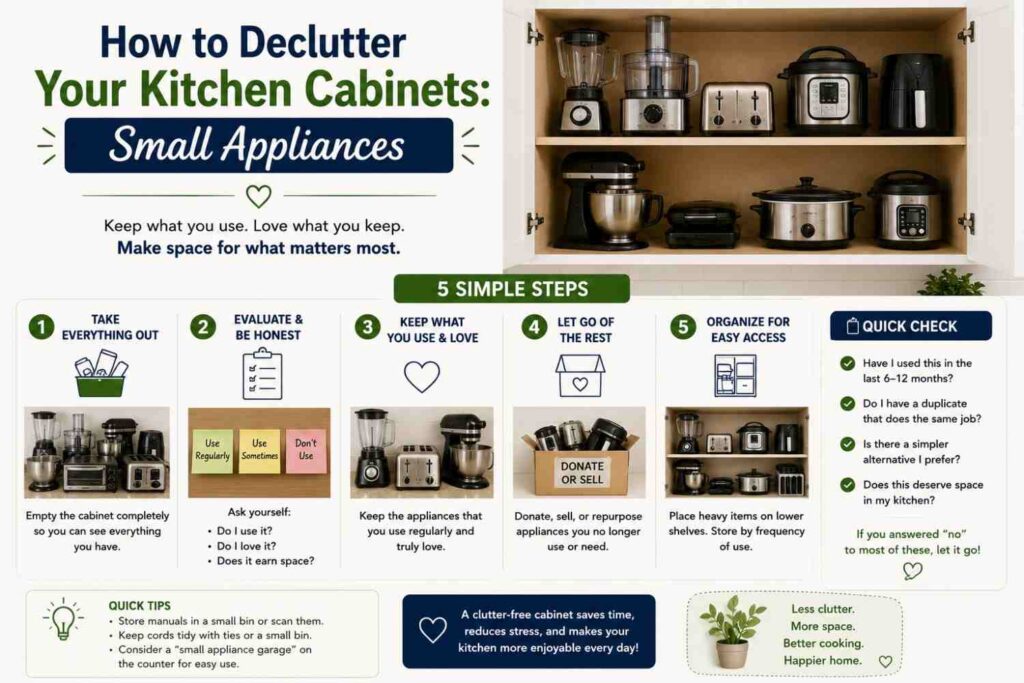
Small appliance cabinets or the spaces where small appliances have been stored are often the most emotionally difficult zone to address when you how to declutter your kitchen cabinets because of the cost attached to these items and the perpetual sense that they might be useful someday.
The honest assessment required here is straightforward. Has this appliance been used in the past year? If the answer is no, it occupies cabinet space or counter space every single day in exchange for zero contribution to how the kitchen actually functions.
The bread machine used twice since purchase. The ice cream maker from a summer phase that passed. The juicer that seemed transformative at the time of purchase and has not been touched since. The electric griddle that duplicates what the stovetop handles perfectly well. These are the items that make small appliance storage feel impossible, and they are the items most households can release without any practical impact on daily cooking.
When you how to declutter your kitchen cabinets in the small appliance zone, keep only the appliances you have used at least once in the past year and that perform a function not handled by another appliance you already own. Everything else can be donated to Goodwill (https://www.goodwill.org) or a similar organization where it will likely find a household that uses it regularly.
For appliances that remain after decluttering, store them in cabinets nearest to where they are used. The coffee maker supplies near where the coffee maker sits. The blender near the prep area where it is used. Storing appliances based on where they are used reduces the daily friction of getting them in and out of storage.
How to Declutter Your Kitchen Cabinets: Under the Sink
The cabinet under the kitchen sink is one of the most neglected storage zones in the kitchen and one of the most important to address when you how to declutter your kitchen cabinets completely. It collects cleaning supplies, garbage bags, dish soap backstock, and a collection of items that ended up there without any organizational logic.
The first step when you how to declutter your kitchen cabinets under the sink is to check for any moisture, rust staining, or signs of a slow leak. A cabinet under the sink that has been accumulating items for years often has moisture damage that has gone unnoticed because nothing prompted opening the cabinet door fully and looking at the back corners.
Remove everything. Wipe down the interior completely. Check the condition of the pipes and connections visible inside the cabinet. Return only the cleaning supplies and household items that are actively used and appropriate for this location, organized so that what is needed most frequently is at the front and accessible without removing other items to reach it.
Discard any cleaning products that are nearly empty, expired, or duplicated by a product you prefer. The collection of three similar surface cleaners, two mostly empty dish soaps, and cleaning products from brands you no longer buy are taking up space that could be used for what you actually reach for.
How to Keep Your Kitchen Cabinets Decluttered
Knowing how to declutter your kitchen cabinets gets you to a clean organized starting point. The habits below keep them that way.
Before anything new goes into a kitchen cabinet, it needs a designated space. If there is no logical space for a new item without pushing something else into a worse position, that is a signal that either the new item should not be purchased or something currently in the cabinet should leave to make room. The one in one out principle applied at the cabinet level prevents the gradual accumulation that makes it necessary to how to declutter your kitchen cabinets from scratch on a recurring basis.
Do a quick cabinet assessment every six months. Open each cabinet and spend thirty seconds honestly asking whether everything in it is still earning its space. Catching accumulation when it is small takes minutes. Letting it build until the cabinet is fully cluttered again requires another full session to address.
When you how to declutter your kitchen cabinets and finish the process, take a photo of how each cabinet looks when organized. These reference photos are useful for returning cabinets to their organized state after a period of high use or after someone else in the household has been putting items away without the organizational logic you established.
A kitchen with properly decluttered and organized cabinets is a meaningfully different daily experience than one where every cabinet is a minor battle to access. Cooking is faster, cleanup is easier, and the kitchen feels genuinely calm rather than like a space being managed rather than enjoyed. That is what learning how to declutter your kitchen cabinets actually delivers, and it is worth every minute of the initial effort.