
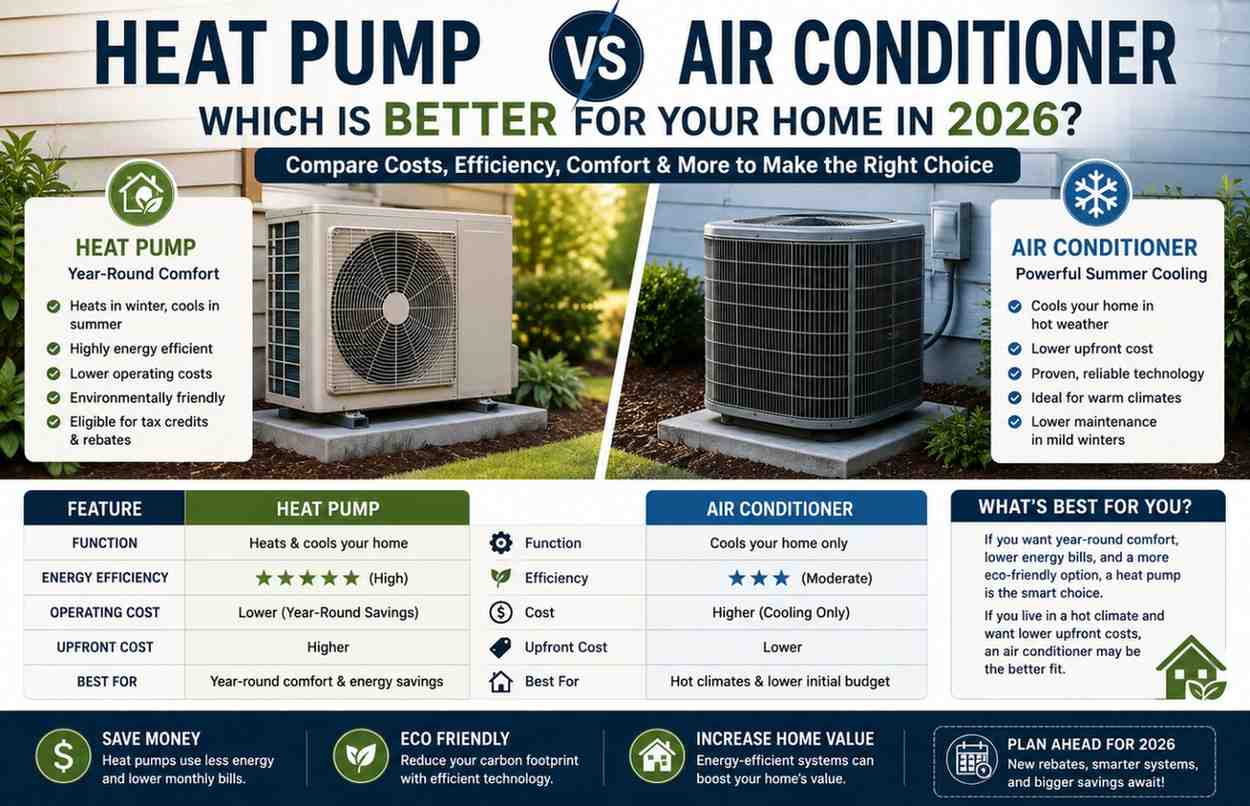
If you are replacing your home’s cooling or heating system in 2026, you are facing a decision that did not feel nearly as complicated ten years ago. The heat pump vs air conditioner debate has moved from a niche conversation among HVAC professionals into one of the most common questions American homeowners are asking right now, and for good reason.
Energy costs are higher than they have ever been. Federal tax incentives have changed the math on certain systems significantly. And the technology behind heat pumps has improved to the point where they are now a genuinely viable option in climates where they were previously impractical.
This guide breaks down the heat pump vs air conditioner question completely, covering how each system works, what each one costs, which performs better in different climates, and which one makes more sense for your specific situation in 2026.
Heat Pump vs Air Conditioner: How Each System Works
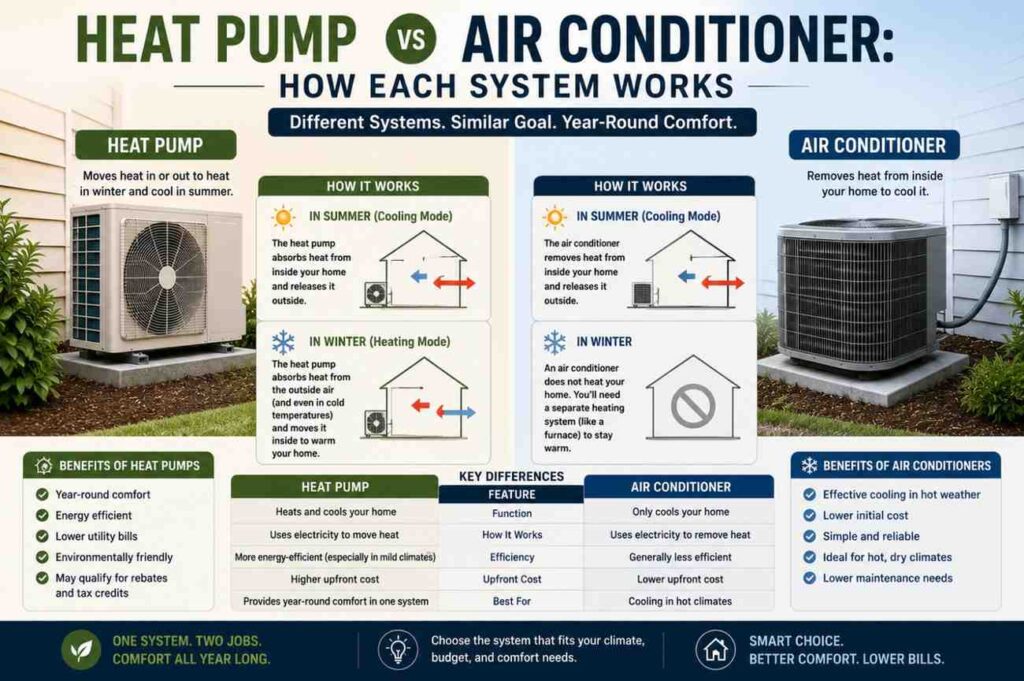
Understanding the heat pump vs air conditioner comparison starts with understanding what each system actually does, because they are more similar than most people realize and the difference between them is less about cooling and more about what happens in winter.
An air conditioner does one thing. It removes heat from inside your home and releases it outside, cooling the interior in the process. It works in one direction only and has no heating function. To heat the home in winter, a traditional air conditioner setup requires a separate furnace running on gas, oil, or electric resistance heating.
A heat pump does everything an air conditioner does but adds one critical capability. It can reverse its operation in winter, pulling heat from the outdoor air and bringing it inside to warm the home. This sounds counterintuitive because outdoor air in winter feels cold, but even cold air contains heat energy that a heat pump can extract and use. In summer, a heat pump operates identically to an air conditioner, removing heat from the interior and releasing it outside.
The practical result of this difference is that a heat pump is a single system that handles both heating and cooling, while a traditional air conditioner is a cooling-only system that must be paired with a separate heating source.
Heat Pump vs Air Conditioner: Efficiency and Energy Costs
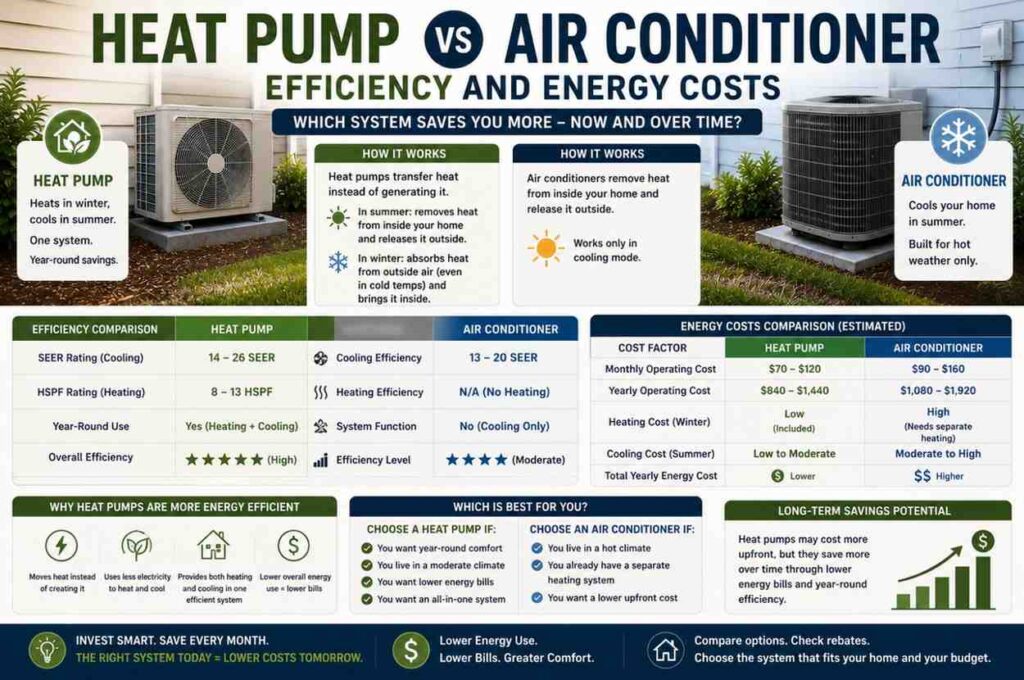
This is where the heat pump vs air conditioner comparison becomes most significant for most American homeowners, because the efficiency difference between the two systems has a direct and ongoing impact on your monthly utility bill.
Air conditioners are measured by their SEER rating, which stands for Seasonal Energy Efficiency Ratio. Modern air conditioners range from SEER 14 to SEER 26, with higher numbers indicating greater efficiency. A high-SEER air conditioner is genuinely efficient at cooling, but it still requires a separate heating system that may be significantly less efficient, particularly if that system uses electric resistance heating.
Heat pumps are measured by both their SEER rating for cooling and their HSPF rating, which stands for Heating Seasonal Performance Factor, for heating. The heating efficiency of a heat pump is where the technology becomes compelling. A heat pump delivering heat to your home uses one unit of electricity to move two to three units of heat energy, giving it an effective efficiency of 200 to 300 percent compared to the 100 percent efficiency of electric resistance heating.
The U.S. Department of Energy (https://www.energy.gov/energysaver/heat-pump-systems) states that heat pumps can reduce electricity use for heating by approximately 50 percent compared to electric resistance heating systems like baseboard heaters or standard electric furnaces. For homeowners currently heating with electricity rather than gas, the savings from switching to a heat pump can be substantial.
For homeowners currently heating with natural gas, the heat pump vs air conditioner calculation is more nuanced. Gas furnaces are highly efficient and gas prices in most US markets remain lower per BTU than electricity. In these situations, the energy cost savings from a heat pump may be smaller than expected, and the decision often comes down to factors beyond monthly bills.
Heat Pump vs Air Conditioner: Upfront Cost
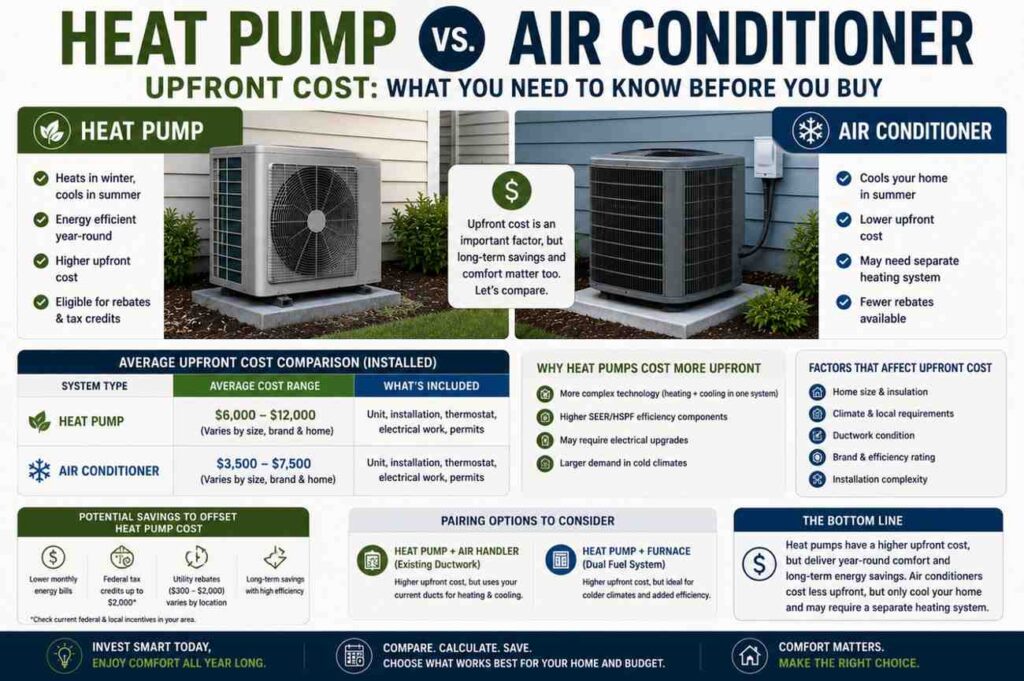
In the heat pump vs air conditioner comparison, upfront cost is where many homeowners hesitate on the heat pump side. A heat pump system typically costs more to purchase and install than a comparable air conditioner, though the gap has narrowed as the technology has become more mainstream.
A central air conditioner installation in the United States typically costs between $3,800 and $7,500 depending on the size of the home, the efficiency rating chosen, and the labor costs in your region. This cost covers cooling only and does not include any heating system.
A central heat pump installation typically costs between $4,500 and $10,000 for the same home. This higher upfront cost covers a system that handles both heating and cooling, which means the fair comparison is not heat pump versus air conditioner alone but heat pump versus air conditioner plus furnace or other heating system.
When compared on a complete system basis, the heat pump vs air conditioner total installation cost difference is often smaller than it initially appears, and in many cases the heat pump comes out ahead when you account for the fact that it replaces two systems rather than one.
The federal Inflation Reduction Act tax credits currently available through 2032 provide up to 30 percent of the cost of a qualifying heat pump installation, with a maximum credit of $2,000 per year. The Database of State Incentives for Renewables and Efficiency (https://www.dsireusa.org) maintains a current list of federal, state, and utility incentives available for heat pump installations by location, and consulting this resource before making a decision can significantly change the financial calculation.
Heat Pump vs Air Conditioner: Performance in Different Climates
Climate is one of the most important factors in the heat pump vs air conditioner decision, and it is the area where blanket recommendations most often lead homeowners astray.
In mild to moderate climates, including most of the Southeast, the Mid-Atlantic, the Pacific Northwest, and coastal California, heat pumps perform exceptionally well year-round. Winters in these regions rarely push temperatures to extremes that challenge a heat pump’s heating capability, and the efficiency advantages are fully realized throughout the heating season.
In hot and dry climates like the Southwest, both systems cool effectively. The heat pump vs air conditioner distinction matters less for cooling performance and more for how you heat the home in the relatively mild winters of these regions.
In cold northern climates including the Midwest, New England, and the Mountain West, the heat pump vs air conditioner question has historically been complicated by the fact that older heat pump technology lost efficiency rapidly in temperatures below 35 degrees Fahrenheit and became effectively non-functional below about 25 degrees. This made them impractical as primary heating systems in regions with severe winters.
Cold-climate heat pumps, sometimes called hyper heat or cold climate heat pumps, have changed this calculation significantly. These systems, now available from most major manufacturers, maintain effective heating performance at outdoor temperatures as low as negative 13 degrees Fahrenheit. The Northeast Energy Efficiency Partnerships (https://neep.org) has published extensive research showing that cold-climate heat pumps are now a viable primary heating source across most of the northern United States, a conclusion that was not supportable with older technology.
For homeowners in the coldest US climates, a dual fuel system that pairs a heat pump with a gas furnace backup is often the most practical approach. The heat pump handles heating efficiently during mild and moderately cold weather, and the gas furnace takes over during extreme cold when the heat pump would be less efficient. This combination captures the efficiency benefits of a heat pump for the majority of the heating season while maintaining the reliability of a gas system during the coldest periods.
Heat Pump vs Air Conditioner: Lifespan and Maintenance
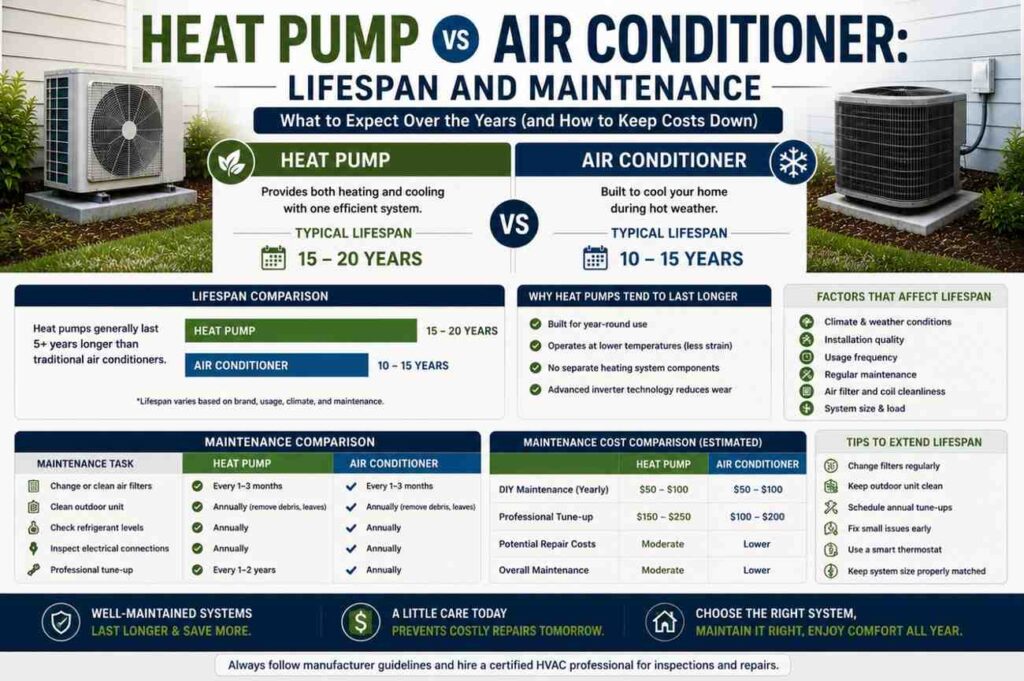
In the heat pump vs air conditioner comparison, lifespan is a factor that affects the long-term cost calculation in a meaningful way.
A well-maintained central air conditioner typically lasts 15 to 20 years. A gas furnace paired with it often lasts 20 to 30 years. These are separate systems with separate maintenance requirements and separate replacement timelines.
A heat pump typically lasts 15 to 20 years, similar to an air conditioner, but it is a single system handling both functions. When it reaches end of life, one replacement covers both heating and cooling rather than two separate replacements at different times.
Maintenance requirements for a heat pump vs air conditioner are similar. Both systems require annual professional servicing, regular filter changes, and keeping the outdoor unit clear of debris. Heat pumps run year-round rather than only during cooling season, which means they accumulate more operating hours annually and some components may experience more wear over time. However, modern heat pumps are designed for year-round operation and the quality of the equipment has improved substantially.
Heat Pump vs Air Conditioner: Which Is Right for Your Home in 2026?
The answer to the heat pump vs air conditioner question depends on your specific situation, but a few general principles apply clearly in 2026.
If you are currently heating with electric resistance heating and cooling with a standard air conditioner, switching to a heat pump is almost certainly the right financial decision. The efficiency gains in heating alone will typically pay for the system upgrade within a reasonable timeframe, and the federal tax credit reduces the upfront barrier significantly.
If you are in a mild or moderate climate and replacing an aging air conditioner, a heat pump deserves serious consideration as the replacement. The upfront cost difference is manageable, the efficiency benefits are real, and you gain the flexibility of a single system handling both functions.
If you are in a cold northern climate and currently heating with a high-efficiency gas furnace, the heat pump vs air conditioner decision is genuinely more complex. A cold-climate heat pump or dual fuel system may still make financial sense depending on your local electricity and gas rates, but the payback period will be longer and the calculation requires a careful look at your specific utility costs.
If you are replacing only a cooling system in a home that has a relatively new and efficient gas furnace, adding a heat pump for cooling may not provide enough additional benefit over a high-efficiency air conditioner to justify the additional cost. In this situation, a high-SEER air conditioner may be the more practical choice.
The best approach for any homeowner facing this decision is to get quotes for both options from a licensed HVAC contractor, ask specifically about the federal and state incentives available for heat pumps in your area, and calculate the estimated annual energy costs for each system based on your local utility rates. The heat pump vs air conditioner decision is ultimately a financial one, and having accurate numbers for your specific home and location makes the right choice clear.
Final Thoughts on Heat Pump vs Air Conditioner in 2026
The heat pump vs air conditioner landscape in 2026 looks meaningfully different than it did even five years ago. Improved cold-climate technology, federal tax incentives, rising energy costs, and growing availability of qualified installers have all shifted the balance in the heat pump’s favor in more situations than before.
That does not mean a heat pump is the right answer for every home. It means the heat pump vs air conditioner conversation deserves a genuine evaluation rather than a default to whichever system you have always had. For most American homeowners replacing a system in 2026, that evaluation will find the heat pump a more compelling option than it has ever been.